Portion precision matters more for Labrador puppies than almost any other breed. This is a large-breed dog whose skeleton is especially sensitive to growth rate — grow too fast and the joint dysplasia risk this breed already carries goes up — and it’s also a breed carrying a well-documented genetic tendency toward overeating. Getting the numbers right in puppyhood sets the pattern for the rest of the dog’s life.
- Why Labradors Need Large-Breed Puppy Formulas
- Feeding Frequency by Age
- Portion Sizes by Current and Expected Adult Weight
- Reading and Using the Food Bag Feeding Chart Correctly
- Transitioning Meal Counts and Switching Foods Safely
- Managing the Labrador Appetite
- Wet vs. Dry vs. Raw Considerations
- Feeding Red Flags and When to Consult Your Vet
- Frequently Asked Questions
Why Labradors Need Large-Breed Puppy Formulas (Controlled Calcium and Growth)
Large-breed puppy formulas carry the AAFCO growth statement with the large-breed provision, which tightly controls calcium and phosphorus levels — roughly 1.2–1.8% calcium and 1.0–1.6% phosphorus on a dry matter basis, at a controlled ratio. This matters specifically because excess calcium during rapid growth is linked to skeletal abnormalities in large-breed puppies, compounding the hip and elbow dysplasia risk Labradors already carry genetically. OFA data suggests 12–15% of AKC-registered Labradors show some degree of hip or elbow dysplasia, and research indicates that puppies grown at the faster end of the breed’s range develop more severe joint conformation issues than genetically similar puppies grown at a moderate pace — meaning growth rate, not just genetics, meaningfully affects outcomes.
Stay on a large-breed puppy formula until at least 12 months, and consider 15 months for larger males, given the breed’s longer growth window compared to smaller breeds.
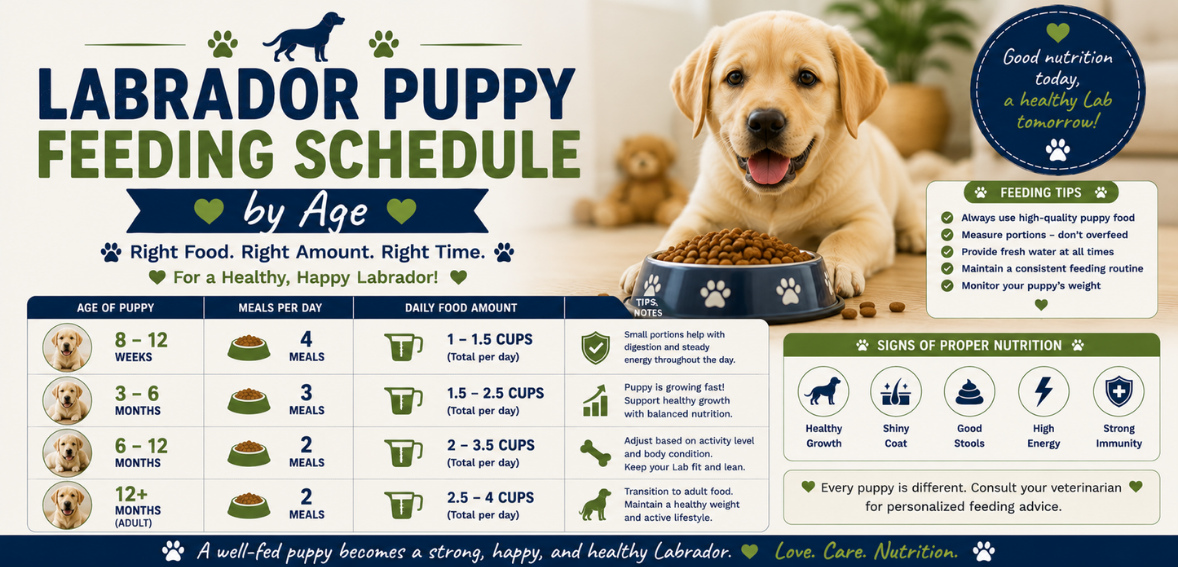
Feeding Frequency by Age (8–12 Weeks, 3–6 Months, 6–12 Months)
| Age | Meals per Day | Notes |
|---|---|---|
| 8–12 weeks | 3–4 | Frequent small meals support a small stomach and stable blood sugar |
| 3–6 months | 3 | Peak growth period; monitor weekly weight gain closely |
| 6–12 months | Transitioning to 2 | Most owners shift to 2 meals between 6–7 months as growth slows |
| 12+ months (adult) | 2 | Standard adult feeding pattern going forward |
Portion Sizes by Current Weight and Expected Adult Weight
| Age | Typical Weight Range | Approx. Daily Calories* |
|---|---|---|
| 8 weeks | 8–15 lb | ~400–600 kcal |
| 4 months | 25–35 lb | ~800–1,100 kcal |
| 6 months | 44–57 lb | ~1,200–1,600 kcal |
| 9–12 months | Approaching adult size | Gradually declining toward adult maintenance |
| Adult (12+ months) | 55–80 lb | ~1,100–1,700 kcal |
*These are general starting-point ranges based on typical large-breed puppy formulas and standard growth curves — actual needs vary with individual metabolism, activity level, and the specific food’s calorie density. Males typically run toward the higher end of each range, females toward the lower end.
Weigh your puppy weekly during peak growth (2–6 months). A gain of roughly 5–8 lb per month is typical during this window; consistent gains above 10 lb per month warrant reducing portions and mentioning it at your next vet visit.
Reading and Using the Food Bag Feeding Chart Correctly
The chart printed on your specific bag of food is more accurate for that product than any generic online chart, including this one — calorie density varies meaningfully between brands and formulas.
- Find your puppy’s current weight on the bag’s chart, not their expected adult weight
- Weigh food with a kitchen scale rather than a scoop or cup — cup measurements can vary by 20–30% depending on how the kibble settles
- Treat the bag’s number as a starting point, then adjust up or down based on body condition — ribs should be easy to feel with light pressure but not visible
- Recalculate as your puppy grows, checking the chart against their updated weight every couple of weeks during peak growth
Transitioning Meal Counts (3 Meals Down to 2) and Switching Foods Safely
Most Labradors are ready to transition from 3 meals to 2 somewhere between 6 and 7 months old, once growth has started to slow. Make the change gradually over one to two weeks:
- Week 1: Remove the midday meal and add its calories evenly to breakfast and dinner.
- Week 2: Settle into two roughly equal meals, ideally 10–12 hours apart (for example, 7–8 AM and 5–6 PM).
When switching to a new food entirely — whether a new brand or the eventual move to adult food — transition over 7–10 days, gradually increasing the new food’s proportion while decreasing the old, to avoid digestive upset. Most Labs are ready to move from puppy to adult food between 12 and 15 months.
Managing the Labrador Appetite: Overfeeding, Begging, and Healthy Weight
Labradors carry a well-documented POMC gene mutation linked to increased appetite and slower satiety signaling, found in roughly 1 in 4 pet Labradors. In practice, this means a Lab puppy will enthusiastically eat well past its actual caloric needs if allowed, and appetite alone is not a reliable feeding guide for this breed — body condition monitoring is.
- Measure every meal; never free-feed a Labrador
- Count treats toward the daily calorie total — treats can easily add up to 20–30% of daily intake if untracked
- Don’t respond to begging with extra food; a consistent schedule reduces begging behavior over time far more effectively than giving in
- Ask your vet for a body condition score at every visit as an objective check against the numbers on paper
See our full guide to preventing obesity in Labradors for strategies that carry this habit into adulthood.
Wet vs. Dry vs. Raw Considerations for Growing Labs
- Dry kibble: The most common and typically most calorie-controlled option, with a clear feeding chart and long shelf life. Confirm it’s specifically labeled for large-breed puppy growth.
- Wet food: Higher moisture and often more palatable, but calorie-dense per can — measure carefully, as it’s easy to underestimate portions.
- Raw diets: Require careful, professionally-formulated balance to meet a growing large-breed puppy’s calcium and phosphorus needs; an improperly balanced raw diet during rapid growth carries real skeletal risk. Work with a veterinary nutritionist before choosing this route for a growing Labrador puppy specifically.
Whichever format you choose, confirm it carries an AAFCO growth statement appropriate for large-breed puppies before committing to it long term.
Feeding Red Flags and When to Consult Your Vet
- Weight gain consistently above 10 lb per month during peak growth
- Ribs that are difficult to feel even with firm pressure
- Sudden loss of appetite lasting more than a day
- Persistent vomiting, diarrhea, or bloating after meals
- Visible lameness or reluctance to rise, which can be linked to overly rapid growth
Your vet can confirm whether your puppy’s growth trajectory and body condition are on track, which matters more than matching any generic chart exactly. See our Labrador puppy growth stages month by month guide for what else to expect developmentally alongside feeding changes, and our guide to bringing your Labrador puppy home the first week for getting the earliest feeding routine started right.
Frequently Asked Questions
How much should I feed my Labrador puppy by age?
Roughly 400–600 kcal/day at 8 weeks, 800–1,100 kcal/day at 4 months, and 1,200–1,600 kcal/day by 6 months, though exact amounts depend on your specific food’s calorie density and your puppy’s individual weight — always start from the bag’s feeding chart and adjust based on body condition.
How many times a day should a Lab puppy eat?
3–4 times a day from 8–12 weeks, 3 times a day through about 6 months, then transitioning to 2 meals a day between roughly 6 and 7 months as growth slows.
When do I switch my Labrador puppy from 3 meals to 2?
Most Labradors transition from 3 meals to 2 between 6 and 7 months old. Make the switch gradually over 1–2 weeks by removing the midday meal and redistributing its calories to breakfast and dinner.
What’s a feeding schedule for an 8-week-old Labrador?
3–4 measured meals a day, spaced evenly, totaling roughly 400–600 kcal depending on the puppy’s weight and food’s calorie density, using a large-breed puppy formula with controlled calcium and phosphorus.
How much food does a 4-month-old Lab puppy need per day?
Typically around 800–1,100 kcal per day for a puppy in the 25–35 lb range at this age, split across 3 meals, though this should be confirmed against your specific food’s feeding chart and adjusted for body condition.
Sources
- Association of American Feed Control Officials (AAFCO) — Dog Food Nutrient Profiles, Growth Statement Requirements
- WSAVA (World Small Animal Veterinary Association) — Global Nutrition Guidelines
- National Research Council — Nutrient Requirements of Dogs and Cats (2006), National Academies Press
- Orthopedic Foundation for Animals (OFA) — Hip and Elbow Dysplasia Statistics by Breed
- Raffan, E., et al. “A Deletion in the Canine POMC Gene Is Associated with Weight and Appetite in Obesity-Prone Labrador Retriever Dogs.” Cell Metabolism, 2016.