Labrador puppies don’t just chew — they swallow. That’s the distinction that makes puppy-proofing for this breed a genuinely different task than for a more cautious chewer. Vets who perform foreign-body removal surgery will tell you Labradors show up on that operating table more often than most breeds, precisely because their food drive and lack of discrimination about what counts as “food” combine into a breed that will eat a sock, a corn cob, or a piece of a toy without hesitation.
This guide walks through puppy-proofing room by room, the specific toxins to lock away, and how to set up barriers that actually hold up against a determined Lab puppy.
- Why Labradors Are Especially Destructive Chewers and Swallowers
- Room-by-Room Hazard Audit
- Toxic Foods, Plants, and Chemicals to Lock Away
- Electrical Cords, Small Objects, and Choking Risks
- Baby Gates, Crates, and Exercise Pens
- Securing Trash, Laundry, and Counters
- Outdoor and Fence Puppy-Proofing
- Creating a Safe Designated Puppy Zone
- Frequently Asked Questions
Why Labradors Are Especially Destructive Chewers and Swallowers
Labradors were bred as retrievers — dogs whose entire working purpose was carrying objects in their mouths. That instinct, combined with the breed’s well-documented strong food drive, means a Lab puppy investigates the world mouth-first and is unusually likely to actually swallow what it picks up, rather than just mouthing and dropping it. Veterinary surgeons consistently name Labradors among the breeds most frequently presented for gastrointestinal foreign-body obstruction surgery — a procedure to remove an object stuck in the stomach or intestines that can’t pass on its own, and one that’s genuinely dangerous if not caught quickly.
Repeated vomiting, refusal to eat, lethargy, a visibly painful or bloated abdomen, or straining without producing stool are all reasons to call your vet immediately, especially if you know or suspect your puppy swallowed something. This can become a life-threatening emergency within hours.
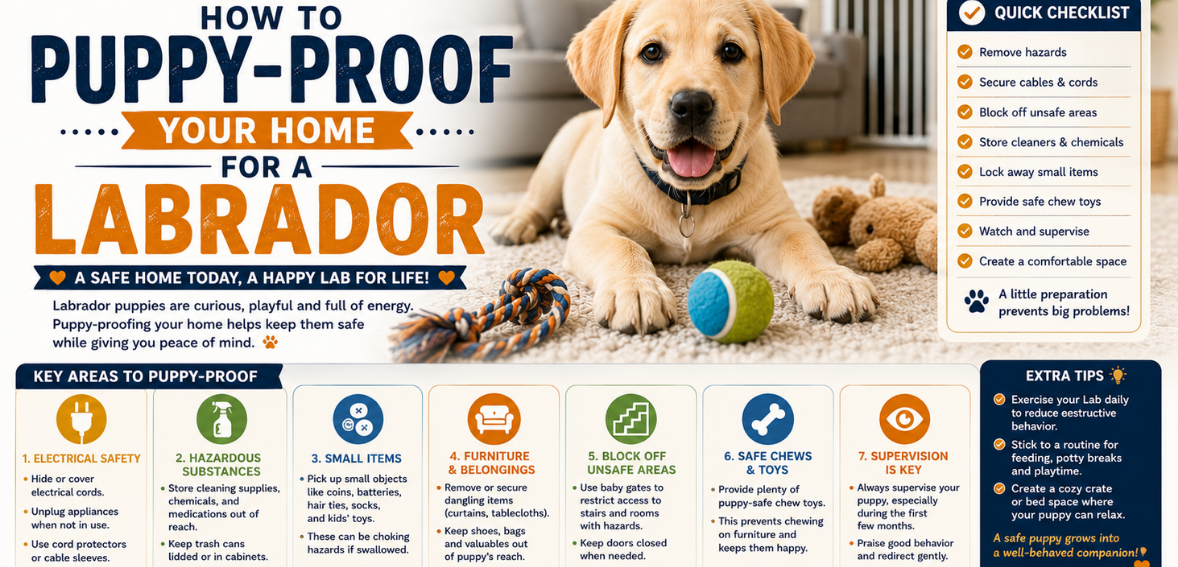
Room-by-Room Hazard Audit
Kitchen
- Store food, including anything on counters, out of jumping-and-reaching range
- Keep the trash can behind a secured cabinet or fitted with a locking lid
- Store cleaning products, dish tabs, and sponges up high, never under an accessible sink
Living Room
- Bundle or hide cords behind furniture or in cord channels
- Remove small remote controls, phone chargers, and decorative items from low surfaces
- Move houseplants out of reach or confirm they’re non-toxic (see the list below)
Bathroom
- Keep the toilet lid closed and cleaning chemicals in a latched cabinet
- Store medications, dental floss, and razors well out of reach — floss especially poses a serious linear foreign-body risk
- Keep the trash can lidded or behind a cabinet
Garage
- Store antifreeze, fertilizer, and pesticides on high shelves — antifreeze in particular is highly toxic and has a sweet taste dogs are drawn to
- Keep small tools, screws, and nails swept up and stored away
- Restrict garage access entirely if it can’t be fully secured
Yard
- Check the fence line for gaps a growing puppy could squeeze through or eventually jump
- Remove mushrooms, which can appear quickly after rain and include toxic varieties
- Identify and remove or fence off toxic plants and mulch types (cocoa mulch is toxic and smells appealing to dogs)
Toxic Foods, Plants, and Household Chemicals to Lock Away
| Category | Common Examples |
|---|---|
| Toxic foods | Chocolate, xylitol (in gum, candy, some peanut butter), grapes and raisins, onions and garlic, alcohol, macadamia nuts, avocado, caffeine |
| Toxic plants | Sago palm, lilies, azaleas, tulips, and many other common houseplants and garden plants |
| Household chemicals | Antifreeze, rodenticides, fertilizers, pesticides, cleaning products |
The ASPCA Animal Poison Control Center maintains complete, regularly updated lists of toxic foods and toxic and non-toxic plants — worth bookmarking before you bring a puppy home. If you suspect your puppy has ingested something toxic, call the ASPCA Animal Poison Control hotline at (888) 426-4435 or your vet immediately. See our full guide to foods toxic to Labradors for a more complete breakdown.
Managing Electrical Cords, Small Objects, and Choking or Blockage Risks
- Electrical cords: Route behind furniture, use cord protectors/channels, or unplug and coil unused cords entirely — a chewed live cord risks burns and electrocution, not just a ruined charger.
- Small objects: Get in the habit of a floor-level sweep of any room your puppy has access to — coins, hair ties, buttons, and children’s small toys are common obstruction culprits.
- Common blockage risks specific to this breed’s indiscriminate eating: corn cobs, peach or avocado pits, socks, and string or ribbon (which can cause a particularly dangerous “linear” obstruction as it moves through the intestines).
Using Baby Gates, Crates, and Exercise Pens to Limit Access
You don’t need to puppy-proof your entire house in one weekend — limiting access to only the rooms you’ve fully proofed is a far more realistic strategy while you work through the rest.
- Baby gates block off unproofed rooms, staircases, and kitchens during unsupervised moments
- A properly sized crate gives your puppy a safe space when you can’t supervise directly at all, such as overnight or when you leave the house
- Exercise pens create a larger contained area than a crate for supervised independent play in a fully puppy-proofed zone
See our full guide to bringing your Labrador puppy home the first week for how these tools fit into the broader early routine.
Securing Trash, Laundry, and Counters from a Food-Driven Breed
- Use trash cans with locking or weighted lids in every room, not just the kitchen
- Keep the laundry room door closed or gated — dryer sheets, socks, and detergent pods are all genuine hazards for a breed this prone to swallowing fabric and small items
- Push counter items back and avoid leaving food unattended, even briefly — Labradors are notorious counter-surfers, and this habit is far easier to prevent early than to correct later
Outdoor and Fence Puppy-Proofing
- Walk your fence line at puppy height, checking for gaps, loose boards, or digging spots
- Store any yard chemicals, tools, and equipment in a space your puppy can’t access
- Check for and remove toxic plants and mushrooms regularly, especially after rain
- Never leave a puppy unsupervised in the yard until you’re confident in both the fence’s integrity and your puppy’s recall
Creating a Safe Designated Puppy Zone
Rather than proofing the whole house at once, designate one fully secured room or gated area as your puppy’s home base for the first few weeks — food, water, crate, and safe toys all within it, nothing chewable or toxic anywhere in reach. Expand your puppy’s access to new rooms only after each one has been fully audited using the room-by-room list above.
- Trash cans locked or lidded in every room
- Electrical cords bundled, covered, or out of reach
- Toxic foods stored well out of reach
- Toxic houseplants removed or relocated
- Cleaning chemicals in latched cabinets
- Medications and floss secured
- Small objects swept from floors regularly
- Toilet lids kept closed
- Fence line checked for gaps
- Garage chemicals stored on high shelves
- Baby gates installed at unproofed room entries
- Crate and safe zone set up before arrival day
Frequently Asked Questions
How do I puppy-proof my house for a Labrador?
Go room by room removing or securing anything chewable, swallowable, or toxic, use baby gates and crates to limit access to unproofed areas, and keep trash, food, and small objects consistently out of reach given the breed’s tendency to swallow rather than just chew.
What household items are dangerous to a Lab puppy?
Common dangers include toxic foods (chocolate, xylitol, grapes, onions), household chemicals (antifreeze, cleaning products), small swallowable objects, electrical cords, and items like corn cobs, socks, and string that commonly cause intestinal obstructions.
Which plants are toxic to Labrador puppies?
Sago palm, lilies, azaleas, and tulips are among the most common toxic plants for dogs. The ASPCA maintains a complete, regularly updated list of toxic and non-toxic plants worth checking before bringing any new plant into a home with a puppy.
How do I stop my Lab puppy from chewing everything?
You can’t eliminate chewing entirely during puppyhood, but you can redirect it by puppy-proofing thoroughly, providing appropriate chew toys, supervising closely, and using crates or gates to prevent access to unproofed areas when you can’t watch directly.
Once your home is secured, the next step is building good habits from day one.
Read our guide to dealing with Labrador puppy biting and nipping →Sources
- ASPCA Animal Poison Control Center — Toxic and Non-Toxic Plants List, People Foods to Avoid Feeding Pets
- U.S. Food and Drug Administration (FDA) — Potentially Dangerous Items for Your Pet
- Veterinary surgical literature on gastrointestinal foreign-body obstruction in dogs