The first week with an 8-week-old Labrador puppy is a strange mix of pure joy and complete exhaustion — and if nobody warns you about the exhaustion part, it can feel like something’s wrong when really, it’s just normal. Every Lab puppy I’ve raised has followed roughly the same pattern: a wobbly, overwhelmed first day, a genuinely hard first night or two, and then a fairly fast turnaround as they realize this new, loud, exciting house is actually home.
This guide walks through exactly what to do before pickup, hour by hour on day one, and day by day through the first week — with the specific quirks Labradors bring to the table, like their food motivation and their tendency to want to be touching you at all times. Where a topic needs more depth, we’ve linked to our full guides.
- Pre-Arrival Shopping Checklist and Puppy-Proofing
- The Car Ride Home and First Hour
- Surviving the First Night
- Establishing a Feeding and Potty Schedule
- Introducing Family, Kids, and Existing Pets
- First Vet Visit and Paperwork to Gather
- Early Crate and Name Recognition Training
- Signs of Stress vs. Normal Adjustment
- Day-by-Day First Week Breakdown
- Frequently Asked Questions
Pre-Arrival Shopping Checklist and Puppy-Proofing Prep
Have everything ready before pickup day — the last thing you want is a frantic pet-store run while a puppy is crying in a crate at home. Save or screenshot this list:
- Crate sized for adult Lab, with a divider panel
- Puppy-specific large-breed food (the brand the breeder used)
- Food and water bowls
- Flat collar with ID tag + 6-foot leash
- Baby gates for doorways
- Puppy pads or an enzymatic cleaner for accidents
- Soft bedding/blanket (ideally something that smells like littermates)
- Appropriately sized chew toys (avoid anything easily destroyed)
- A frozen, food-stuffed toy for crate time
- Treats for training (pea-sized, soft)
- Grooming brush and nail clippers
- Vet appointment booked for the first few days
Before your puppy arrives, walk through every room at floor level and remove or block off electrical cords, small chewable objects, toxic plants, and household chemicals. Labradors are notoriously mouthy, and an 8-week-old puppy will investigate almost everything with their teeth. Our full puppy-proofing guide covers this room by room.
The Car Ride Home and First Hour
Keep the ride itself calm and low-key: a secured crate or a passenger holding the puppy wrapped in a blanket works well, and it’s normal for a puppy to whine, drool, or even be sick on a first car ride — the motion and separation from littermates is a lot all at once.
Once home, resist the urge to invite the whole extended family over for a welcome party. Bring the puppy straight to your designated potty spot outside first, let them sniff and relieve themselves, then bring them inside to a quiet, puppy-proofed room. Keep the first hour low-energy: quiet voices, minimal handling by unfamiliar people, and access to water and their crate with the door open so they can explore it on their own terms.
Surviving the First Night (Crate Placement, Crying, Comfort)
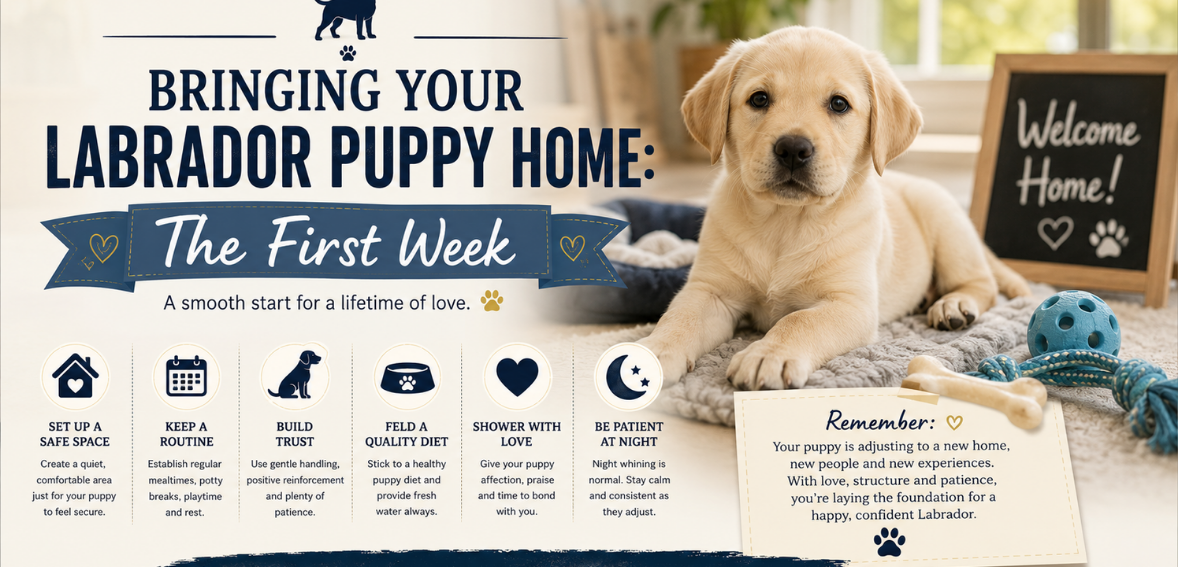
The first night is almost always the hardest part of the whole week, and that’s completely normal — your puppy has just been separated from their mother and littermates for the first time in their life.
- Crate placement: Put the crate in your bedroom, next to your bed, for at least the first week. Puppies settle faster when they can hear and smell you nearby, and it makes overnight potty breaks far easier to manage.
- Expect some crying: Whining or crying for the first 10–30 minutes as the puppy settles is typical, especially on night one and two.
- Don’t rush to pull them out the second they cry, but do respond if crying is sustained and distressed — a puppy that needs a potty break will often have a different, more urgent tone than one who’s simply protesting bedtime.
- Comfort without creating bad habits: A hand resting near the crate, a soft word, or a warm (not hot) covered water bottle and a blanket that smells like their littermates can help without teaching the puppy that crying gets them fully out of the crate every time.
- Plan for at least one nighttime potty break in the first week — an 8-week-old puppy’s bladder simply can’t hold through a full night yet.
For a full night-by-night approach as your puppy grows, see our night-time routine guide for new Labrador puppies.
Take your puppy out to potty immediately before bed and set a middle-of-the-night alarm for a bathroom break rather than waiting for crying to wake you — it prevents accidents and teaches the crate stays clean and dry.
Establishing a Feeding and Potty Schedule From Day One
Labradors are famously food-motivated even as young puppies, which actually works in your favor for building routine fast. At 8–12 weeks old, most puppies do best on three to four measured meals a day, spaced evenly through the day rather than free-fed.
Pair every meal, wake-up, and playtime with an immediate trip outside to the same potty spot — puppies typically need to go within 15–20 minutes of eating, drinking, waking up, or finishing a play session. Praise or a small treat the moment they go in the right spot builds the association quickly.
| Trigger | Take Puppy Outside |
|---|---|
| Waking up (including naps) | Immediately |
| After eating or drinking | Within 15–20 minutes |
| After play or training | Immediately after |
| Overnight | At least once, first week |
Keep the puppy’s first food identical to whatever the breeder was feeding for at least the first few days — a sudden diet change on top of a new environment is a common cause of loose stools. See our full Labrador puppy feeding schedule by age for how meal frequency shifts as your puppy grows.
Introducing Family Members, Kids, and Existing Pets
Keep first introductions calm, brief, and one at a time rather than a crowd descending all at once.
- Kids: Have children sit on the floor and let the puppy approach them, rather than looming over or scooping the puppy up. Teach gentle handling immediately — no picking up by the legs or squeezing.
- Existing dogs: Introduce on neutral ground if possible (a yard, not straight into the resident dog’s living room), on leash, with calm, short sessions rather than one long free-for-all.
- Cats: Give the cat an escape route and a safe elevated space, and keep the puppy leashed or gated during early interactions so the introduction stays controlled.
- Everyone in the house: Agree on the same house rules (furniture access, feeding times, crate use) before the puppy arrives, so the puppy isn’t getting mixed signals in week one.
First Vet Visit and Paperwork to Gather
Schedule a veterinary visit within the first few days of bringing your puppy home, even if they seem perfectly healthy. Bring:
- Any vaccination and deworming records from the breeder or shelter
- Health clearance paperwork for the puppy’s parents, if provided
- A fresh stool sample, if your vet’s office requests one for a parasite check
- A list of questions — feeding amounts, spay/neuter timing, and what to expect at future visits
Puppies typically begin their vaccination series around 6–8 weeks old, with follow-up doses roughly every 2–4 weeks until about 14–16 weeks, since maternal antibodies can interfere with earlier doses. Your vet will confirm the right schedule based on what the breeder already gave. See our full Labrador puppy vaccination schedule for what’s covered at each visit.
Early Crate and Name Recognition Training
You don’t need formal training sessions in week one — short, low-pressure repetition is enough to start building good habits.
- Crate as a good place: Toss treats inside the open crate throughout the day and feed meals in or next to it, so the puppy builds a positive association before it’s ever used to confine them for long stretches.
- Name recognition: Say your puppy’s name in a happy tone and reward any glance toward you with a treat — a handful of short repetitions a day is plenty at this age.
- Keep sessions under 5 minutes: An 8-week-old Labrador has a short attention span; frequent, brief, upbeat sessions beat one long one.
Signs of Stress vs. Normal Adjustment and When to Call the Vet
Normal Adjustment
- Crying for the first 10–30 minutes at bedtime, improving over 2–3 nights
- Occasional accidents indoors during house-training
- Clinginess and wanting to be near you constantly
- Brief loss of appetite on day one only
- Sleeping heavily between bursts of play
Call the Vet
- Vomiting or diarrhea lasting more than 24 hours
- Refusing food or water for more than a day
- Lethargy or unresponsiveness, not just sleepiness
- Persistent crying or distress that isn’t improving after several days
- Any signs of pain, limping, or difficulty breathing
Some clinginess and a rough first night or two is expected and not a sign anything is wrong. Sustained distress, physical symptoms, or a puppy that seems to be getting worse rather than better as the week goes on is when a call to your vet is worth making.
Day-by-Day First Week Breakdown
| Day | Focus |
|---|---|
| Day 1 | Calm arrival, quiet first hour, potty spot introduction, crate exploration, early bedtime with crate beside your bed |
| Day 2 | Reinforce feeding/potty schedule, brief supervised meetings with household members, first short name-recognition sessions |
| Day 3 | First vet visit if not already done, continue consistent schedule, expect some improvement in nighttime settling |
| Day 4 | Begin very short, positive crate-during-the-day sessions (a few minutes at a time) alongside overnight crating |
| Day 5 | Introduce controlled, calm meetings with resident pets if not already started; keep training sessions short and upbeat |
| Day 6 | Puppy should be more settled into the potty/feeding rhythm; begin light, safe exposure to new household sounds and sights |
| Day 7 | Review the week: adjust feeding portions with your vet’s guidance, confirm the vaccination follow-up date, and start planning safe early socialization |
Frequently Asked Questions
What should I do the first week I bring my Labrador puppy home?
Puppy-proof your home and gather supplies before pickup, keep arrival calm and low-key, place the crate in your bedroom at night, establish a consistent feeding and potty schedule immediately, and book a vet visit within the first few days.
What supplies do I need before picking up my Lab puppy?
At minimum: a properly sized crate, puppy-specific large-breed food, bowls, a collar and leash, baby gates, bedding, appropriate chew toys, and training treats. Book the first vet visit before pickup day as well.
How do I survive the first night with a new Labrador puppy?
Keep the crate in your bedroom, expect some crying for the first 10–30 minutes as normal, avoid immediately removing the puppy every time they whine, and plan for at least one nighttime potty break, since an 8-week-old puppy can’t hold their bladder all night.
Is it normal for my new Lab puppy to cry the first few days?
Yes. Crying, clinginess, and a rough first night or two are typical as a puppy adjusts to being separated from its mother and littermates. This should improve noticeably within 2–3 nights; if distress persists or worsens beyond that, contact your vet.
What’s a day-by-day plan for a Labrador puppy’s first week home?
Day 1 focuses on a calm arrival and crate introduction; days 2–3 add the first vet visit and household introductions; days 4–6 build short daytime crate sessions and controlled pet introductions; day 7 reviews progress and confirms the next vaccination date.
Sources
- American Veterinary Medical Association (AVMA) — Socialization of Puppies and Kittens, Animal Welfare Division literature review
- ASPCA — Puppy Socialization Recommendations
- American Veterinary Society of Animal Behavior (AVSAB) — Position Statement on Puppy Socialization