
I learned this the slightly hard way. Before bringing home my second Labrador, I visited three different “breeders” in person — one was a warm, meticulous kennel with hip and elbow certificates taped inside a binder by the door; one was a backyard setup with a friendly owner but zero paperwork beyond a vet’s word that the parents were “healthy”; and one I walked away from after five minutes because the puppies were kept in a garage with no visible parents on site at all. Only one of those three was a breeder I’d recommend to a friend, and it wasn’t the one with the flashiest website.
That’s the core problem with searching for a “reputable Labrador breeder” — plenty of breeders who aren’t doing the work still look completely legitimate online. This guide walks through exactly what separates a responsible breeder from a backyard operation or puppy mill, what health testing actually means and how to verify it yourself, and the questions that should go both directions before any money changes hands.
- What Makes a Breeder “Reputable”
- Essential Health Clearances
- How to Verify Health Testing (Step by Step)
- Where to Find Reputable Breeders
- Green Flags of a Responsible Breeder
- Red Flags to Walk Away From
- Questions the Breeder Should Ask YOU
- Understanding the Breeder Contract and Health Guarantee
- Reputable Breeder vs. Backyard Breeder vs. Puppy Mill
- Frequently Asked Questions
What Makes a Breeder “Reputable”
A reputable breeder is someone whose entire operation is organized around the long-term health and temperament of the breed, not around producing puppies as quickly or cheaply as possible. In practice, that means four things are consistently true:
- Health testing: Both parents have current OFA (or PennHIP) hip and elbow evaluations, an eye exam, and an EIC DNA test — at minimum — before being bred, following the Labrador Retriever Club’s recommendations.
- Purpose-driven breeding: Litters are planned to improve or preserve specific traits — health, temperament, working ability, or conformation — not simply because two Labs happen to be available.
- Early environment: Puppies are raised inside the home, handled daily, and exposed to normal household sounds and activity from birth.
- Lifetime responsibility: The breeder offers a written health guarantee and will take a dog back at any point in its life if the owner can no longer keep it.
Notably, none of this is guaranteed by AKC registration alone — AKC papers confirm a dog’s lineage is purebred, not that its parents were health tested or that the breeder followed responsible practices.
Essential Health Clearances (OFA Hips/Elbows, EIC, PRA, CNM)
The Labrador Retriever Club (LRC), the AKC’s official parent club for the breed, maintains a specific list of recommended health tests through the Canine Health Information Center (CHIC) — a joint database run with the OFA. A CHIC number means a dog has completed every breed-required test and the results are public, regardless of outcome.
| Test | What It Screens For | Status | Minimum Age |
|---|---|---|---|
| OFA Hip Evaluation | Hip dysplasia | Required for CHIC | 24 months (PennHIP can test earlier) |
| OFA Elbow Evaluation | Elbow dysplasia | Required for CHIC | 24 months |
| Ophthalmologist Eye Exam (OFA/CAER) | Inherited eye disease | Required for CHIC, annually | No strict minimum; done regularly |
| EIC DNA Test | Exercise-induced collapse | Required for CHIC | Any age (DNA test) |
| PRA-prcd DNA Test | Progressive retinal atrophy | Recommended | Any age (DNA test) |
| CNM DNA Test | Centronuclear myopathy | Recommended | Any age (DNA test) |
| D Locus DNA Test | Dilute gene / color dilution alopecia risk | Recommended | Any age (DNA test) |
Passing OFA hip scores are Excellent, Good, or Fair. If a breeder describes a dog as “hip certified” but won’t tell you the actual score or the OFA registration number, treat that as a red flag, not a clearance.
How to Verify Health Testing, Step by Step
Don’t take a breeder’s word for health clearances — every legitimate result is public. Here’s exactly how to check it yourself in a few minutes.
- Ask for the sire and dam’s full registered names and, if available, their OFA or CHIC number — not just their call names (“Max” or “Bella”).
- Go to the OFA database at ofa.org and search the Public Information search tool using the registered name or number.
- Confirm the hip and elbow results shown match what the breeder told you, and check the date — results should be current, not from a decade-old sibling of the parent.
- Check for the eye exam and EIC/PRA/CNM results if the breeder claims them; these may show under the dog’s CHIC profile linked from the same OFA page.
- Cross-check the litter against the LRC breeder referral list or AKC Marketplace listing to confirm the same dogs are named as the litter’s parents.
Where to Find Reputable Breeders (AKC Marketplace, Breed Clubs)
Start with sources that require some baseline accountability rather than a general web search:
- AKC Marketplace — filter for Breeder of Merit or Bred with H.E.A.R.T. breeders specifically; both designations require documented health testing and, for Bred with H.E.A.R.T., ongoing education and AKC inspections.
- The Labrador Retriever Club, Inc. (LRC) — the AKC parent club for the breed maintains its own breeder referral resources and code of ethics that go beyond AKC’s baseline requirements.
- Regional Labrador clubs — many U.S. regions have local Labrador clubs that maintain their own referral lists and hold their members to the same CHIC health-testing standards.
- Field trial and hunt test communities — if you want a field-line working dog, breeders active in AKC field trials or hunt tests are generally well vetted by that community.
For the full journey from choosing a breeder to bringing your puppy home, see our Getting a Labrador category.
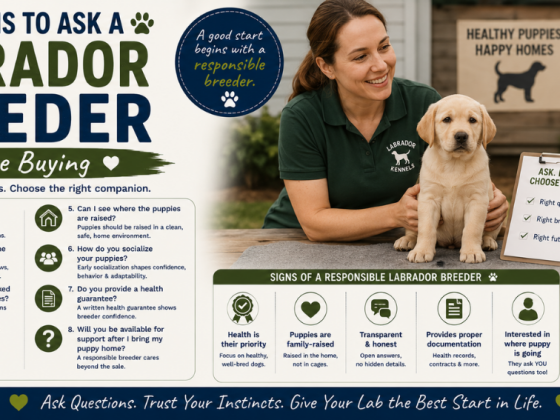
Green Flags of a Responsible Breeder
Green Flags
- Provides OFA/CHIC numbers unprompted, before you even ask
- Lets you visit and meet the puppy’s mother in person
- Asks you detailed questions about your home and lifestyle
- Limits litters to a manageable number per year
- Offers a written health guarantee and lifetime return policy
- Belongs to the LRC or a regional Labrador club
- Keeps puppies until at least 8 weeks old
Red Flags
- Multiple breeds or litters always “available now”
- Won’t let you visit in person or meet the parents
- Can’t produce OFA/CHIC numbers, only verbal claims
- Pressures you to pay a deposit immediately
- Offers to ship a puppy sight-unseen with no contract
- Prices far below or suspiciously above market rate
- No interest in your home, schedule, or experience level
Red Flags to Walk Away From
Some warning signs are serious enough to end the conversation entirely, even if everything else looks fine:
- Refusal to let you see where the puppies are raised. Legitimate breeders raise puppies in the home, not in a separate barn or garage you’re not allowed to enter.
- No paperwork on request. A breeder who becomes evasive or annoyed when asked for OFA numbers is very likely skipping health testing altogether.
- Multiple breeds available simultaneously. This is a hallmark of a commercial breeding operation prioritizing volume over the needs of any single breed.
- Payment only through untraceable methods with no contract — a common pattern in online puppy scams, where the “puppy” never actually exists.
Questions the Breeder Should Ask YOU
A responsible breeder is screening you just as carefully as you’re screening them. Expect — and welcome — questions like:
- Do you have a fenced yard, or a plan for daily exercise?
- Have you owned a Labrador, or a large, high-energy breed, before?
- Who will be home during the day, and for how many hours?
- Do you have young children, other pets, or anyone with allergies?
- What’s your plan if your circumstances change in five or ten years?
If a breeder asks none of these and simply wants payment, that alone is worth pausing on.
Understanding the Breeder Contract and Health Guarantee
A written contract protects both you and the puppy, and a reputable breeder will always provide one before any money changes hands. Typical elements include:
- Health guarantee — a defined period (commonly 1–2 years) covering major genetic conditions, with a replacement puppy or refund if a covered condition is diagnosed.
- Spay/neuter clause — many pet-quality puppies are sold on a “limited registration,” which restricts AKC litter registration and often requires spay/neuter by a certain age, while breeding-quality puppies may go on “full registration.”
- Return clause — a commitment that the breeder will take the dog back, at any age, if you’re ever unable to keep it, rather than have it surrendered to a shelter.
- Vaccination and vet record disclosure — documentation of the puppy’s vaccination schedule, deworming, and any veterinary treatment to date.
Read the contract fully before signing, and ask the breeder to explain anything unclear — a good breeder expects and welcomes those questions.
Reputable Breeder vs. Backyard Breeder vs. Puppy Mill
| Reputable Breeder | Backyard Breeder | Puppy Mill | |
|---|---|---|---|
| Health testing | Full OFA/CHIC panel | Rarely done, or partial | Never done |
| Litters per year | Limited, planned | Occasional, often unplanned | High volume, continuous |
| Where raised | In the home | Usually in the home | Cages or kennels |
| Contract/guarantee | Always provided | Sometimes informal | Rarely or never |
| Breeds offered | One or two breeds | Usually one breed | Often several breeds |
| Buyer screening | Detailed questions asked | Minimal | None — sells to anyone |
A backyard breeder isn’t necessarily malicious — often it’s a well-meaning pet owner whose dog had one litter without full health testing — but the lack of screening still means a higher risk of inherited health issues. A puppy mill is a commercial operation prioritizing volume over welfare, and buying from one, even out of sympathy for the puppy, keeps that business model funded.
Frequently Asked Questions
How do I find a trustworthy Labrador breeder near me?
Start with AKC Marketplace filtered for Breeder of Merit or Bred with H.E.A.R.T. breeders, and check the Labrador Retriever Club’s referral resources or your regional Labrador club. Always verify health testing independently through the OFA database rather than relying on the listing alone.
What certifications should a good Labrador breeder have?
At minimum, OFA hip and elbow evaluations, an annual ophthalmologist eye exam, and an EIC DNA test on both parents, following the Labrador Retriever Club’s CHIC requirements. PRA-prcd and CNM DNA tests are strongly recommended additions.
How can I tell if a Labrador breeder is legit or a scam?
Legitimate breeders let you visit in person, meet the puppy’s mother, and provide verifiable OFA/CHIC numbers. Refusal to meet in person, pressure for immediate deposits, and shipping puppies sight-unseen without a contract are common scam patterns.
What health tests should Labrador breeders do on their dogs?
The Labrador Retriever Club’s CHIC requirements are OFA hip and elbow evaluations, an annual eye exam, and an EIC DNA test, with PRA-prcd, CNM, and D Locus DNA tests recommended as additional screening.
Is an AKC registered breeder always reputable?
No. AKC registration confirms a dog is purebred and its lineage is documented, but it does not require health testing or verify breeding practices. Look specifically for AKC Breeder of Merit or Bred with H.E.A.R.T. status, which do carry health-testing and accountability requirements.
Sources
- American Kennel Club — Sporting Group Health Testing Requirements (Labrador Retriever)
- American Kennel Club — Bred with H.E.A.R.T. Program
- The Labrador Retriever Club, Inc. — Health Issues and CHIC Requirements
- Orthopedic Foundation for Animals (OFA) — Canine Health Information Center (CHIC)