Labradors will eat almost anything you put in front of them, which is exactly why the food itself matters so much. This is a breed genetically wired for a strong appetite and a slower metabolism than the average dog, so the calorie density and portion control built into a food choice matter as much as the ingredient list.
- How We Evaluated and Chose These Foods
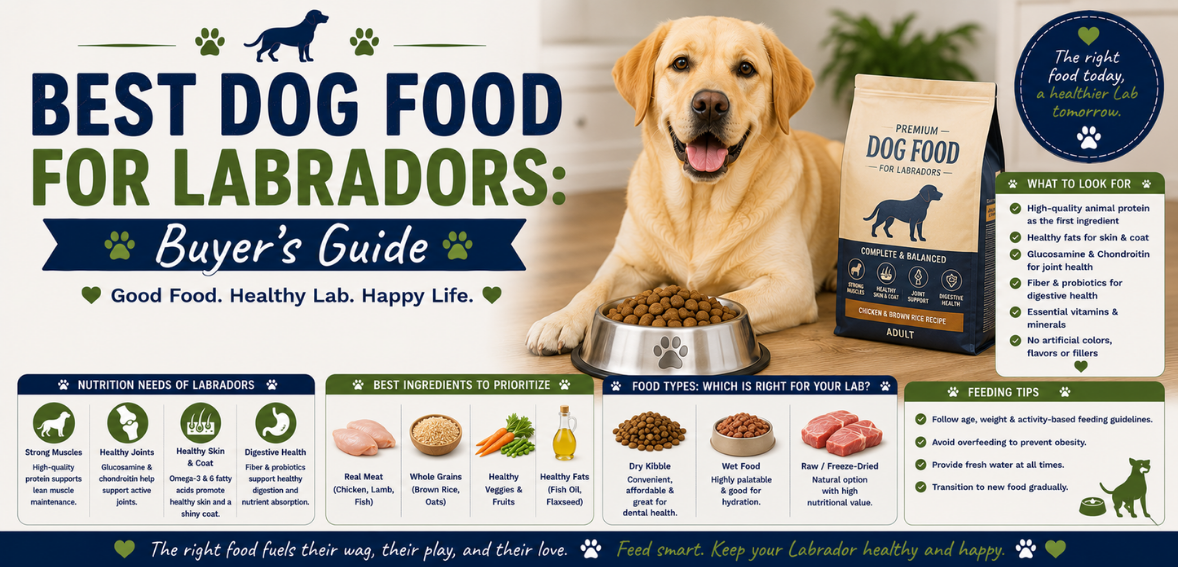
- What Labradors Need Nutritionally
- Top Picks at a Glance
- Best Overall Dog Food for Labradors
- Best Budget Pick
- Best for Weight Management
- Best for Sensitive Stomachs / Allergies
- Ingredients to Avoid
- How to Transition Your Lab to a New Food
- Frequently Asked Questions
How We Evaluated and Chose These Foods
We did not conduct in-house feeding trials — no single household study is a substitute for the large-scale trials manufacturers already run, and unsupervised diet switching carries real risk. Instead, every food on this list was evaluated against the same criteria:
- AAFCO nutrient adequacy statement confirming the food is formulated (or feeding-trial tested) as complete and balanced for the intended life stage, with the large-breed growth provision for any puppy formula
- Protein and fat levels appropriate for an active, obesity-prone breed, checked against the guaranteed analysis
- Named animal protein as the first ingredient, rather than a generic “meat” or “animal by-product” listing
- Manufacturer transparency, including named quality-control standards and the availability of a staff veterinary nutritionist
- Independent veterinary and nutritionist guidance, cross-checked with our reviewing veterinary nutritionist rather than manufacturer marketing claims alone
Any product-specific health claim should still be discussed with your own veterinarian, who can account for your individual dog’s weight, activity level, and any existing conditions.
What Labradors Need Nutritionally
| Nutrient | Typical Adult Lab Target | Why It Matters |
|---|---|---|
| Protein | ~24–30% (dry matter) | Supports lean muscle in an active, athletic breed |
| Fat | ~12–16% for active adults; lower for less active or overweight dogs | Concentrated energy source; needs adjusting to activity level given obesity risk |
| Calories | Varies widely by activity; measure, don’t estimate | Labradors are prone to overeating and slower satiety signaling |
| Calcium/Phosphorus (puppies) | Ca 1.2–1.8% / P 1.0–1.6% DM, ratio 1:1 to 2:1 | Prevents developmental orthopedic disease in a large-breed puppy’s growing skeleton |
| Omega-3s (EPA/DHA) | Present in a meaningful amount | Supports joint and skin health given the breed’s dysplasia and skin-condition risk |
| Glucosamine/Chondroitin | Often included in “joint support” formulas | May support joint health alongside, not instead of, healthy body weight |
Any large-breed puppy food should specifically carry the AAFCO “growth” statement with the large-breed provision (for dogs expected to reach 70+ lbs as adults) — this controls calcium and phosphorus levels tightly enough to reduce the risk of skeletal problems during rapid growth.
Top Picks at a Glance
| Pick | Best For | Protein | Price Tier |
|---|---|---|---|
| Purina Pro Plan Large Breed Adult | Best Overall | ~26% | Mid-range |
| Purina ONE SmartBlend Large Breed | Best Budget | ~26% | Budget |
| Hill’s Science Diet Perfect Weight | Best for Weight Management | ~24% | Premium |
| Purina Pro Plan Sensitive Skin & Stomach | Best for Sensitive Stomachs/Allergies | ~26% | Mid-range |
| Royal Canin Labrador Retriever Adult | Best Breed-Specific Alternative | ~26% | Premium |
Best Overall Dog Food for Labradors
Purina Pro Plan Large Breed Adult (Chicken & Rice Formula)
Verdict: The most broadly vet-recommended option for healthy adult Labs — real chicken as the first ingredient, feeding-trial verified, and priced below most breed-specific premium formulas.
Real chicken leads the ingredient list, and the formula is feeding-trial tested rather than only lab-formulated, which is a meaningfully higher AAFCO bar. It includes live probiotics for digestive health and a glucosamine/EPA blend aimed at joint support — relevant given the breed’s dysplasia risk.
Pros
- Feeding-trial tested, not just formulated
- Real meat first ingredient
- Widely available and reasonably priced for the quality tier
Cons
- Contains corn and wheat, which may not suit grain-sensitive dogs
- Not breed-specific kibble shape (a consideration for fast eaters)
If your Lab eats too quickly, has visible early joint changes, or your vet has specifically recommended a breed-specific diet, Royal Canin Labrador Retriever Adult is worth the higher price: its donut-shaped kibble is designed to slow fast eaters (a meaningful bloat-risk consideration), and it includes L-carnitine to support fat metabolism alongside an EPA/DHA blend targeted at the breed’s joint and coat needs.
Best Budget Pick
Purina ONE SmartBlend Large Breed Adult
Verdict: Solid, AAFCO-compliant nutrition with real meat first, at a meaningfully lower price point than the premium tier — a reasonable choice for a healthy Lab with no special dietary needs.
This formula still leads with real chicken and meets AAFCO adult maintenance standards with a protein level appropriate for an active breed, without the price premium of boutique or prescription-tier brands.
Pros
- Real meat first ingredient at a budget price point
- Widely available in large bags, lowering per-day cost further
- AAFCO adult maintenance compliant
Cons
- Less robust clinical research backing than premium tiers
- Not tailored to specific health conditions
Best for Weight Management
Hill’s Science Diet Perfect Weight (Large Breed Adult)
Verdict: The strongest clinical research backing of any over-the-counter weight-management formula, and a sensible first step before a prescription-tier diet is needed.
Given how directly obesity shortens a Labrador’s lifespan and worsens joint disease, a dedicated weight-management formula is one of the highest-impact food choices an owner can make for an overweight or weight-prone Lab. This formula combines reduced calorie density with elevated fiber and protein to help preserve lean muscle during weight loss.
Pros
- Strong clinical backing specifically for weight loss
- Elevated fiber and protein to support satiety and muscle retention
- Available in both dry and wet formats
Cons
- Premium price point
- Weight loss still requires portion control and exercise — food alone isn’t a fix
For a clinically obese Lab, ask your vet about a prescription-tier therapeutic weight-loss diet, which goes further than over-the-counter formulas but requires veterinary sign-off. See our full guide to helping an overweight Labrador lose weight for a complete plan.
Best for Sensitive Stomachs / Allergies
Purina Pro Plan Sensitive Skin & Stomach (Salmon & Rice Formula)
Verdict: A limited-ingredient, single novel-protein formula that’s a sensible first step for a Lab with chronic ear, skin, or digestive issues, before committing to a full elimination diet.
Salmon as the primary protein source, combined with easily digestible rice, gives sensitive dogs fewer common allergens to react to while still meeting AAFCO adult maintenance standards.
Pros
- Single novel animal protein source
- Includes prebiotic fiber for digestive support
- Widely available at a mid-range price
Cons
- Not a substitute for a true elimination diet if allergies are suspected
- Salmon-based formulas cost more than chicken-based equivalents
If symptoms like chronic ear infections, itchy skin, or GI upset persist, ask your vet about a proper 8–12 week elimination diet trial using a novel or hydrolyzed protein formula before assuming a single ingredient is the culprit.
Ingredients to Avoid
- Vague “meat” or “animal by-product” as the first ingredient, rather than a named source like “chicken” or “salmon”
- No AAFCO nutrient adequacy statement on the label — this is a significant red flag for any food marketed as a complete meal
- Excessive grain-free, legume-heavy formulas without clear justification, given the FDA’s ongoing investigation into a possible association between certain grain-free, pea/lentil-heavy diets and canine dilated cardiomyopathy (DCM) in some dogs. The link isn’t fully established, but it’s worth discussing with your vet before choosing grain-free without a specific medical reason.
- Artificial colors that serve no nutritional purpose and exist purely for visual appeal to owners, not dogs
- Excessive calorie density in a food fed to a sedentary or already-overweight Lab, regardless of ingredient quality
How to Transition Your Lab to a New Food
Switch gradually over 7–10 days to avoid digestive upset — Labradors’ food motivation doesn’t mean their stomachs handle sudden change any better than other breeds.
| Days | Old Food | New Food |
|---|---|---|
| 1–2 | 75% | 25% |
| 3–4 | 50% | 50% |
| 5–6 | 25% | 75% |
| 7+ | 0% | 100% |
Watch for loose stools, vomiting, or excessive gas during the transition, and slow the schedule down further if any of these appear. See our full guide to how much you should feed your Labrador for portioning once the new food is fully introduced, and our guide to best food for senior Labradors and grain-free dog food for Labradors for life-stage and diet-specific considerations.
Frequently Asked Questions
What is the best dog food for a Labrador Retriever?
For most healthy adult Labs, a large-breed formula with real meat as the first ingredient and 24–30% protein, like Purina Pro Plan Large Breed, is a strong all-around choice. Dogs with specific joint, weight, or digestive concerns may do better on a targeted formula like Royal Canin’s Labrador-specific diet or a weight-management formula.
Which dog food do vets recommend for Labs?
Veterinarians most commonly recommend Purina Pro Plan, Hill’s Science Diet, and Royal Canin, largely due to their extensive feeding-trial research, in-house veterinary nutritionists, and consistent quality control across manufacturing.
What should I look for in dog food for a Labrador?
Look for an AAFCO nutrient adequacy statement matching your dog’s life stage, a named animal protein as the first ingredient, appropriate protein and fat levels for your dog’s activity level, and — for puppies — the large-breed growth provision controlling calcium and phosphorus.
Is large breed formula necessary for Labradors?
For puppies, yes — large-breed puppy formulas control calcium and phosphorus levels specifically to reduce the risk of developmental orthopedic disease during rapid skeletal growth. For adults, a large-breed formula is a reasonable choice but less strictly necessary than for puppies.
What’s a good affordable dog food for an adult Lab?
Purina ONE SmartBlend Large Breed Adult is a solid budget option, meeting AAFCO adult maintenance standards with real meat as the first ingredient at a meaningfully lower price than premium or breed-specific tiers.
Sources
- Association of American Feed Control Officials (AAFCO) — Dog Food Nutrient Profiles
- U.S. Food and Drug Administration (FDA) — Investigation into Potential Link Between Certain Diets and Canine Dilated Cardiomyopathy
- VCA Animal Hospitals — Nutritional Requirements for Large Breed Dogs
- The Labrador Retriever Club, Inc. — Health and Weight Management Guidance