Our current dog came to us through a breed rescue at age four, and the honest truth is she settled in faster than either of the puppies we’d raised from eight weeks old — no destructive chewing phase, already house trained, and clearly grateful in a way that’s hard to describe unless you’ve experienced it yourself. Rescue Labs get an unfair reputation as “damaged” or unpredictable, when in reality most are simply dogs whose circumstances changed, not their temperament.
- Why Adopt a Labrador
- Where to Find Labs for Adoption
- The Adoption Process Step by Step
- Adoption Fees and What They Cover
- Evaluating a Rescue Lab’s Health and Temperament
- Adopting Puppies vs. Adults vs. Seniors
- Preparing Your Home for a Rescue Dog
- Common Challenges and the Decompression Period
- Frequently Asked Questions
Why Adopt a Labrador
Adopting gives a homeless dog a second chance while sidestepping the wait times and cost associated with buying from a breeder, and it comes with real practical advantages many people overlook. Adult and senior rescue Labs are frequently already house trained, past the destructive adolescent chewing phase, and their adult temperament and energy level are already known quantities rather than a puppy’s unpredictable potential. Roughly a quarter of all shelter dogs nationally are purebred, so contrary to a common myth, finding a genuine Labrador through rescue isn’t rare or difficult.
Where to Find Labs for Adoption (Breed Rescues, Shelters, Petfinder)
- Breed-specific Labrador rescues — organizations dedicated entirely to Labradors and Lab mixes, such as Lab Rescue LRCP, Labs4rescue, and Labrador Retriever Rescue of Florida (LRRoF). These groups specialize in the breed’s health, temperament, and exercise needs, and often have deep foster networks.
- The AKC Rescue Network (akc.org/dog-breeds/rescue-network) — connects adopters with 450+ breed-specific rescue organizations covering nearly every AKC breed, including Labradors, and is a reliable starting point for finding a vetted regional rescue.
- The Labrador Retriever Club’s rescue resource list — the AKC parent club maintains a list of Labrador rescue organizations by region, along with guidance on vetting any rescue before adopting.
- Petfinder — the largest searchable adoption database in the U.S., listing over 250,000 adoptable animals across both breed-specific rescues and general shelters at any given time.
- Local and municipal animal shelters — often overlooked in favor of online searching, but frequently have Labs and Lab mixes available, sometimes with lower or waived fees during capacity events.
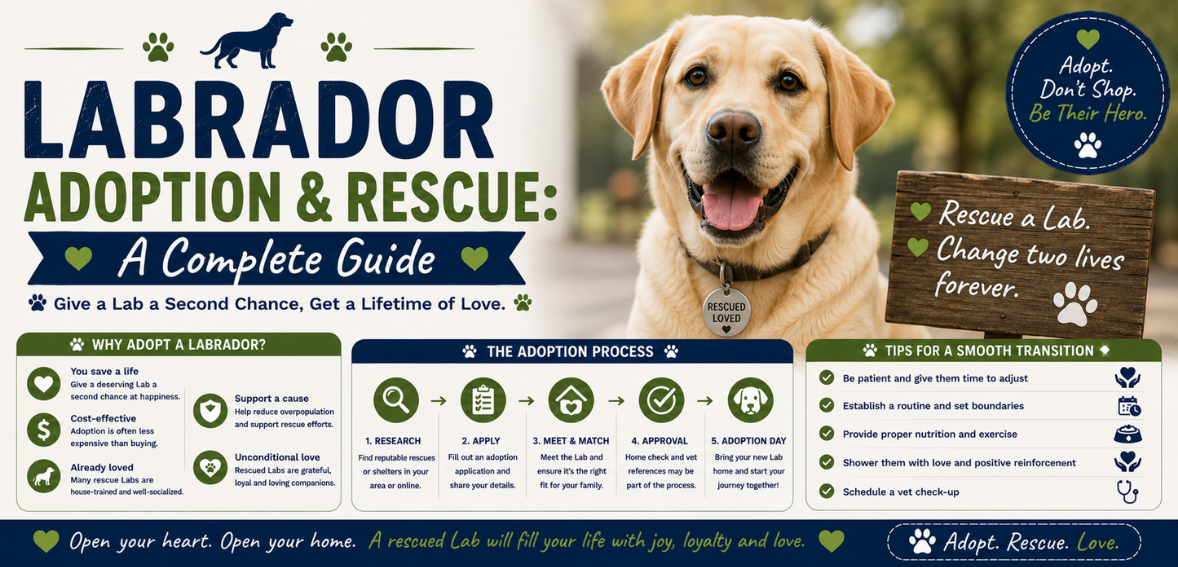
The Adoption Process Step by Step
- Research and choose organizations: Look into a few breed rescues and shelters in your area, checking their nonprofit status, reviews, and how they describe their vetting and foster process.
- Submit an application: Most rescues require a written application covering your home situation, other pets, experience with dogs, and what you’re looking for in a match.
- Complete a home check or interview: Many breed-specific rescues conduct a home visit or video call to confirm the environment suits the dog being considered.
- Meet the dog: A supervised meet-and-greet, sometimes including a resident dog or family member, helps confirm the match works both ways.
- Sign the adoption contract and pay the fee: This typically includes health guarantees, a return policy, and terms like keeping vaccinations current.
- Bring your dog home and begin the decompression period: Follow the 3-3-3 rule and keep the first days calm and low-stimulation as your new dog adjusts.
Adoption Fees and What They Cover
| Source | Typical Fee Range | What’s Usually Included |
|---|---|---|
| Breed-specific Labrador rescue | $300–$500 | Spay/neuter, vaccinations, microchip, vet wellness check, sometimes heartworm testing |
| Municipal/county animal shelter | $50–$300 | Spay/neuter, core vaccinations, microchip |
| Fee-waived adoption events | $0–$70 | Same core services; run periodically to reduce shelter capacity |
These fees typically cover only a portion of the true cost of care — many breed rescues report actual veterinary and transport costs of $1,000 or more per dog, with the rest funded by donations. Compare this to the overall cost of dog ownership in our guide to how much a Labrador costs, which covers both adoption and purchase paths.
Evaluating a Rescue Lab’s Health and Temperament
Reputable rescues provide a vet wellness check and disclose any known health or behavior history before adoption — asking the right questions upfront helps you go in with realistic expectations.
- What is known about this dog’s history, and how long have they been in foster care?
- Has the dog been evaluated around children, other dogs, and cats?
- What medical records are available, and have any conditions been diagnosed?
- Is there a return policy if the placement doesn’t work out?
- What support does the rescue offer post-adoption if behavior issues surface?
Foster-based rescues in particular tend to have detailed, real-world observations about a dog’s behavior in a home setting, which is often more useful than a brief shelter meet-and-greet alone.
Adopting Puppies vs. Adults vs. Seniors
| Age | Pros | Considerations |
|---|---|---|
| Puppies | Full socialization control; grows up in your home from the start | Most time-intensive; house training and adolescent energy still ahead |
| Adults (1–7 years) | Known temperament and energy level; often already house trained | May have an unknown or difficult history to work through |
| Seniors (7+ years) | Typically calm, grateful, and easy to integrate; fees often waived or reduced | Shorter time together; higher likelihood of age-related health needs |
Senior Labradors are especially overlooked in shelters despite being some of the easiest transitions for many households — calmer energy, established manners, and enormous gratitude for a comfortable home in their later years. See our full comparison of puppy vs. adult Labradors to think through which stage fits your household.
Preparing Your Home for a Rescue Dog
- Puppy-proof and secure the home just as you would for a new puppy, since a rescue dog’s habits in your specific space are still unknown
- Set up a designated quiet space with a crate or bed the dog can retreat to
- Have basic supplies ready in advance — see our Labrador puppy checklist for a supply list that applies to rescues of any age too
- Plan a low-key arrival day, avoiding a houseful of visitors or a big introduction to other pets all at once
- Schedule a vet visit within the first couple of weeks to establish your own baseline records
Common Challenges and the Decompression Period
The widely used “3-3-3 rule” is a helpful, realistic framework for what to expect:
- 3 days to decompress from the shock of a new environment — expect a quieter, more withdrawn dog than their true personality during this window
- 3 weeks to begin learning your household’s routine and starting to show more of their genuine personality
- 3 months to feel fully secure and settled, with trust and routine solidly established
Common early challenges include mild appetite changes, house-training slip-ups even in dogs previously trained, and clinginess or, conversely, withdrawal. Patience during this window, combined with a consistent routine, resolves the large majority of early adjustment issues without needing to second-guess the adoption decision.
If you’re weighing rescue against buying from a breeder as a first dog, see our guide to whether Labradors are good for first-time owners for a broader look at what the breed asks of any new owner, rescue or otherwise.
Frequently Asked Questions
Where can I adopt a Labrador Retriever?
Through breed-specific Labrador rescues (find one via the AKC Rescue Network or The Labrador Retriever Club’s rescue list), general animal shelters, or search platforms like Petfinder, which lists adoptable Labs and Lab mixes across the country.
How much does it cost to adopt a Lab from a rescue?
Typically $50–$500 depending on the organization, usually covering spay/neuter, vaccinations, and microchipping. Breed-specific rescues tend toward the higher end of that range, while municipal shelters and fee-waived events are often lower or free.
Is it better to adopt or buy a Labrador?
Both are valid paths. Adoption is typically less expensive, gives a homeless dog a home, and often comes with a known adult temperament. Buying from a health-tested breeder gives more control over lineage and early puppyhood but costs more and requires careful breeder vetting.
What should I expect when adopting a rescue Lab?
Expect an adjustment period following the 3-3-3 rule: about 3 days of initial decompression, 3 weeks to settle into your routine, and up to 3 months to feel fully secure and show their true personality.
Can you find purebred Labradors in shelters?
Yes. Roughly 1 in 4 shelter dogs nationally is purebred, and Labrador Retrievers are consistently among the most common breeds found in both general shelters and breed-specific rescues.
Sources
- American Kennel Club — AKC Rescue Network
- The Labrador Retriever Club, Inc. — Rescue Organizations Resource List
- Petfinder — Adoption Search Database
- ASPCA — Adoption and Shelter Statistics
- Shelter Animals Count — 2025 Annual Data Report