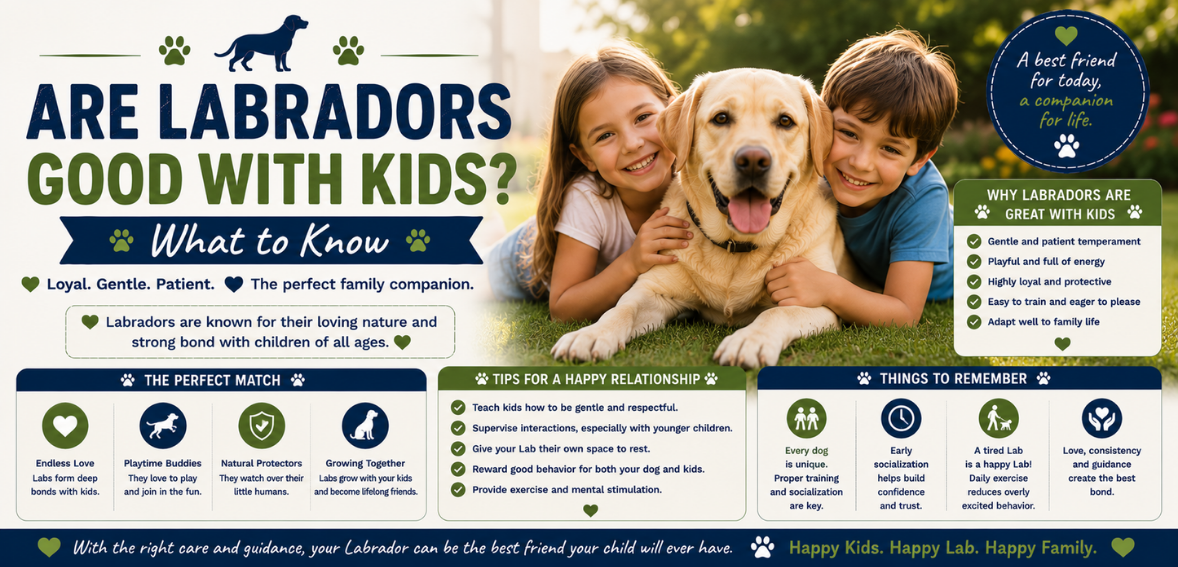
Our Lab has genuinely never so much as growled at either of my kids, and I still never leave them alone together when they were small — not because I doubted her temperament, but because that’s just sound practice with any dog, regardless of breed or history. That combination — a breed with a wonderful reputation around kids, paired with supervision that never fully lets its guard down — is really the whole story of Labradors and children done right.
- Why Labradors Are Considered Family-Friendly
- Labs with Babies vs. Toddlers vs. Older Kids
- The Knock-Over and Mouthing Risk
- How to Supervise Lab-and-Child Interactions Safely
- Teaching Kids How to Interact with the Dog
- Socializing and Training a Lab Around Children
- Warning Signs a Lab Is Stressed by Kids
- When a Labrador May NOT Be the Right Fit
- Frequently Asked Questions
Why Labradors Are Considered Family-Friendly (Temperament Traits)
Labradors were bred for generations to work closely and cooperatively with people, and that shows up as patience, a high tolerance for handling, and a genuine eagerness to be included rather than left alone. Unlike more independent or territorial breeds, Labs are typically not possessive over space, food, or toys when properly socialized, and they tend to recover quickly from startling or uncomfortable moments rather than escalating. This combination — sociability, resilience, and a low baseline of territorial guarding — is exactly why the breed shows up so consistently on family-dog recommendation lists.
Labs with Babies vs. Toddlers vs. Older Kids
| Child Age | What to Expect | Key Consideration |
|---|---|---|
| Infants (0–12 months) | Most Labs are curious but gentle around a new baby once introduced calmly | Never leave the baby and dog alone in the same room, even briefly |
| Toddlers (1–3 years) | The highest-risk age group for accidental injury, mostly due to the toddler’s own unpredictable movements and face-height | Constant, active, within-arm’s-reach supervision is essential |
| Young children (4–7 years) | Can start learning gentle handling and simple commands with guidance | Still requires direct supervision; children this age can’t reliably read canine stress signals |
| Older children (8+ years) | Often able to handle basic care tasks and calmer play under general supervision | Supervision can loosen somewhat but shouldn’t disappear entirely |
National injury data backs up why toddlers are the highest-risk group: children account for at least half of the roughly 4.5 million dog bites reported annually in the U.S., and children under 4 are disproportionately affected, with more severe bites concentrated to the head and neck simply because of their height relative to the dog. This isn’t a Labrador-specific statistic — it applies across all breeds — but it’s exactly why this age range demands the closest supervision regardless of how gentle your particular dog is.
See our full guide on how to introduce a new baby to your Labrador for a step-by-step approach before bringing an infant home.
The Knock-Over and Mouthing Risk with Small Children
The realistic risk with a Labrador and small children usually isn’t aggression — it’s the breed’s sheer size, enthusiasm, and mouthiness. A large, excited adult Lab can easily knock over a toddler simply through exuberant greeting behavior, without any bad intent at all. Similarly, the breed’s soft-mouth retrieving instinct means Labs are naturally inclined to put things — including hands — gently in their mouths, which can startle or worry a small child even when the dog means no harm.
Neither of these is a reason to avoid the breed, but both are reasons active supervision matters more than temperament alone.
How to Supervise Lab-and-Child Interactions Safely
- Stay within arm’s reach during any interaction with infants or toddlers, not just in the same room.
- Watch both the child and the dog simultaneously — supervision means actively observing body language, not just being physically present.
- Interrupt calmly before things escalate, redirecting either the child or the dog at the first sign of overstimulation on either side.
- Give the dog an escape option, such as a crate or gated area the child cannot access, so the dog can remove itself from an overwhelming situation.
- Never leave a baby or young child alone with any dog, even a calm, well-trained family pet, per AVMA guidance — this applies regardless of the dog’s history or breed reputation.
Teaching Kids How to Interact with the Dog
- Ask first, every time — even with the family dog, model asking permission before petting or approaching.
- No hugging around the neck or climbing on the dog, which many dogs, including easygoing Labs, find uncomfortable even if they tolerate it.
- Never approach a sleeping, eating, or resting dog, and don’t take toys, food, or bones away from the dog.
- Teach gentle touch — flat hand, slow movement, no pulling ears, tail, or fur.
- Teach children to recognize a dog that wants space and to back away calmly rather than pursue.
Socializing and Training a Lab Around Children
Early, positive exposure matters as much as innate temperament. Puppies benefit from calm, structured introductions to children of different ages during their primary socialization window, paired with basic obedience training that gives you reliable control in the moment — commands like “leave it,” “off,” and a solid recall are especially useful around kids. See our Labrador training basics for puppies guide for building this foundation, and our guide to Labrador temperament and personality traits for the breed context behind these behaviors.
Warning Signs a Lab Is Stressed by Kids
Dogs communicate discomfort well before a growl or bite, and both parents and children benefit from learning to recognize these signals early.
- Turning the head or body away from the child
- Stiffening posture or freezing in place
- Lip licking, yawning, or showing the whites of the eyes (“whale eye”)
- Moving away or trying to create distance
- Growling — a clear, direct communication that should always be respected, never punished
Any of these signals means it’s time to calmly separate the child and dog, not push the interaction further. A dog that growls is communicating appropriately, not misbehaving — punishing a growl only removes an important warning signal without addressing the underlying discomfort.
When a Labrador May NOT Be the Right Fit
Despite the breed’s excellent reputation, a Labrador isn’t automatically right for every family situation:
- Households unable to commit to genuine, active supervision during the early years of both a young dog and young children
- Families with a child who has a strong fear of dogs that hasn’t been gradually and gently addressed
- Homes without space or ability to give an excitable adolescent Lab enough exercise to prevent overexuberant behavior around small kids
- Situations where an individual dog, regardless of breed, has shown resource guarding or fear-based aggression that hasn’t been addressed with professional support
These are situational and individual-dog factors rather than a reason to rule out the breed broadly — but they’re worth an honest assessment before bringing a Lab into a home with young children, or vice versa.
Frequently Asked Questions
Are Labrador Retrievers good with young children?
Yes, generally. Labradors are consistently rated among the most patient and gentle family breeds, though their size and exuberance mean active supervision is still essential with young children.
Is a Labrador safe around toddlers and babies?
Most well-socialized Labradors are gentle around babies and toddlers, but this age group carries the highest risk of accidental injury with any dog breed, largely due to the child’s unpredictable movements and face-height. Constant, active supervision is essential and should never be skipped.
What age is a Labrador good for a family with kids?
Labradors can do well with children of any age when properly trained and supervised, though households with infants or toddlers should be especially prepared for close, constant supervision during a young dog’s more excitable early years.
Do Labradors get along with children better than other breeds?
Labradors are consistently ranked among the top family-friendly breeds due to their sociability, patience, and low tendency toward possessiveness, though individual temperament and training always matter more than breed alone, and any dog can bite under the wrong circumstances.
Can a Labrador accidentally hurt a small child?
Yes — the more realistic risk with Labradors and small children is accidental injury from the breed’s size and exuberance, such as being knocked over during excited greetings, rather than aggression. This is exactly why supervision matters even with a well-tempered dog.
Sources
- American Veterinary Medical Association (AVMA) — Dog Bite Prevention and National Dog Bite Prevention Week Guidance
- ASPCA — Pets and Children: Keeping Kids Safe When Animals Are in the Home
- American Kennel Club — Labrador Retriever Temperament and Family Suitability