Labradors are friendly and social by nature, but they’re still a retriever breed with a moderate prey drive bred for chasing and carrying — which matters more for small, fast-moving pets than for other dogs. The good news is that with the right pace and setup, most Labs learn to live peacefully alongside cats, other dogs, and even smaller animals. This guide walks through the actual steps for each situation, plus how to read body language and manage resources so introductions go smoothly.
- Labrador Prey Drive and What It Means
- Introducing a Lab to a Cat
- Lab-to-Dog Introductions on Neutral Ground
- Labs with Rabbits, Birds, and Pocket Pets
- Reading Body Language
- Managing Feeding, Toys, and Resource Guarding
- Setting Up Safe Zones and Baby Gates
- Timeline and Signs It’s Working
- Frequently Asked Questions
Labrador Prey Drive and What It Means for Other Pets
Labradors were bred to chase, retrieve, and carry game — a moderate prey drive that’s much lower than sighthounds or terriers, but still real. In practice, this usually shows up as excitement toward fast movement (a cat bolting, a small animal darting) rather than genuine predatory intent toward a calm, familiar housemate. This is exactly why the pace of introductions matters: a calm, gradual process lets everyone involved settle before that chase instinct ever gets triggered by sudden movement or fear-driven fleeing. See our full guide to Labrador prey drive and hunting instincts for more on how this trait shows up day to day.
Introducing a Lab to a Cat (Step-by-Step, Scent-First)
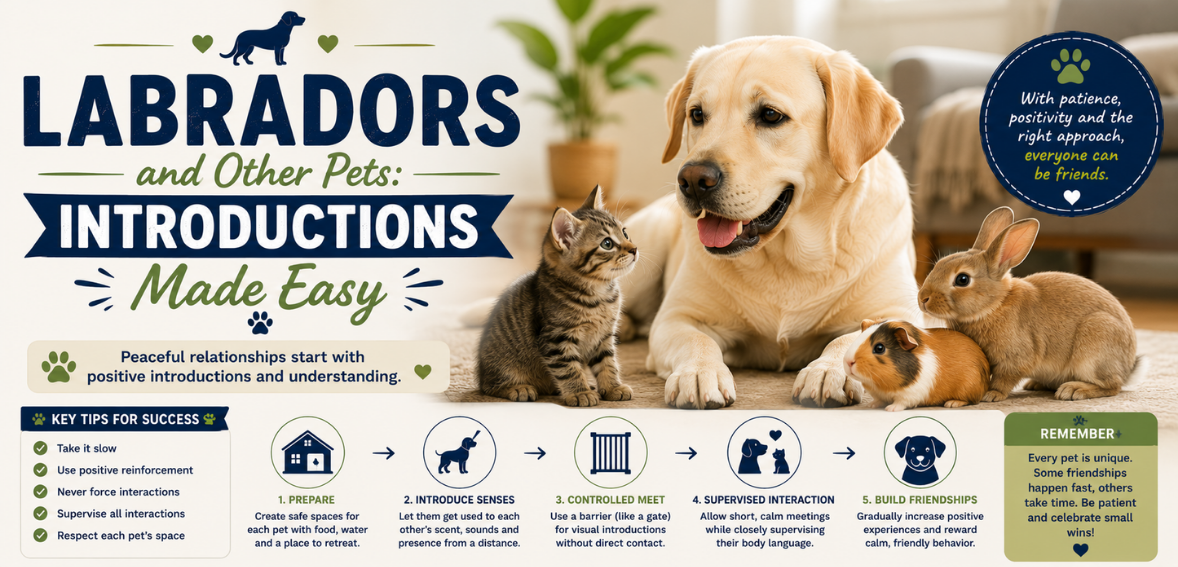
- Separate spaces first: Keep the cat and dog in separate rooms for the first few days, giving the cat full access to escape routes and vertical space.
- Swap scents before any visual meeting: Exchange bedding or a worn towel between them so each becomes familiar with the other’s smell before ever meeting face to face.
- Feed on opposite sides of a closed door: This builds a positive association with the other animal’s presence during a naturally calm activity.
- First visual introduction, dog leashed: Let them see each other briefly through a baby gate or with the dog on a leash, keeping the session calm and short.
- Reward calm behavior from both sides: Treat the dog for looking at the cat calmly rather than lunging or fixating, and let the cat approach or retreat entirely on its own terms.
- Gradually increase supervised time together, always giving the cat an escape route and never forcing proximity.
- Only allow unsupervised time together once both animals have shown calm, relaxed behavior together consistently over multiple sessions.
Lab-to-Dog Introductions on Neutral Ground
- Choose truly neutral territory, like a park neither dog frequents regularly, not either dog’s own yard or home.
- Keep both dogs leashed with loose, relaxed leashes — tension travels down the leash and can make dogs feel more defensive.
- Walk them parallel, at a distance, before any direct approach, allowing both dogs to acclimate to each other’s presence without pressure.
- Allow a brief, calm sniff greeting, then call them apart before the interaction has a chance to escalate either way.
- Watch body language throughout (see the section below) and separate calmly at the first sign of stiffening or excessive fixation.
- Only bring them to a shared home after several successful neutral-ground meetings, and introduce the home itself gradually with supervision.
Labs with Rabbits, Birds, and Pocket Pets
Small, fast-moving animals like rabbits, birds, and pocket pets (hamsters, guinea pigs) are the group most affected by a Labrador’s prey drive, since quick movement is exactly what triggers chase instinct regardless of the dog’s overall friendliness. Many Labs can be trained to calmly coexist near these animals, but full off-leash trust with small pets loose in the same room is not realistic for most dogs and isn’t a fair expectation to set.
- Keep small pets in secure, elevated enclosures the dog cannot access, always
- Practice a solid “leave it” cue before ever allowing the dog near the enclosure
- Never leave a Labrador unsupervised in the same room as a loose small pet, regardless of how calm previous interactions have been
- Treat calm behavior near the enclosure, building a positive association with proximity rather than chasing
Reading Body Language During Introductions
Good Signs
- Loose, relaxed body posture in both animals
- Soft eyes, relaxed ears, wagging at a natural height
- Brief sniffing followed by disengaging calmly
- Either animal choosing to approach voluntarily
Stop and Separate If You See
- Stiff, frozen body posture or a hard stare
- Raised hackles, bared teeth, or growling
- Intense fixation that doesn’t break even when called
- A cat or small animal with flattened ears, puffed tail, or trying repeatedly to flee
Any of the “stop and separate” signs means it’s time to calmly end the session and try again later at a slower pace, not push through hoping it resolves on its own.
Managing Feeding, Toys, and Resource Guarding
- Feed all pets separately, in different rooms or at a clear distance, especially during the first weeks — food is one of the most common triggers for tension in a new multi-pet household.
- Provide separate toys and beds initially, even if you eventually expect them to share, to avoid early competition over specific items.
- Watch for early resource guarding signs — stiffening over a bowl or toy, a hard stare when another pet approaches — and address it with distance and management rather than punishment.
- Pick up high-value items (bones, stuffed toys) when pets are together unsupervised until you’re confident there’s no competition over them.
Setting Up Safe Zones and Baby Gates
Every pet in a multi-pet household should have a space entirely inaccessible to the others — a room, a crate, or a gated area where they can fully relax without needing to monitor another animal. Baby gates are useful for controlled, gradual visual access without full physical proximity, and vertical space (cat trees, shelves) gives cats an escape route that doesn’t rely on a door being open. See our Labrador-friendly home setup ideas for practical layout suggestions that support this kind of multi-pet management.
Timeline and Signs the Introduction Is Working
| Timeframe | What to Expect |
|---|---|
| Days 1–3 | Scent swapping and separate spaces; no direct contact yet |
| Week 1–2 | First supervised, brief visual introductions |
| Weeks 2–4 | Gradually increasing supervised time together, calm coexistence emerging |
| Month 1–3 | Most pairs show relaxed, comfortable coexistence; some pairs take longer |
Every pair moves at its own pace, and rushing past a stage where either animal still shows stress signals typically extends the process rather than shortening it. If tension hasn’t improved after a few weeks of consistent, gradual work, consider consulting a certified trainer or behaviorist for a tailored plan — and see our full Labrador socialization guide for building broader comfort with new people, animals, and environments beyond the household.
Frequently Asked Questions
How do I introduce my Labrador to a cat?
Start with scent swapping and separate spaces, then move to brief, leashed visual introductions, rewarding calm behavior and always giving the cat an escape route. Increase time together gradually and only allow unsupervised time once both show consistent calm behavior.
Are Labradors good with other dogs?
Generally yes — Labradors are typically sociable with other dogs, especially with proper introductions on neutral territory and adequate early socialization. Individual temperament and the other dog’s personality still matter.
Do Labradors have a high prey drive around small pets?
Labradors have a moderate prey drive, lower than sighthounds or terriers but still real, especially triggered by fast movement from small animals like rabbits or pocket pets. Supervision and secure enclosures remain necessary regardless of how calm the dog seems.
What’s the best way to introduce a new dog to my Labrador?
Meet on neutral territory with both dogs leashed, walk them parallel at a distance before any direct approach, allow a brief calm greeting, and separate at the first sign of stiffening or fixation. Avoid a first meeting in either dog’s own home or yard.
How long does it take a Lab and cat to get along?
Many pairs show relaxed coexistence within a few weeks to about a month of gradual, consistent introduction work, though timelines vary significantly by individual temperament and should never be rushed past signs of stress.
Sources
- ASPCA — Introducing Your Dog to Other Pets
- American Veterinary Society of Animal Behavior (AVSAB) — Multi-Pet Household Introduction Guidance
- American Kennel Club — Labrador Retriever Temperament and Sociability