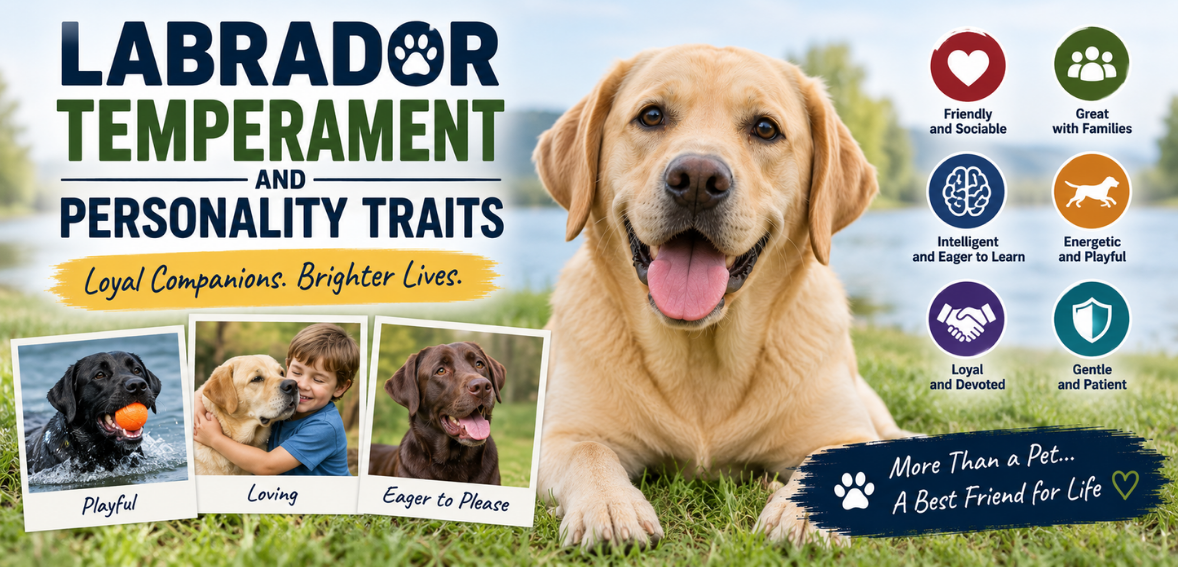
Ask ten Labrador owners to describe their dog in one word and you hear the same answers on repeat: friendly, goofy, hungry, busy. That personality is why the breed spent 31 straight years as America’s most-registered dog, and why it still sits at No. 2 in the American Kennel Club rankings today.
But “friendly” is only half the picture. The same forward, people-seeking enthusiasm that makes a Lab so easy to love is what knocks over toddlers, drags owners down the sidewalk, and eats the sofa cushion. My own yellow Lab greeted every visitor by sprinting to the door with a shoe in his mouth for the first two years of his life. This guide covers both halves honestly — the temperament you’re getting, and the work it takes to live with it.
- The Classic Labrador Personality
- Friendliness and Sociability
- Behavior With Children and Other Pets
- Energy Levels and the Need for Exercise
- Intelligence and Trainability
- Common Behavioral Challenges
- Are Labradors Good Guard Dogs?
- When Do Labradors Mature and Calm Down?
- Is a Labrador Right for You?
- Frequently Asked Questions
| Trait | Rating | What it means day to day |
|---|---|---|
| Affection toward family | 5 / 5 | Wants to be in whatever room you’re in |
| Good with young children | 5 / 5 | Tolerant and gentle, but big enough to knock them over |
| Good with other dogs | 5 / 5 | Socially confident and play-motivated |
| Friendliness to strangers | 5 / 5 | Greets visitors like long-lost friends |
| Energy level | 5 / 5 | Needs 1–2 hours of real exercise daily |
| Trainability | 5 / 5 | Food-motivated and quick to learn |
| Playfulness | 5 / 5 | Keeps puppy silliness well into adulthood |
| Barking level | 3 / 5 | Alerts, then settles — not a nuisance barker |
| Guarding instinct | 2 / 5 | Will announce a visitor, not deter one |
| Tolerates being alone | 2 / 5 | Prone to separation distress without training |
The Classic Labrador Personality (Breed Standard and Working Origins)
The Labrador was developed in Newfoundland as a fisherman’s dog, hauling nets and retrieving fish that slipped the line, then refined in England as a gundog. Every one of those jobs required a dog that worked with people rather than independently, carried things without damaging them, and didn’t pick fights with the other dogs on the boat or in the shooting field.
That history explains nearly every Labrador behavior trait you’ll meet. The breed standard describes the ideal disposition as a kindly, outgoing, tractable nature — a dog eager to please and non-aggressive toward both people and animals. Experienced breed judges treat temperament not as a bonus but as the defining characteristic: a Labrador without it isn’t really a Labrador, however good it looks standing still.
In a family home, that shows up as four consistent qualities: a strong pull to be near people, a mouth that wants to carry something, an appetite bordering on obsessive, and a body that doesn’t seem to run out of fuel. The last three are all useful in training, and all capable of becoming problems when nobody gives them an outlet.
Friendliness and Sociability (Why Labradors Are So Friendly)
Labradors are so friendly because they were deliberately bred to be. Gundogs work in close quarters with unfamiliar people and unfamiliar dogs, and any dog showing suspicion or aggression simply wasn’t bred from. Generations of that selection produced a dog whose default reaction to a stranger is delight rather than caution.
A well-socialized Lab typically greets visitors with a wagging tail, a wriggling body, and something in its mouth offered as a gift — a shoe, a toy, a cushion, whatever was nearest the door. They rarely hold grudges, recover quickly from startling events, and are usually comfortable in busy places like cafés, school gates and vet waiting rooms.
A 70-pound dog launching at guests isn’t showing aggression — it’s showing enthusiasm badly. Decide from day one that greetings only happen with all four feet down, and have every visitor ignore the dog until they are. Teaching this to an eight-week-old puppy takes days. Fixing it in an eighteen-month-old adolescent takes months.
The flip side of all this sociability is that Labradors make poor candidates for anyone wanting a naturally aloof or protective dog, and it means greeting manners have to be taught on purpose rather than assumed.
Behavior With Children and Other Pets
Yes, Labradors are excellent with children and other pets. High tolerance for handling, low resource-guarding tendency and a playful nature make them one of the most reliable family breeds available. The realistic caveat is size and speed, not temperament.
A young Labrador weighs 55–80 pounds, moves fast, and has no idea where its back end is. Most injuries involving Labs and small children are accidental collisions, tail swipes and over-excited jumping — not bites. Supervision during the first two years is about physics as much as behavior.
Ground rules that work in real homes:
- Give the dog an off-limits retreat — a crate or bed children never follow it into. Labs are tolerant, but every dog needs an exit.
- Feed the dog away from family meals. A Lab is food-driven enough that a toddler wandering past with a cookie is a genuine temptation.
- Teach children not to hug or lean over the dog. Tolerance isn’t consent, and even patient dogs give warning signals that children miss.
- Redirect mouthing onto toys immediately. A retrieving breed will carry something — make sure it’s a toy and not a sleeve.
With other dogs, Labs are usually confident and play-heavy, sometimes to the irritation of quieter breeds. With cats, success depends heavily on early exposure: a Lab raised with cats generally lives happily alongside them, while an adult Lab meeting one for the first time may treat it as something to chase. Small pets like rabbits and birds should always be housed securely — retrieving instinct and prey drive sit closer together than most owners expect.
Energy Levels and the Need for Exercise
An adult Labrador needs one to two hours of genuine exercise every day. This is the most underestimated part of the breed and the most common reason Labs end up in rescue. A twenty-minute walk around the block doesn’t touch the sides.
The energy isn’t only physical. A Lab that has run for an hour but used its brain for none of it comes home and finds itself a job — usually unpacking the trash or excavating a flowerbed. Sniffing walks, retrieve games, scent work and short training sessions tire a Labrador far more efficiently than distance alone.
- Two walks totaling 60–90 minutes, at least one with free running or swimming
- 10–15 minutes of structured training or trick work
- A food puzzle, snuffle mat or scatter-feed in place of one bowl meal
- Regular retrieve games — most Labs will keep going until you stop
- A genuine rest period; over-tired Labs get more boisterous, not less
Puppies are the exception. Growing joints shouldn’t be over-exercised, and a common breeder guideline is roughly five minutes of formal walking per month of age, twice daily, until growth plates close. Free play on soft ground is gentler than repetitive forced exercise like jogging or long ball-launcher sessions. Because the breed is already predisposed to hip and elbow problems, this restraint matters more in Labradors than in many breeds — ask any breeder for OFA hip and elbow evaluations on both parents.
Intelligence and Trainability
Labradors are among the most trainable dogs in the world, which is exactly why they dominate guide dog, assistance dog, search-and-rescue and detection work. They combine the three things trainers want: a strong desire to work with humans, high food motivation, and enough resilience to recover from mistakes without shutting down.
The practical consequence for a pet owner is that a Lab learns fast — including things you didn’t mean to teach. A dog that gets attention for jumping learns jumping. A dog that once found a roast chicken on the counter will check that counter for the rest of its life. Consistency matters more with this breed than raw training skill does.
Reward-based methods work far better here than corrections. A Lab’s willingness is its greatest asset, and harsh handling of a soft, people-oriented dog usually produces a confused dog rather than a compliant one. Keep sessions short, pay well, and use part of the dog’s daily food allowance so training doesn’t add weight — a real concern in a breed this prone to obesity. Our guide to basic obedience commands every Labrador should know covers where to start.
Common Behavioral Challenges (Mouthing, Chewing, Separation Anxiety)
Labradors are easy dogs, not effortless ones. Four problems come up again and again, and all four are predictable enough to prevent.
Mouthing and carrying
A retrieving breed is hardwired to hold things. Puppies mouth hands, sleeves and furniture, and this peaks during teething at roughly 12–20 weeks. The fix is redirection rather than suppression: always have a legal item available and reward the puppy for choosing it. Trying to stop a Lab carrying things altogether tends to fail — giving it something appropriate to carry works. See our guide to teething in Labrador puppies for the full timeline.
Destructive chewing
Chewing that continues past teething is nearly always boredom, under-exercise or anxiety rather than defiance. Audit the day before you address the behavior: a Lab left alone for eight hours with no enrichment is behaving normally, not badly.
Separation anxiety
The same sociability that makes Labs wonderful companions makes solitude hard. Signs include vocalizing, destruction focused on doors and windows, house-soiling and refusing food when alone. Build independence gradually from the first week — short absences, calm departures, no dramatic greetings — rather than waiting for a problem to appear. Established separation anxiety is a genuine welfare issue and warrants help from a qualified behaviorist.
Scavenging and food obsession
Labradors are notorious counter-surfers and trash-raiders. Researchers have identified a genetic variant affecting appetite regulation that is unusually common in this breed, which means the food obsession owners describe has a biological basis rather than simply poor manners. Manage the environment, measure meals, and be strict about scraps — this trait drives the breed’s high obesity rates, and obesity in turn worsens the joint problems Labradors already face. Our guides to portion sizes and helping an overweight Labrador lose weight go deeper.
New irritability, withdrawal, reluctance to be touched or unusual reactivity should be treated as a health issue first and a training issue second. Pain from hip or elbow dysplasia, ear infections and thyroid disease can all present as behavior change in this breed. Book a veterinary exam before starting a behavior program — training a dog through pain rarely works and isn’t fair to the dog.
Are Labradors Good Guard Dogs?
No — Labradors are poor guard dogs, and that’s by design. The breed standard explicitly calls for a non-aggressive dog, and a Lab is far more likely to greet an intruder than confront one. Anyone wanting genuine protection should look at breeds developed for that purpose.
Labs do make reasonable watchdogs, which is a different job. Most will bark at a knock at the door or an unfamiliar noise, and their size alone deters opportunists from a distance. What they won’t do is hold their ground, and trying to train protection behavior into a Labrador is both unreliable and unfair to the dog.
Do Labradors bark a lot? Generally no. They’re moderate barkers that alert and then settle. Persistent barking in a Lab usually signals boredom, under-exercise or separation distress rather than a breed tendency.
When Do Labradors Mature and Calm Down?
Most Labradors begin to calm down between two and three years old, with a noticeable settling around the two-year mark. They reach physical maturity well before emotional maturity, so you’ll have a fully grown dog with an adolescent brain for a considerable stretch.
| Age | What you’ll see |
|---|---|
| 8–16 weeks | Sponge-like learning, mouthing, short attention span. Prime socialization window. |
| 4–8 months | Teething, peak chewing, rapid growth, testing boundaries. |
| 8–18 months | Adolescence. Recall often falls apart, distraction is high, learned cues seem forgotten. |
| 2 years | Noticeable settling. Impulse control improves, energy stays high. |
| 3 years | Adult temperament established, though playfulness persists for life. |
| 7+ years | Gradual slowing. Exercise needs drop but don’t disappear. |
Adolescence catches most first-time Lab owners off guard. A dog with a perfect recall at six months may ignore you completely at eleven months. This is normal, temporary, and worth training through rather than around — the owners who keep working during this phase end up with the calm, biddable adult the breed is famous for. If your dog seems permanently stuck in overdrive, our guide to why your Labrador is so hyper covers the usual causes.
Is a Labrador Right for You?
A Labrador is an outstanding choice if you want a sociable, trainable dog that fits into family life and you can commit to daily exercise for the next decade. It’s a poor choice if you want a low-energy companion, a protective dog, a breed that tolerates long stretches alone, or a dog that will be calm within its first year.
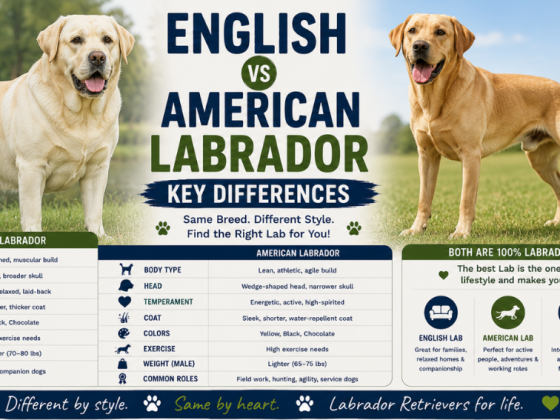
If that sounds like a fit, read our complete Labrador Retriever breed guide next. Working and show lines differ noticeably in energy, so our comparison of English vs American Labradors is worth reading before you choose a puppy. You may also want to know how long Labradors live, and whether coat color has any bearing on behavior — covered in Labrador colors explained.
Ready to turn that eager-to-please temperament into real-world manners?
See our guide to basic obedience commands every Labrador should know →
Frequently Asked Questions
What is a Labrador Retriever’s temperament like?
Friendly, affectionate, eager to please and highly energetic. The breed standard describes a kindly, outgoing and tractable dog that is non-aggressive toward people and other animals. Labradors are people-oriented, food-motivated and playful well into adulthood.
Are Labradors good with children and other pets?
Yes. Labradors are one of the most child-tolerant breeds and usually get along well with other dogs. The main risk is accidental injury from their size and enthusiasm rather than aggression, so supervise young children and teach calm greetings early. Cats are usually fine if the dog is raised with them.
Do Labradors make good guard dogs?
No. Labradors are bred to be non-aggressive and typically greet strangers rather than challenge them. They make acceptable watchdogs, since most will bark to announce a visitor, but they will not deter an intruder.
Why are Labradors so friendly?
Because they were selectively bred for it. As fishing and gundog partners they had to work closely with unfamiliar people and dogs, so any dog showing suspicion or aggression was not bred from. Friendliness in a Labrador is a deliberate genetic outcome, not a coincidence.
At what age do Labradors calm down?
Most Labradors settle noticeably around two years old and reach full emotional maturity by about three. Adolescence between eight and eighteen months is typically the hardest period, when recall and impulse control temporarily deteriorate.
Do Labradors bark a lot?
Not usually. Labradors are moderate barkers that alert to visitors and noises, then settle. Excessive barking generally indicates boredom, insufficient exercise or separation distress rather than a breed trait.
How much exercise does a Labrador need?
One to two hours daily for a healthy adult, combining walks, free running or swimming, and mental work such as training or scent games. Puppies need far less structured exercise to protect developing joints.
Sources
- American Kennel Club — Labrador Retriever Breed Standard and Breed Profile
- American Kennel Club — Most Popular Dog Breeds, annual registration statistics
- The Labrador Retriever Club, Inc. — Temperament and New Puppy Guidance
- Orthopedic Foundation for Animals — Hip and Elbow Dysplasia Evaluation Databases
- VCA Animal Hospitals — Separation Anxiety in Dogs