This might be the single most misunderstood Labrador topic online — plenty of people genuinely believe “English Lab” and “American Lab” are two different breeds you could register separately, or that one is somehow more authentic than the other. Neither is true. This guide clarifies exactly what the split actually means and how to figure out which type fits your life.
Two Types, One Breed
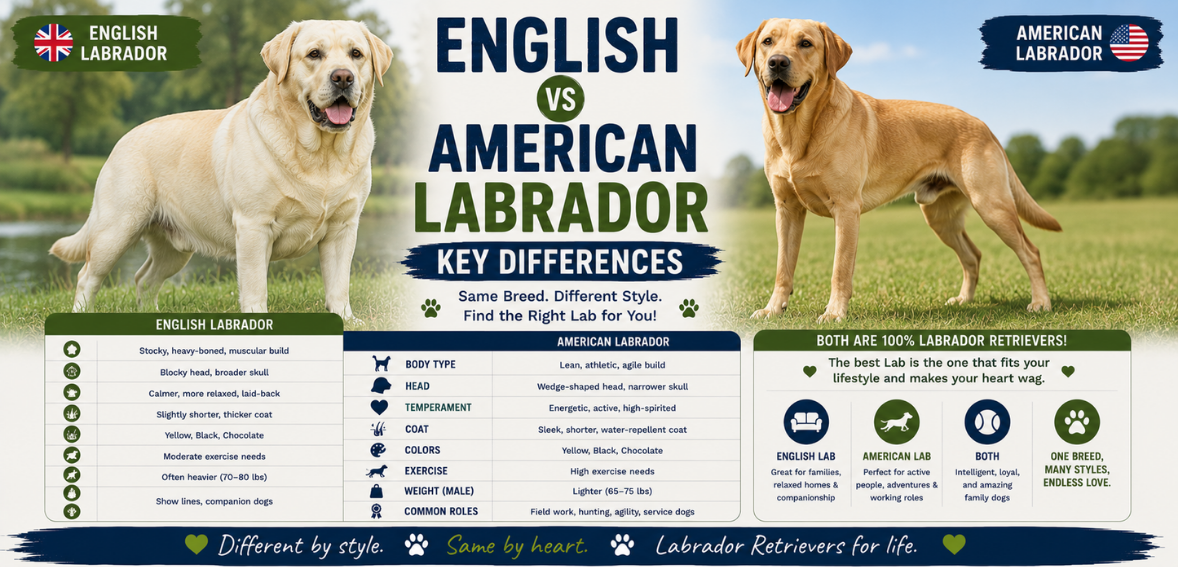
“English Labrador” and “American Labrador” are informal, commonly used terms — neither the AKC nor The Kennel Club (UK) recognizes them as official breed categories. Both types are fully Labrador Retrievers, registered identically, and can even appear in the same litter depending on the parents’ lines. The terms simply describe which breeding tradition — conformation showing (often loosely called “English” or “bench”) versus field trial and hunting work (often called “American” or “field”) — a particular dog’s ancestry leans toward.
Origins of the Show vs. Field Split
As the Labrador Retriever grew in popularity through the 20th century, breeders in the UK and the US began selecting for somewhat different goals. Show-line breeders bred toward the AKC/Kennel Club conformation standard — favoring a blockier head, stockier build, and calmer ring temperament. Field-line breeders, especially in the US, bred primarily for performance in hunting and field trials, prioritizing stamina, drive, and a leaner, faster build over strict conformation to the show standard. Over decades, these selection pressures produced two recognizably different — but genetically still fully Labrador — physical and temperament profiles.
Physical Differences (Build, Head, Coat)
| Trait | English (Show/Bench) | American (Field/Working) |
|---|---|---|
| Build | Stockier, more heavily boned | Leaner, more athletic |
| Head shape | Broader, blockier | Narrower, more refined |
| Height | Often slightly shorter at the shoulder | Often slightly taller, leggier |
| Coat | Dense, thick double coat | Slightly thinner, sleeker coat |
| Tail | Thick “otter tail,” carried level | Similar otter tail, often more constant motion |
Temperament and Energy Differences
Show-line Labradors tend toward a calmer, more easygoing baseline temperament, partly a byproduct of breeding for steady, controllable behavior in the show ring. Field-line Labradors tend toward higher energy, faster reflexes, and stronger drive — traits directly useful for hunting and field trial work, but which mean a field-line dog is often more demanding for a first-time or lower-activity household. These are general tendencies, not guarantees — individual variation within either line can be significant, and most pet Labradors fall somewhere between the two extremes rather than at a pure end of either spectrum.
Trainability and Working Drive
Both types are highly trainable — trainability is a defining Labrador trait regardless of line — but they express it differently. Field-line dogs typically show a stronger, more intense working drive: a near-compulsive desire to retrieve, a longer attention span for repetitive retrieving work, and higher tolerance for physically demanding training. Show-line dogs are generally just as capable of learning obedience and tricks but tend to have a lower baseline drive to work continuously, making them easier to satisfy with moderate daily training and exercise.
Which Type Suits Families vs. Hunters
- Families and first-time owners often do better with a show-line Lab, given the calmer baseline temperament and lower daily exercise ceiling
- Hunters, field trial competitors, and very active households are typically better matched to a field-line Lab, whose drive and stamina align with that level of activity
- Most pet owners end up with a dog somewhere in between, since many breeders don’t breed strictly for one extreme or the other
See our full guide to Labrador temperament and personality traits for more on how these tendencies show up day to day, and our Labrador Retriever breed guide for the full picture of the breed beyond just line differences.
Health and Longevity Considerations
There’s no robust, line-specific research directly comparing health outcomes between English and American Labradors as distinct categories — most major health studies (hip dysplasia rates, lifespan data) look at the breed as a whole rather than splitting results by show versus field lines. Some breeders and vets anecdotally suggest that the heavier, more heavily boned build common in show lines may place somewhat more mechanical stress on joints already predisposed to hip and elbow dysplasia, while leaner field-line dogs may run a slightly lower obesity risk given their typically higher activity level — but these remain reasonable hypotheses rather than confirmed findings backed by dedicated line-specific studies. Whichever line a puppy comes from, the same core health-testing priorities apply: verified OFA hip and elbow scores, eye clearances, and EIC/PRA/CNM DNA testing on both parents.
How to Identify Each Type
- Ask the breeder directly which lines (show, field, or a mix) the puppy’s parents come from — pedigree paperwork will show titles like “CH” (champion, show) or “FC”/”MH” (field champion/master hunter, field)
- Look at the parents, not just the puppy, since adult build and head shape are far more diagnostic than a puppy’s still-developing features
- Ask about the parents’ energy level and daily exercise needs directly, since this tells you more about what to expect than labels alone
See our full Labrador size and weight chart and the official Labrador breed standard for the physical benchmarks both lines are ultimately measured against.
Frequently Asked Questions
What is the difference between an English and American Labrador?
They’re the same breed, not separate breeds — just different breeding lines. English (show/bench) Labs tend toward a stockier build and calmer temperament, while American (field/working) Labs tend toward a leaner build and higher energy and drive.
Are English Labs calmer than American Labs?
Generally, yes, as a tendency rather than a guarantee. Show-line breeding has favored a calmer, steadier temperament suited to the show ring, while field-line breeding has favored higher drive and energy suited to hunting work.
Which Labrador type is better for a family pet?
Show-line (English) Labs are often an easier fit for families and first-time owners given their typically calmer baseline and lower daily exercise ceiling, though individual temperament varies and many pet Labradors fall between the two extremes.
Do English and American Labradors look different?
Yes, on average. English (show) Labs tend to have a stockier build, broader blockier head, and thicker coat, while American (field) Labs tend to be leaner, taller, and more narrow-headed.
Is there really a difference between show and field Labradors?
Yes, in typical build, energy level, and working drive, shaped by decades of different breeding priorities, but both remain the same breed — fully interbreedable and registered identically by kennel clubs.
Want the full picture of the breed beyond line differences?
Read our complete Labrador Retriever breed guide →Sources
- American Kennel Club — Official Standard for the Labrador Retriever
- The Kennel Club (UK) — Labrador Retriever Breed Standard
- The Labrador Retriever Club, Inc. — Breed History and Line Development