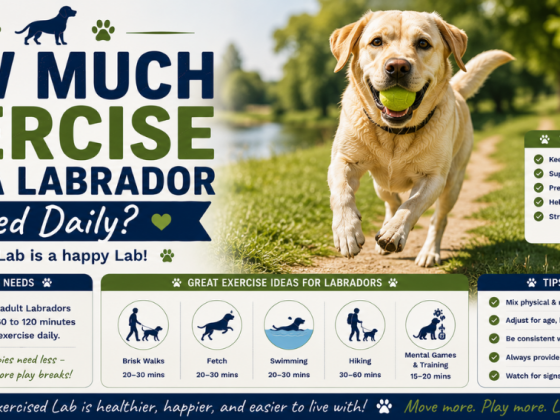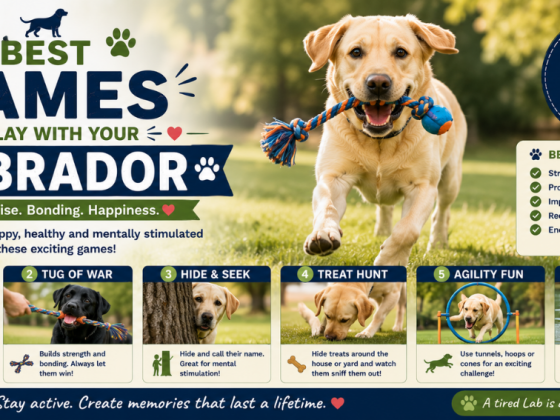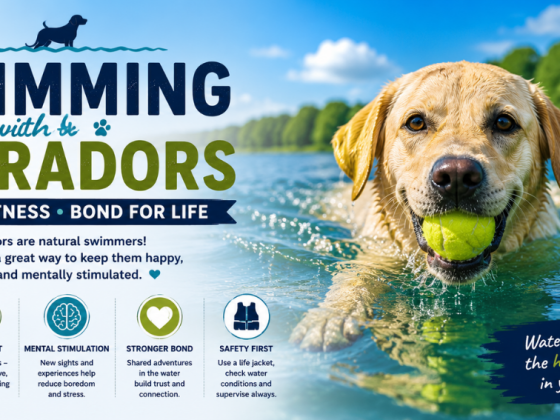
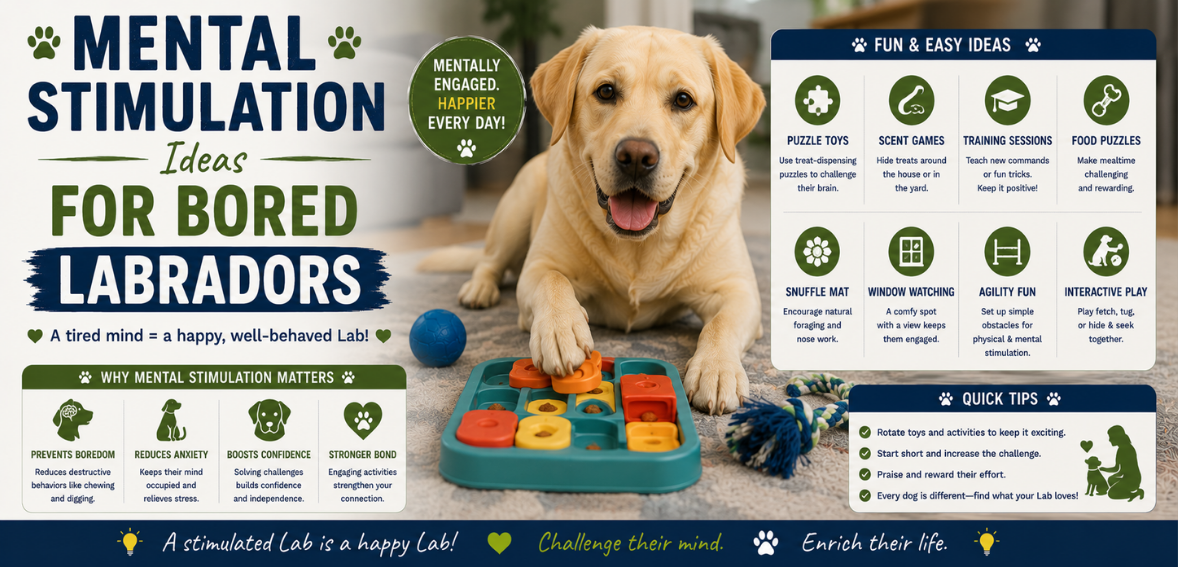
If you’ve ever come home to a demolished couch cushion despite walking your Lab that morning, the problem usually isn’t a lack of exercise — it’s a lack of mental work. Labradors are working retrievers bred to problem-solve and use their nose, and a body that’s tired but a brain that’s completely under-stimulated is a genuinely common recipe for destructive, restless behavior.
- How to Tell If Your Lab Is Bored
- Why Mental Exercise Matters as Much as Physical
- Food Puzzles, Snuffle Mats, and Slow Feeders
- Nose Work and Scent Games
- Training New Tricks and Obedience as Enrichment
- DIY and Low-Cost Enrichment Ideas
- Chew and Lick-Based Enrichment for Solo Time
- Building a Daily Enrichment Routine
- Frequently Asked Questions
How to Tell If Your Lab Is Bored (Behavioral Signs)
- Destructive chewing of furniture, shoes, or household items
- Excessive barking or whining, especially when left alone
- Restlessness, pacing, or difficulty settling even after exercise
- Digging, especially in yards or at carpets and bedding
- Attention-seeking behavior that escalates over time (nudging, pawing, jumping)
- Following you from room to room excessively, unable to self-settle
Any of these, especially if they show up despite regular physical exercise, point toward a mental stimulation gap rather than a simple need for more walks.
Why Mental Exercise Matters as Much as Physical
Problem-solving, scent work, and training all require sustained focus and decision-making in a way that walking simply doesn’t demand. For a breed bred to scent-track downed birds and think through retrieving problems, this kind of work taps into a genuinely different — and for many dogs, more satisfying — kind of tiredness than physical exertion alone. Combining both physical and mental activity consistently produces a calmer, more settled dog than maxing out physical exercise while leaving the brain idle.
Food Puzzles, Snuffle Mats, and Slow Feeders
- Snuffle mats: Scatter kibble or treats through the fabric strips and let your dog sniff out each piece — a genuinely tiring, low-impact activity perfect for rainy days or recovery periods.
- Stuffed, freezable toys: Fill a hollow rubber toy with kibble and a soft filler like plain yogurt or canned pumpkin, then freeze — this extends the challenge significantly and works well for crate time.
- Slow feeders: A raised, maze-patterned bowl turns an entire meal into a puzzle, useful for fast eaters and as a built-in daily enrichment moment.
- Rotating puzzle toys: Treat-dispensing puzzles that require pushing, sliding, or flipping panels keep a food-motivated Lab engaged far longer than a simple bowl.
Nose Work and Scent Games
Labradors were bred to scent-track downed game, and formal or informal nose work taps directly into that instinct.
“Find It” Scent Game
Hide treats around a room or yard and cue “find it,” gradually increasing difficulty as your dog improves.
Muffin Tin Game
Place treats in some cups of a muffin tin, cover all cups with tennis balls, and let your dog work out which ones to move to find the treats.
Structured Nose Work Classes
Formal scent-detection classes teach a dog to search for a specific target odor across increasingly complex environments — genuinely exhausting mental work for an intelligent, scent-driven breed.
Training New Tricks and Obedience as Enrichment
Short training sessions count as real mental enrichment, not just skill-building. Teaching a brand-new trick — even something purely for fun like “spin” or “roll over” — requires focused problem-solving in a way that reinforcing an already-known command doesn’t. See our full guide to basic obedience commands every Labrador should know for a foundation to build new tricks on top of, and rotate in something novel every week or two to keep sessions mentally fresh.
DIY and Low-Cost Enrichment Ideas
| Idea | Cost | Effort |
|---|---|---|
| Cardboard box “shred and find” (treats hidden in crumpled paper inside a box) | Free | Low |
| Frozen treat-stuffed toy | Low (just food) | Low |
| Muffin tin puzzle | Low | Low |
| DIY snuffle mat (fleece strips tied to a rubber mat) | Low | Medium (one-time setup) |
| Towel roll-up (treats rolled inside a towel to unroll) | Free | Low |
| Water play with floating toys in a shallow tub | Free | Low |
None of these require significant money or time — the goal is variety and novelty, not expensive gear.
Chew and Lick-Based Enrichment for Solo Time
Chewing and licking are naturally calming behaviors for dogs, releasing endorphins that help a dog settle rather than just burn energy.
- Frozen lick mats spread with plain yogurt, pumpkin, or a thin layer of wet food, frozen for extended engagement
- Appropriately sized, safe chew toys rotated regularly to keep interest high — see our guide to the best chew-proof toys for Labradors
- Offering these specifically during alone time (before you leave, or during a crate session) helps build a positive association with solo time itself
These are especially useful for the specific window when a dog is left alone, since they provide calming engagement without requiring supervision. See our guide to Labrador destructive chewing solutions if chewing has become a significant problem beyond normal enrichment needs.
Building a Daily Enrichment Routine
| Time | Activity |
|---|---|
| Morning | Physical exercise (walk or fetch) + a few minutes of training |
| Midday (if home alone) | Frozen stuffed toy or lick mat before you leave |
| Evening | Nose work game or puzzle feeder at mealtime |
| Before bed | Calm chew session to wind down |
Rotate which specific activity fills each slot every few days to keep novelty high — the same puzzle every single day loses its mental challenge once a dog has fully solved it. See our guides to the best games to play with your Labrador and indoor activities for rainy days for more variety, and our guide to exercising a Labrador in an apartment if space is limited.
Frequently Asked Questions
How do I mentally stimulate a bored Labrador?
Use food puzzles, snuffle mats, nose work games, new trick training, and chew or lick-based enrichment, rotating activities regularly to keep them mentally challenging. Aim for a mix of physical and mental activity every day rather than relying on walks alone.
What are signs my Lab is bored?
Destructive chewing, excessive barking or whining, restlessness, digging, and escalating attention-seeking behavior are common signs, especially if they persist despite regular physical exercise.
Does mental stimulation tire a dog out more than a walk?
Often, yes. Problem-solving and scent work engage sustained focus and decision-making in a way walking doesn’t, and for an intelligent, scent-driven breed like the Labrador, this can produce a deeper tiredness than physical exercise alone.
What can I give my Lab to keep it busy while I’m at work?
A frozen, stuffed food toy or lick mat given right before you leave provides calming, extended engagement during alone time, along with safe chew toys rotated for novelty.
What are cheap DIY enrichment ideas for Labradors?
A cardboard box with treats hidden in crumpled paper, a muffin tin puzzle with tennis balls, a towel rolled up with treats inside, and a DIY snuffle mat all provide genuine mental engagement at little to no cost.
Looking for more structured play to round out the routine?
See our guide to the best games to play with your Labrador →Sources
- Certified Professional Dog Trainer (CPDT-KA) standards on canine enrichment and boredom-driven behavior
- American Kennel Club — Enrichment Activities for Dogs