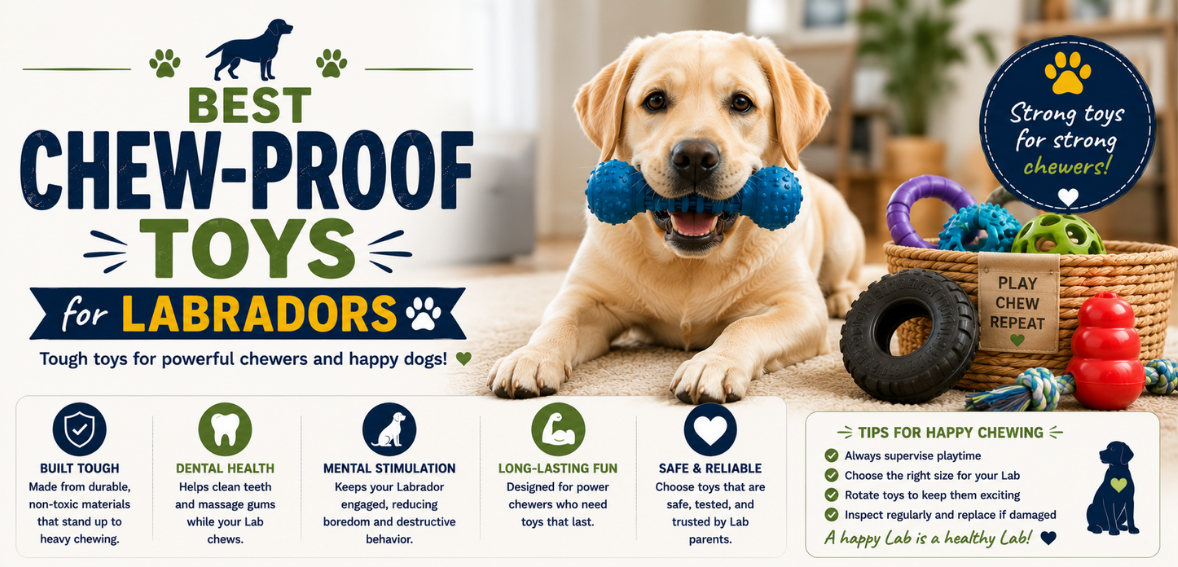
Labradors are frequently ranked among the strongest-jawed retriever breeds, and that bite strength, combined with their retrieving instinct to carry and mouth objects constantly, means “chew-resistant” claims get tested fast in a Lab household. This guide breaks down what actually holds up by material category, what “chew-proof” honestly means (spoiler: nothing is 100% indestructible), and the safety considerations — dental and choking risk — that matter more than durability alone.
How We Evaluated Durability
We did not run a controlled, logged multi-week destruction test with a panel of dogs for this guide — a single household’s chewing style isn’t representative of how millions of Labradors with wildly different bite strength and chewing habits will treat a product, and we didn’t want to present anecdotal wear-and-tear as if it were a scientific durability rating. Instead, every pick below was evaluated against consistent, verifiable criteria:
- Manufacturer durability claims and materials (rubber hardness/density, nylon composition, any published guarantee or warranty)
- Verified buyer feedback patterns, specifically looking for recurring reports of cracking, gulped chunks, or toys surviving months versus days
- Veterinary input on dental and choking safety — some genuinely “durable” materials are hard enough to risk tooth fractures, which matters more than raw destruction-resistance
- Manufacturer replacement guarantees, where offered, as a meaningful real-world signal of how much a company stands behind its own durability claims
If you have real experience with any of these toys and your own power-chewing Lab, we’d genuinely welcome hearing about it — that kind of first-hand feedback is exactly what would make a future update of this guide stronger.
Top Chew-Proof Picks by Category (Rubber, Nylon, Rope, Dental)
KONG Extreme (Black Kong)
Solid, dense black rubber · Hollow center for stuffing · Sized for large/power-chewing breeds
Verdict: The most broadly recommended rubber chew for strong-jawed Labs, combining real durability with a rubber density gentler on teeth than hard nylon.
The black rubber formula is noticeably denser than KONG’s standard red version, and its rounded shape has no hard edges or flat surfaces prone to cracking under pressure. The hollow center also doubles it as a food puzzle toy.
Pros
- Dense rubber holds up well against strong chewers
- Doubles as a food puzzle toy
- Rubber is gentler on teeth than harder materials
Cons
- Still not indestructible for the most extreme power chewers
- Higher price than basic rubber toys
Goughnuts Original Ring or MAXX
Reinforced rubber with a visible inner “safety layer” · Available in multiple sizes and hardness levels
Verdict: A genuinely useful safety feature sets this apart — a bright inner layer becomes visible if the outer layer wears through, giving owners a clear replace-it signal before the toy fails completely.
Rather than just claiming durability, Goughnuts builds in a visual wear indicator: if your dog chews through to the red inner core, that’s the manufacturer’s own signal to stop use and replace the toy, which is a meaningfully more honest approach to “durability” than most competitors offer.
Pros
- Built-in visual safety indicator for wear
- Available in hardness levels matched to chew strength
Cons
- Premium price point
- Simple ring/stick shapes, less variety than some competitors
Nylabone Power Chew
Durable nylon with textured ridges · Various flavors and shapes · Sized for large breeds
Verdict: A reliably long-lasting option for dogs who prefer a harder chewing texture, with the important caveat that nylon’s hardness carries a higher dental-fracture risk than rubber if your dog chews too aggressively.
Nylon holds up extremely well against sustained chewing pressure and doesn’t compress or tear the way rubber or rope can. That same hardness is exactly why a vet safety check matters before choosing this material for a genuinely aggressive chewer.
Pros
- Extremely long-lasting against sustained chewing
- Doesn’t tear or shred like rope or fabric toys
Cons
- Hardness carries a real dental fracture risk for aggressive chewers
- Not recommended for dogs with existing dental issues
Mammoth Flossy Chews Cotton Rope Tug
Thick woven cotton rope · Various sizes for large breeds
Verdict: A good tug-and-play toy that also helps floss teeth during use, but it’s genuinely not a chew-proof material — treat it as a supervised-play toy, not an unsupervised power-chew option.
Rope toys work well for interactive tug play and can help mechanically clean teeth through the fibrous texture, but rope fibers fray and can be swallowed if a determined chewer is left with one unsupervised for extended periods.
Pros
- Great for interactive tug play
- Fiber texture offers mild dental-cleaning benefit during use
Cons
- Not chew-proof; frays with sustained unsupervised chewing
- Loose strings pose a swallowing risk if left unsupervised
Nylabone Dental Chew
Textured nylon-based chew with a shape designed for tooth and gum contact
Verdict: A solid option for adding a dental-health angle to chew time, though it should complement, not replace, brushing or veterinary dental cleanings.
The ridged, textured design is meant to scrape plaque during normal chewing, giving your dog’s regular chew habit a bit of dental benefit alongside the durability of the underlying nylon material.
Pros
- Adds a dental-health angle to routine chewing
- Reasonably durable given the harder nylon base
Cons
- Not a substitute for brushing or professional dental cleanings
- Same nylon hardness caution applies for aggressive chewers
West Paw Zogoflex Qwizl or Tux
Proprietary Zogoflex rubber-like material · Backed by a manufacturer replace-if-destroyed guarantee
Verdict: The manufacturer’s own guarantee to replace the toy if your dog destroys it is a genuinely useful real-world signal of confidence, on top of a solid, food-puzzle-friendly design.
West Paw’s Zogoflex material is designed to flex rather than shatter under chewing pressure, and the company backs it with an actual replacement policy for toys destroyed during normal use — a concrete commitment rather than just a durability claim.
Pros
- Manufacturer replacement guarantee if destroyed
- Doubles as a treat-dispensing puzzle toy
Cons
- Premium price point
- Guarantee process requires proof of purchase and some paperwork
What “Chew-Proof” Really Means (and Safety Caveats)
No commercially available toy is truly indestructible against every dog — “chew-proof” and “indestructible” in product marketing really mean “significantly more durable than average,” not “guaranteed to survive any dog.” A useful rule of thumb from veterinary dentistry: if you can’t press a fingernail into a toy’s surface at all, it may be too hard and risks fracturing teeth, particularly the large upper premolars dogs use for heavy chewing. This is exactly why rubber options like KONG Extreme and Goughnuts, which retain slight give, are often safer long-term choices than the hardest nylon or real bone products, even when the latter last longer before visible wear.
Choosing Toys by Chew Strength and Lab Age (Puppy/Adult/Senior)
| Life Stage | Best Toy Types | Notes |
|---|---|---|
| Puppy (teething, under 6 months) | Softer rubber teething toys, frozen wet washcloths | Avoid hard nylon or extreme-durability toys until adult teeth are in; see our puppy teething guide |
| Adolescent/Adult (moderate-heavy chewer) | KONG Extreme, Nylabone Power Chew, Goughnuts | Match hardness to your individual dog’s chewing intensity, not just age |
| Senior (reduced chewing intensity) | Softer rubber, dental chews | Watch for worn or loose teeth that make harder textures uncomfortable |
Material Safety and Non-Toxic Considerations
- Choose toys explicitly labeled non-toxic and free of BPA, phthalates, and lead, especially for puppies who mouth toys constantly
- Avoid toys with small, chewable-off decorative parts (bells, hard plastic eyes) for a strong chewer
- Check for a size appropriate to your dog’s mouth — undersized toys for a large-jawed Lab increase both breakage and choking risk
- Inspect new toys for manufacturing defects (rough seams, weak points) before giving them unsupervised
Durability Comparison Table
| Toy | Material | Best For | Price Tier |
|---|---|---|---|
| KONG Extreme | Dense black rubber | General power chewers | Mid-range |
| Goughnuts Original/MAXX | Reinforced rubber with wear indicator | Extreme power chewers | Premium |
| Nylabone Power Chew | Hard nylon | Sustained heavy chewers (monitor dental risk) | Budget–Mid |
| Mammoth Flossy Chews Rope | Cotton rope | Supervised tug play only | Budget |
| Nylabone Dental Chew | Textured nylon | Dental-health-focused chewing | Budget–Mid |
| West Paw Zogoflex Qwizl/Tux | Proprietary flexible rubber-like material | Chewers + puzzle feeding, guarantee-backed | Premium |
Signs a Toy Is Unsafe and When to Replace It
- Visible cracks, tears, or chunks missing
- Sharp edges or points where material has broken away
- Fraying rope with loose strings your dog could swallow
- A visible inner layer showing through on wear-indicator toys like Goughnuts
- Any piece small enough to be fully swallowed or lodged in the throat
If your dog ever swallows a piece of a toy, contact your vet promptly, even if they seem fine — some fragments can cause internal blockages that aren’t immediately obvious. See our guide to Labrador destructive chewing solutions if toy destruction is happening unusually fast or frequently, which can sometimes point to boredom, anxiety, or insufficient exercise rather than just normal chewing behavior. For structured mental engagement alongside chew toys, see our best puzzle toys for Labradors guide, and our best dog dental chews for Labs guide for dedicated dental products.
FAQ: Chewing Behavior and Toy Rotation
What are the most indestructible toys for a Labrador that destroys everything?
No toy is truly indestructible, but dense rubber options like the KONG Extreme and reinforced designs like Goughnuts (which has a built-in wear indicator) tend to hold up longest against strong-jawed Labradors.
Are Kong toys chew-proof for aggressive Labrador chewers?
The black KONG Extreme is significantly more durable than standard KONG toys and holds up well for most power chewers, but no toy is guaranteed indestructible for every dog. Monitor for wear and replace at the first sign of cracking or missing chunks.
What chew toys are safe for a Lab’s teeth?
Rubber toys with some give, like KONG Extreme or Goughnuts, are generally gentler on teeth than very hard materials like nylon, antlers, or real bones. A useful test: if you can’t press a fingernail into the surface at all, it may be too hard for safe chewing.
Which dog toys last longest with a power-chewing Labrador?
Dense rubber (KONG Extreme, Goughnuts) and hard nylon (Nylabone Power Chew) toys generally last longest against sustained chewing, while rope and softer rubber toys wear faster and require closer supervision.
What should I get a Lab puppy that’s teething and chewing?
Softer rubber teething toys and a frozen, damp washcloth are good options for teething puppies. Save harder, extreme-durability toys like Nylabone Power Chew or Goughnuts for after adult teeth come in, typically around 6 months.
Sources
- American Veterinary Dental College — Safe Chew Toy Guidance
- VCA Animal Hospitals — Choosing Safe Chew Toys for Dogs
- Manufacturer specifications for products reviewed (KONG, Goughnuts, Nylabone, Mammoth, West Paw)