Medical Disclaimer: This article is for general information and is not a substitute for veterinary advice. Vaccination schedules vary by region, local disease prevalence, state law and your individual puppy’s health. Your veterinarian directs the final schedule, and you should follow their plan over any general guide, including this one.
Vaccination is the one part of puppy care where timing genuinely matters. The gap between a puppy losing its mother’s antibody protection and building its own is the window in which parvovirus kills puppies, and the whole structure of the series exists to close that window as tightly as possible.
This guide lays out the schedule by age, explains which vaccines are core and why that list changed recently, and answers the question almost every new Labrador owner asks their vet: when can I actually take this puppy outside?
- Core Vaccines Every Labrador Puppy Needs
- Non-Core Vaccines by Lifestyle and Region
- Age-by-Age Vaccination Schedule
- Why the Full Series Matters and Parvo Risk
- When Your Puppy Is Safe for Parks and Socialization
- Typical Costs and What to Expect at Each Visit
- Vaccine Side Effects and Reactions to Watch For
- Keeping Records and Staying on Schedule
- Frequently Asked Questions
Core Vaccines Every Labrador Puppy Needs (DAP, Rabies, Leptospirosis)
Core vaccines are those recommended for every dog regardless of lifestyle or location. For Labrador puppies in the United States that means three things: the combination DAP vaccine, rabies, and — as of a 2024 update to the AAHA guidelines — leptospirosis.
| Vaccine | Protects against | Starting age |
|---|---|---|
| DAP / DHPP | Canine distemper virus, adenovirus (infectious hepatitis), parvovirus. The “H” and second “P” in DHPP refer to hepatitis and parainfluenza. | 6–8 weeks |
| Rabies | Rabies virus. Fatal, zoonotic, and legally mandated in most jurisdictions. | 12 weeks (licensed products are labeled for 3 months and older) |
| Leptospirosis | Leptospira bacteria, spread through the urine of wildlife and rodents. Causes kidney and liver failure and can transmit to humans. | 12 weeks, with a second dose 2–4 weeks later |
Leptospirosis was considered a non-core, lifestyle-based vaccine for years, and many older articles still describe it that way. AAHA updated its guidance in 2024 to recommend it as core for all dogs, following consensus statements from the American College of Veterinary Internal Medicine and WSAVA. The reasoning is that prevalence has risen substantially, urban dogs are exposed as readily as rural ones, the disease is zoonotic, and modern vaccines have a better safety record than earlier generations. If your vet recommends lepto for a city-dwelling Labrador, this is why.
Non-Core Vaccines by Lifestyle and Region (Bordetella, Lyme, Influenza)
Non-core vaccines are recommended based on where you live and what your dog actually does. Your vet will assess these individually rather than giving them by default.
| Vaccine | Consider it if | Notes |
|---|---|---|
| Bordetella (kennel cough) | Boarding, daycare, grooming salons, training classes, dog shows | Most facilities require it. Available intranasal, oral or injectable; intranasal and oral forms act faster |
| Lyme disease (Borrelia burgdorferi) | You live in or travel to a tick-endemic region — the Northeast, upper Midwest and parts of the West Coast | Vaccination supplements, never replaces, year-round tick prevention |
| Canine influenza (H3N2/H3N8) | Frequent boarding or daycare, or an active local outbreak | Two doses 2–4 weeks apart for the initial series |
| Rattlesnake toxoid | Hiking or living in rattlesnake country, mainly the southwestern US | Reduces severity only; a bitten dog is still an emergency |
For a Labrador specifically, the swimming and field habits of the breed push both leptospirosis and tick-borne disease higher up the risk list than they would be for a sedentary indoor dog. Mention your dog’s actual lifestyle to your vet — “she’ll be in ponds most weekends” changes the recommendation.
Age-by-Age Vaccination Schedule
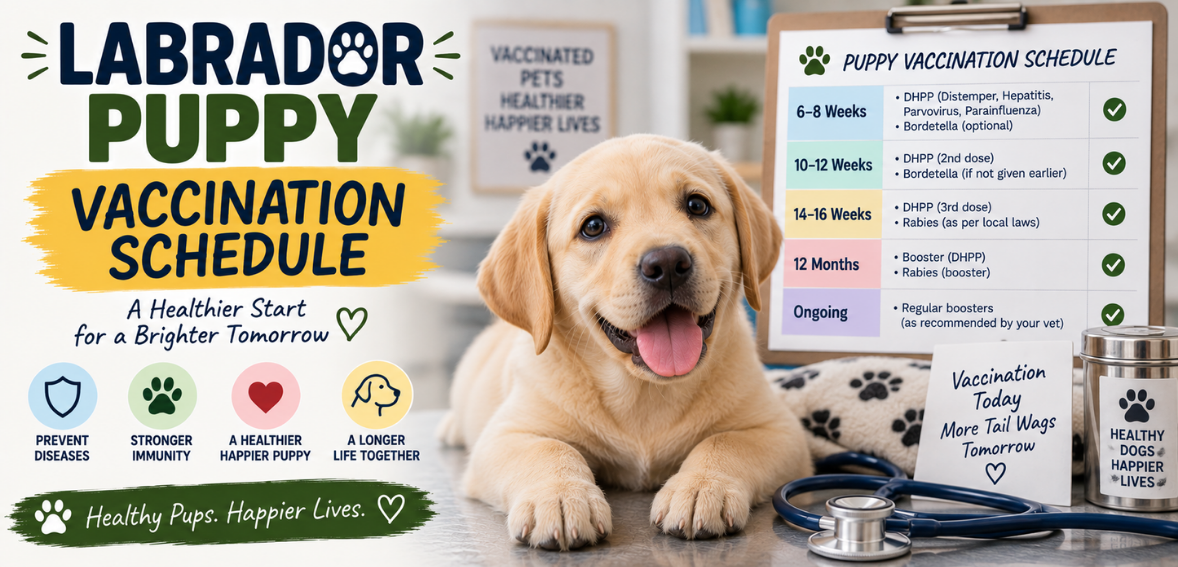
The core series runs from 6–8 weeks to at least 16 weeks, with doses every 3–4 weeks. The final DAP dose must fall at or after 16 weeks of age — this is the single most important timing rule in the whole schedule.
| Puppy age | Vaccines given | Notes |
|---|---|---|
| 6–8 weeks | DAP (1st dose) | Usually given by the breeder before pickup. Deworming typically starts here too |
| 10–12 weeks | DAP (2nd dose) | Your first vet visit in most cases. Bring the breeder’s records |
| 12–16 weeks | Rabies (1st dose); Leptospirosis (1st dose) | Rabies age is set by state law; many states require it by 4 months |
| 14–16 weeks | DAP (3rd dose); Leptospirosis (2nd dose) | Lepto’s second dose comes 2–4 weeks after the first |
| 16–18 weeks | Final DAP dose if not already given at 16 weeks | Must be at or after 16 weeks. Some vets extend to 18–20 weeks in high-risk settings |
| ~12 months | DAP booster; rabies booster; leptospirosis booster | The one-year booster catches puppies that didn’t respond to the initial series |
| Adult | DAP every 3 years; rabies every 1–3 years by law; leptospirosis annually | Your vet sets intervals based on product and local requirements |
Two points that commonly confuse owners. First, these dates overlap because vets combine visits — a single appointment at 14 weeks may cover DAP, rabies and lepto together. Second, if your puppy starts late, the series doesn’t reset; it simply continues at 3–4 week intervals until the 16-week threshold is met.
Why the Full Series Matters and Parvo Risk Before Completion
Puppies absorb antibodies from their mother’s first milk, and those antibodies protect them for the first weeks of life. They also block vaccines from working. As maternal antibodies fade — at an unpredictable time between roughly 6 and 16 weeks, differing puppy to puppy — the puppy becomes both susceptible to disease and capable of responding to a vaccine.
Nobody can know when that switch happens in an individual puppy, which is why the series uses repeated doses rather than one. Each dose is another chance to catch the moment maternal antibodies have dropped far enough. The dose at 16 weeks or later matters most, because by that age maternal interference has almost always ended.
Parvovirus is the reason this matters so much. It is highly contagious, survives in the environment for months, resists many common disinfectants, and causes severe vomiting and bloody diarrhea that can kill an unvaccinated puppy within days. Treatment is intensive, expensive and not always successful. A puppy that has had two of three doses is partially protected, not protected.
Contact your veterinarian immediately if an incompletely vaccinated puppy shows repeated vomiting, bloody or foul-smelling diarrhea, sudden lethargy or collapse, refusal to eat or drink, or thick discharge from the eyes or nose. Parvovirus and distemper both progress quickly, and early intensive treatment substantially improves the odds. Call ahead rather than walking into a waiting room — clinics isolate suspected parvo cases to protect other patients.
When Your Puppy Is Safe for Parks, Socialization and Outdoors
Your puppy can begin controlled socialization about a week after its first vaccine set, but should avoid dog parks and unknown dogs until roughly one to two weeks after the final dose at 16 weeks or later. Those are two different questions, and conflating them causes real harm.
The American Veterinary Society of Animal Behavior takes the position that puppies should be socialized before they are fully vaccinated, calling it the standard of care. Their guidance is that puppies can start socialization classes from 7–8 weeks provided they have had at least one set of vaccines at least seven days beforehand plus a first deworming, and stay current through the class. The reasoning is blunt: behavioral problems, not infectious disease, are the leading cause of death in dogs under three years old, and the socialization window closes at around 12–16 weeks whether the vaccine series is finished or not.
- Safe early — carrying your puppy through busy streets, car rides, your own garden, a well-run puppy class on a disinfectable floor
- Safe early — visits to friends’ homes where the resident dogs are healthy and fully vaccinated
- Safe early — meeting people of all ages, hearing traffic, seeing bikes and umbrellas, walking on different surfaces
- Wait — public dog parks, which have unknown vaccination status and heavy fecal contamination
- Wait — pet store floors, rest stops, and any high-traffic dog area
- Wait — greeting unknown dogs on walks, and puddles or standing water where leptospirosis persists
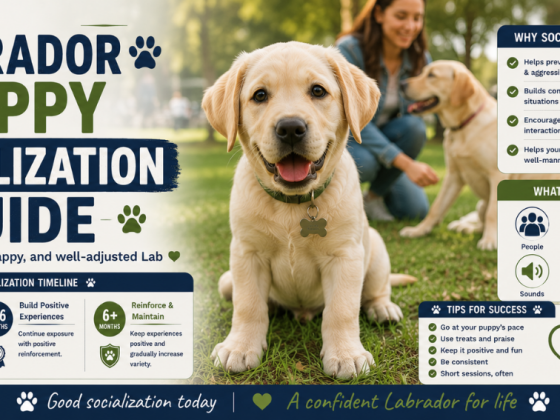
A Labrador that misses its socialization window becomes a large, strong, anxious adult, and that is a far more common outcome than a well-managed puppy catching parvo at a clean puppy class. Our Labrador puppy socialization guide covers how to fill those weeks safely.
Typical Costs and What to Expect at Each Vet Visit
Costs vary widely by region and clinic type, so treat these as broad US ranges rather than quotes. Low-cost clinics and shelter vaccine events sit well below private practice pricing.
| Item | Typical US range | Notes |
|---|---|---|
| Puppy exam fee | $50–$80 per visit | Often charged per visit on top of vaccines |
| DAP dose | $25–$50 | Three to four doses across the series |
| Rabies | $20–$40 | Sometimes discounted at public clinics |
| Leptospirosis | $25–$45 per dose | Two doses in the initial series |
| Bordetella | $25–$45 | Only if boarding, daycare or classes require it |
| Full puppy series, all in | $250–$500 | Including exams, deworming and fecal testing |
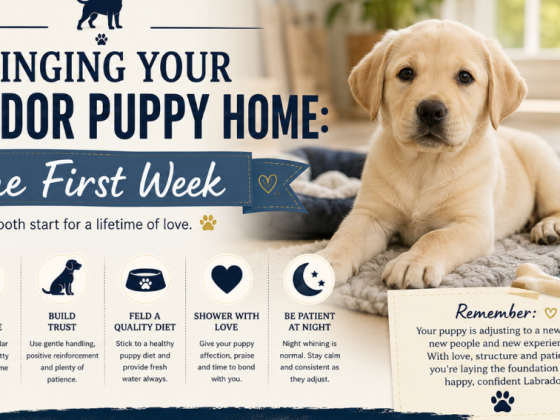
Each visit typically includes a weight check, a full physical examination, a fecal test for parasites, deworming, the scheduled vaccines, and a conversation about nutrition and behavior. Many clinics offer puppy packages that bundle the series at a lower total cost — worth asking about at the first appointment. Budget for the series before the puppy arrives, alongside the other first-year costs covered in our guide to bringing your Labrador puppy home.
Vaccine Side Effects and Reactions to Watch For
Most puppies have no reaction at all. Mild effects are common, short-lived, and not a reason to skip future doses.
Normal and expected (24–48 hours)
- Mild lethargy or sleeping more than usual
- Soreness at the injection site
- Reduced appetite for a meal or two
- A small, firm lump at the injection site that resolves over a few weeks
- Low-grade fever
- Sneezing or a mild cough for a few days after an intranasal Bordetella vaccine
Severe allergic reactions are rare but happen fast, usually within minutes to a few hours of vaccination. Seek emergency care for facial or muzzle swelling, hives or welts across the body, repeated vomiting or diarrhea, difficulty breathing, pale gums, weakness or collapse. Tell the clinic your puppy was vaccinated and when. If your puppy has had a reaction before, say so before every future vaccination — your vet can pre-medicate, split the visit across multiple appointments, or adjust the protocol.
Staying at or near the clinic for 20–30 minutes after the first vaccination of a puppy’s life is a reasonable precaution, since the most serious reactions occur in that window.
Keeping Records and Staying on Schedule
You will be asked for vaccination records more often than you expect — by boarding kennels, groomers, daycare, training classes, insurers, apartment buildings, and anyone crossing a state or international border.
- The breeder’s record of any vaccines and dewormings given before pickup
- Your clinic’s vaccination certificate listing product, date and next-due date
- The rabies certificate and tag number, kept separately — this is the one most often requested
- Photos of every document stored in your phone and backed up to cloud storage
- Calendar reminders set for each next-due date the moment you leave the clinic
- Your local licensing requirements, which usually require proof of current rabies vaccination
If a dose is delayed, call your vet rather than guessing. A short delay usually means continuing the series, while a long one may mean restarting a two-dose vaccine. What you should not do is quietly skip the final dose because your puppy “seems fine” — that dose is the one that matters most.
Once the series is complete, vaccination becomes part of a broader preventive routine alongside parasite control, weight management and the joint monitoring this breed needs. Our guide to common health issues in Labradors covers what to watch for as your dog grows, and Labrador puppy growth stages month by month maps the first year.
Vaccines are only half of a safe first few months.
Frequently Asked Questions
What vaccines does a Labrador puppy need and when?
Labrador puppies need the DAP vaccine (distemper, adenovirus, parvovirus) every 3–4 weeks from 6–8 weeks of age, with the final dose no earlier than 16 weeks. Rabies is given from 12 weeks of age, and leptospirosis — now recommended as a core vaccine — from 12 weeks with a second dose 2–4 weeks later. Non-core vaccines such as Bordetella and Lyme are added based on lifestyle and region.
At what age does my Lab puppy get its first shots?
The first DAP dose is usually given at 6–8 weeks, typically by the breeder before you collect the puppy. Your own first vet visit generally falls at 10–12 weeks for the second dose. Always bring the breeder’s records so your vet can see what has already been given.
When is a Labrador puppy fully vaccinated?
A puppy is considered fully covered by the initial series roughly one to two weeks after the final DAP dose, which must be given at 16 weeks of age or later. For most Labradors that means full protection at around 17–18 weeks. A booster of the core vaccines follows about one year afterward.
What’s the difference between core and non-core puppy vaccines?
Core vaccines are recommended for every dog regardless of lifestyle because the diseases are widespread, severe or transmissible to humans — DAP, rabies and, since the 2024 AAHA update, leptospirosis. Non-core vaccines such as Bordetella, Lyme and canine influenza are recommended selectively based on geography, travel and activities like boarding or daycare.
When can my Lab puppy safely go outside after vaccines?
Controlled socialization can begin about seven days after the first vaccine set, which is what the American Veterinary Society of Animal Behavior recommends as standard care. Your own garden, carried outings, friends’ vaccinated dogs and well-run puppy classes are appropriate early. Public dog parks, pet store floors, standing water and unknown dogs should wait until one to two weeks after the final dose at 16 weeks or later.
Why does my puppy need so many parvo shots?
Antibodies from the mother’s milk protect a puppy early but also block vaccines from working, and they fade at an unpredictable point between roughly 6 and 16 weeks. Repeated doses ensure that at least one lands after maternal antibodies have dropped. The dose given at 16 weeks or later is the most important, because interference has almost always ended by then.
Are vaccine side effects normal in Labrador puppies?
Mild lethargy, injection-site soreness, a small temporary lump, reduced appetite and a low-grade fever for 24–48 hours are common and not concerning. Facial swelling, hives, repeated vomiting, difficulty breathing, pale gums or collapse indicate a serious allergic reaction and require emergency veterinary care immediately.
What happens if I miss a puppy vaccine appointment?
Call your veterinarian rather than guessing. A short delay usually means simply continuing the series at 3–4 week intervals, while a longer gap may require restarting a two-dose vaccine. Skipping the final dose leaves the puppy incompletely protected even if it appears healthy.
Sources
- American Animal Hospital Association — 2022 Canine Vaccination Guidelines (updated 2024 to include leptospirosis as core)
- WSAVA Vaccination Guidelines Group — 2024 Guidelines for the Vaccination of Dogs and Cats
- UC Davis School of Veterinary Medicine — Vaccination Guidelines for Dogs and Cats
- American Veterinary Society of Animal Behavior — Position Statement on Puppy Socialization
- American College of Veterinary Internal Medicine — 2023 Leptospirosis Consensus Statement Update