A jumping Labrador isn’t being defiant — it’s a dog who’s genuinely thrilled you’re home and doesn’t yet have a better way to say so. That’s actually good news: you’re not fighting a behavior problem rooted in dominance or disrespect, you’re redirecting enthusiasm that’s already there into a greeting you can actually live with.
Why Labradors Jump (Excitement and Attention-Seeking)
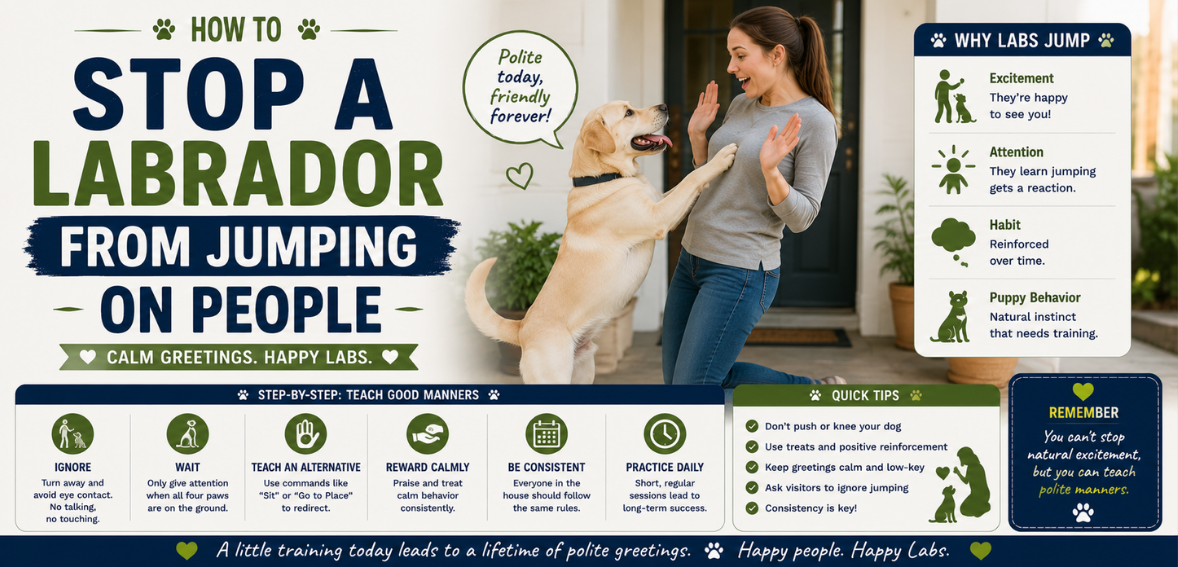
Puppies naturally greet adult dogs by reaching up toward their face, and jumping on people is simply that same instinct redirected toward a taller target. It’s reinforced early, often accidentally — a jumping puppy is small and easy to laugh off, pet, or pick up, all of which reward the exact behavior that becomes a genuine problem once the dog weighs 70 pounds. By adulthood, jumping is almost always a mix of excitement and learned attention-seeking: it works, so the dog keeps doing it.
Why Punishment and Kneeing Backfire
Kneeing a dog in the chest, stepping on their back paws, or shoving them down are outdated corrections that carry real downsides and rarely solve the problem long-term.
| What NOT to Do | Why It Backfires | What to Do Instead |
|---|---|---|
| Kneeing or pushing the dog | Risk of injury; can create fear or defensive reactions rather than teaching an alternative | Turn away and withhold attention |
| Yelling or scolding | Still counts as attention to an excited dog — often reinforces rather than discourages | Stay silent and neutral until calm |
| Pushing the dog off with hands | Can look and feel like play to a dog, encouraging more jumping | Fold arms, turn body away, no hand contact |
| Inconsistent responses | Confuses the dog about what actually works to get attention | Everyone in the household responds the same way, every time |
The core issue with physical corrections is that they don’t teach the dog what to do instead — at best, they suppress the behavior in the moment through mild discomfort or surprise, without building a reliable new habit, and at worst, they risk physical injury or a fear-based reaction that creates new problems.
The “Four on the Floor” Reward Method
- The instant all four paws are on the ground, mark it with a calm “yes” or clicker, and reward with a treat or calm praise.
- The moment a jump starts, turn away, cross your arms, and remove all attention — no eye contact, no talking, no pushing.
- Wait for four paws back on the floor, even briefly, then immediately reward that instant.
- Repeat consistently every single time your dog jumps, since occasional attention for jumping (even negative attention) will keep the behavior alive far longer than consistent removal of attention.
This works because it removes the reward jumping used to get (your attention) and clearly rewards the behavior you actually want instead.
Teaching an Incompatible Behavior (Sit-to-Greet)
A dog physically cannot sit and jump at the same time — which is exactly why teaching a rock-solid “sit to greet” is one of the most effective jumping fixes available. See our full guide to basic obedience commands every Labrador should know for how to teach sit from scratch if your dog doesn’t have it reliably yet.
- Practice sit in a calm, low-distraction setting first, building a reliable response before adding any excitement.
- Ask for a sit right as you (or a helper) approach the door, rewarding heavily for holding it as the “greeter” gets closer.
- If your dog breaks the sit to jump, the greeter should stop moving and back away slightly, only continuing once your dog resettles.
- Gradually increase the excitement level — a calm approach, then a more energetic one, then an actual door-opening scenario — always at a pace your dog can succeed at.
- Reward generously the first several dozen times a greeting goes well, since this is a genuinely hard skill to build against a strong existing habit.
Managing Greetings With a Leash and Setups
- Keep a leash near the door for real-life greetings, giving you physical ability to prevent a jump rather than only reacting after it happens
- Step on the leash (not tightly, just enough to limit vertical movement) as an interim management tool while training is still in progress
- Use a baby gate or tether to create distance during the highest-arousal moments, like the first 30 seconds after the doorbell rings
- Practice greetings in low-stakes setups before relying on the skill during genuinely exciting real arrivals
Coaching Guests and Visitors to Respond Correctly
Well-meaning guests undo training constantly, simply by petting an excited jumping dog because “it’s fine, I don’t mind.” Before anyone rings your doorbell, let them know your dog is in training and ask them to:
- Ignore the dog completely (no talking, touching, or eye contact) until all four paws are on the floor
- Turn their body away if the dog jumps, rather than stepping back and creating a game of chase
- Wait for you to cue a sit before greeting the dog directly
A quick heads-up text before they arrive works better than trying to coach someone in the moment while your dog is already jumping.
Consistency Across the Whole Household
Every single person in the house needs to respond to jumping the same way, every time, or the dog learns that jumping sometimes works — which is often enough to keep the behavior going indefinitely. Agree on the exact response (turn away, withhold attention, reward four on the floor) as a household rule before you start, not something you figure out inconsistently in the moment.
Practicing With Staged, Controlled Greetings
Real greetings — the doorbell, an actual excited arrival — are the hardest version of this skill, so practice in easier, staged versions first:
- Walk out of the room and back in, practicing calm greetings with no real excitement attached
- Have a family member step outside and knock, then come in, gradually building toward real arrival energy
- Enlist a patient friend for a low-key practice visit, coached in advance on how to respond
- Only move to real, unplanned guest arrivals once the staged versions are consistently successful
See our guides to why your Labrador might be so hyper if excitement issues extend well beyond greetings, and to clicker training basics for Labradors for a precise timing tool that can sharpen the “four on the floor” marking moment. A reliable recall also helps redirect an overexcited dog away from a greeting entirely when needed.
Frequently Asked Questions
How do I stop my Labrador from jumping on people?
Remove all attention the instant your dog jumps, and reward “four on the floor” the moment they’re calm instead. Teaching a sit-to-greet as an incompatible behavior speeds up the process significantly.
Why does my Lab jump on guests when they arrive?
Jumping is a redirected version of a puppy’s natural face-to-face greeting instinct, reinforced by attention (even negative attention) the behavior has received in the past. Guest arrivals are especially high-excitement moments that make the habit harder to control.
How do I train my dog to greet people calmly?
Teach a reliable sit-to-greet in a calm setting first, then practice it at the door with gradually increasing levels of excitement, rewarding heavily for holding the sit as visitors approach.
What’s the fastest way to stop a Labrador jumping up?
Consistency is the biggest speed factor: removing all attention for jumping and rewarding four-on-the-floor every single time, combined with staged practice sessions before relying on the skill during real, unplanned arrivals.
Should I knee my dog to stop jumping?
No. Kneeing risks injury and doesn’t teach an alternative behavior — at best it briefly suppresses jumping through discomfort, and at worst it creates fear or a defensive reaction. Removing attention and rewarding calm greetings is more effective and safer.
Want to build the training foundation this method relies on?
See our guide to basic obedience commands every Labrador should know →Sources
- Certified Professional Dog Trainer (CPDT-KA) force-free training standards
- American Kennel Club — Training Your Dog Not to Jump on People