Obesity is arguably the single most preventable major health risk facing Labrador Retrievers, and real genetics make it a harder fight for this breed than for most others. Understanding exactly why — and having a concrete way to assess and address it — puts you well ahead of where guesswork and good intentions alone would leave you.
How Common Obesity Is in Labs and the POMC Gene Link
In developed countries generally, an estimated 34–59% of pet dogs are overweight or obese. Labradors are consistently identified in genetic research as one of the most obesity-prone breeds of all, and a landmark University of Cambridge study led by Dr. Eleanor Raffan found a specific genetic explanation: roughly 23–25% of Labradors carry at least one copy of a deletion in the POMC gene, which plays a central role in hunger and energy regulation.
Dogs carrying this variant are, on average, about 1.9 kg (roughly 4 lb) heavier per copy of the gene, show measurably higher food motivation on validated behavioral testing, and burn around 25% less energy at rest than Labradors without the mutation. Strikingly, the mutation was found in 76% of Labradors specifically selected to become assistance dogs — likely because their strong food motivation makes them easier to train with food rewards, which is a fascinating trade-off between trainability and obesity risk.
How to Assess Weight (Body Condition Score, Rib and Waist Test)
Body condition scoring, not the number on a scale alone, is the standard veterinary method for assessing whether a dog is at a healthy weight, since ideal weight varies by individual frame size.
Underweight
Ribs, spine, and hip bones easily visible; minimal muscle covering; pronounced waist and tuck
Ideal
Ribs easily felt with light pressure but not visible; visible waist from above; abdominal tuck visible from the side
Overweight/Obese
Ribs difficult to feel under fat; little to no visible waist; no abdominal tuck, sometimes a sagging belly
To do the check yourself: run your hands along your dog’s ribcage with light pressure — you should feel the ribs easily, similar to the backs of your knuckles, without heavy pressing. Look from directly above for an inward waist behind the ribs, and from the side for an upward tuck from chest to abdomen. Ask your vet to confirm a body condition score at every visit as an objective cross-check.
Signs Your Labrador Is Overweight
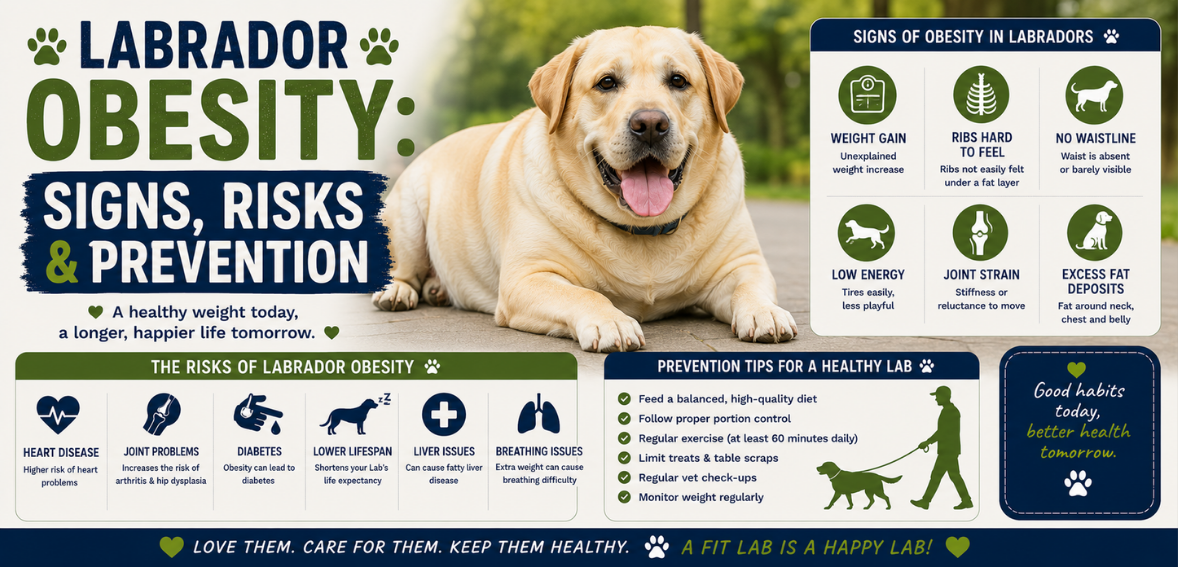
- Difficulty feeling ribs even with firm pressure
- No visible waist from above or tuck from the side
- Reduced stamina, excessive panting after mild activity
- Reluctance to jump, climb stairs, or exercise as readily as before
- Visible weight gain compared to earlier photos at the same age
Health Risks (Joint Disease, Diabetes, Shortened Lifespan, Heart/Respiratory Strain)
| Risk | How Obesity Contributes |
|---|---|
| Joint disease and arthritis | Excess weight increases mechanical stress on joints already predisposed to hip and elbow dysplasia |
| Diabetes mellitus | Obesity is a significant risk factor for insulin resistance and diabetes in dogs, as in humans |
| Shortened lifespan | The landmark Kealy et al. lifetime feeding study found lean-fed Labradors lived a median of 1.8 years longer (13.0 vs. 11.2 years) than littermates kept in heavier body condition |
| Heart and respiratory strain | Excess body fat increases cardiovascular workload and can restrict normal breathing capacity, especially during exercise or heat |
| Reduced quality of life | Lower stamina and mobility limit a dog’s ability to enjoy normal exercise and play |
Causes (Overfeeding, Treats, Neutering, Low Activity)
- Overfeeding relative to actual need: Bag feeding charts often run generous, and eyeballing portions rather than weighing food commonly leads to overfeeding
- Treats and table scraps: These can easily account for 20–30% of daily calories if not tracked, especially in a breed this responsive to training rewards
- Spaying/neutering: Metabolic rate typically drops after the procedure, meaning calorie intake usually needs to be reduced afterward to avoid weight gain
- Low activity relative to intake: A sedentary lifestyle combined with unchanged feeding amounts is one of the most common, and most fixable, causes
- The POMC gene itself: For roughly a quarter of Labradors, genuine biology — not a lack of owner discipline — is working against maintaining a lean weight, requiring stricter-than-average feeding management to compensate
Safe Weight-Loss Plan (Portion Control, Calorie Math, Diet Food)
Weight loss in dogs should be gradual — roughly 1–2% of body weight per week — and always developed with your veterinarian, who can rule out underlying medical causes and set a target weight and rate appropriate for your specific dog.
Resting Energy Requirement (RER) formula: 70 × (target body weight in kg)^0.75
Example: a Lab with a target weight of 65 lb (29.5 kg): 70 × (29.5)0.75 ≈ 903 kcal RER. For supervised weight loss, vets often start around 1.0× RER (roughly 900 kcal/day in this example) rather than the higher multipliers (1.4–1.6× RER) used for a lean, active adult at maintenance — but the right multiplier depends on your dog’s current condition, activity, and any health conditions, which is exactly why this step needs veterinary input rather than a generic online calculator.
- Weigh food with a kitchen scale, not a scoop, since cup measurements vary significantly by how kibble settles
- Consider a veterinary weight-management or therapeutic diet, formulated with higher protein and fiber to support satiety during a calorie deficit
- Count every treat toward the daily total, switching to low-calorie options like plain green beans or small amounts of carrot
- Weigh your dog every 2 weeks to track progress and adjust the plan as needed
Exercise and Feeding Routines
Pair calorie management with consistent daily exercise — see our full guide to how much exercise a Labrador needs daily for the target range by age and condition. Feed at consistent times rather than free-feeding, since a predictable schedule makes portion control and progress tracking far easier, and helps curb the begging behavior this food-motivated breed is prone to between meals.
When to Involve Your Veterinarian
- You’re unsure of your dog’s ideal target weight
- Your dog hasn’t lost weight after 4–6 weeks of a consistent, calorie-controlled plan
- You notice sudden weight gain or loss without a clear feeding change
- Your dog has any existing health condition that could affect a safe rate of weight loss
- You want to confirm dosing before starting any weight-management supplement or therapeutic food
See our full guide to common Labrador health problems for how obesity fits into the broader picture of breed-specific health risks.
Frequently Asked Questions
Is my Labrador overweight?
If you can’t easily feel the ribs with light pressure, there’s no visible waist from above, and no abdominal tuck from the side, your Labrador is likely overweight. A vet visit can confirm with an objective body condition score.
Why are Labradors so prone to obesity?
A significant genetic factor is at play: roughly 23-25% of Labradors carry a mutation in the POMC gene that increases food motivation and lowers resting energy needs, making them prone to overeating and gaining weight more easily than dogs without the mutation.
How much should I feed my Labrador to lose weight?
This depends on your dog’s target weight, current condition, and activity level, and should be set with your veterinarian using a resting energy requirement calculation. As a general framework, weight loss is typically targeted at 1-2% of body weight per week under supervision.
What health problems does obesity cause in dogs?
Obesity increases the risk of joint disease and arthritis, diabetes, heart and respiratory strain, and a measurably shorter lifespan — a landmark feeding study found lean-fed Labradors lived 1.8 years longer on average than overweight littermates.
What is a healthy weight for a Labrador Retriever?
Adult Labradors typically weigh 55-80 lb depending on sex and frame size, but body condition score matters more than a specific number on the scale — a healthy weight is one where ribs are easily felt, a waist is visible from above, and a tuck is visible from the side.
Ready to build a full feeding plan around a healthy weight?
See our complete Labrador portion guide →Sources
- Raffan, E., et al. “A Deletion in the Canine POMC Gene Is Associated with Weight and Appetite in Obesity-Prone Labrador Retriever Dogs.” Cell Metabolism, 2016.
- University of Cambridge — “Genetic variant may help explain why Labradors are prone to obesity”
- Kealy, R.D., et al. “Effects of diet restriction on life span and age-related changes in dogs.” Journal of the American Veterinary Medical Association, 2002.
- WSAVA (World Small Animal Veterinary Association) — Body Condition Score Chart
- VCA Animal Hospitals — Obesity in Dogs