Hip dysplasia is one of the most common orthopedic conditions in Labrador Retrievers, and it’s manageable in the vast majority of cases when caught and treated appropriately. This guide covers what it actually is, how to recognize it early, how vets diagnose it, and the full range of non-surgical and surgical treatment options available today.
What Hip Dysplasia Is and Why Labs Are Predisposed
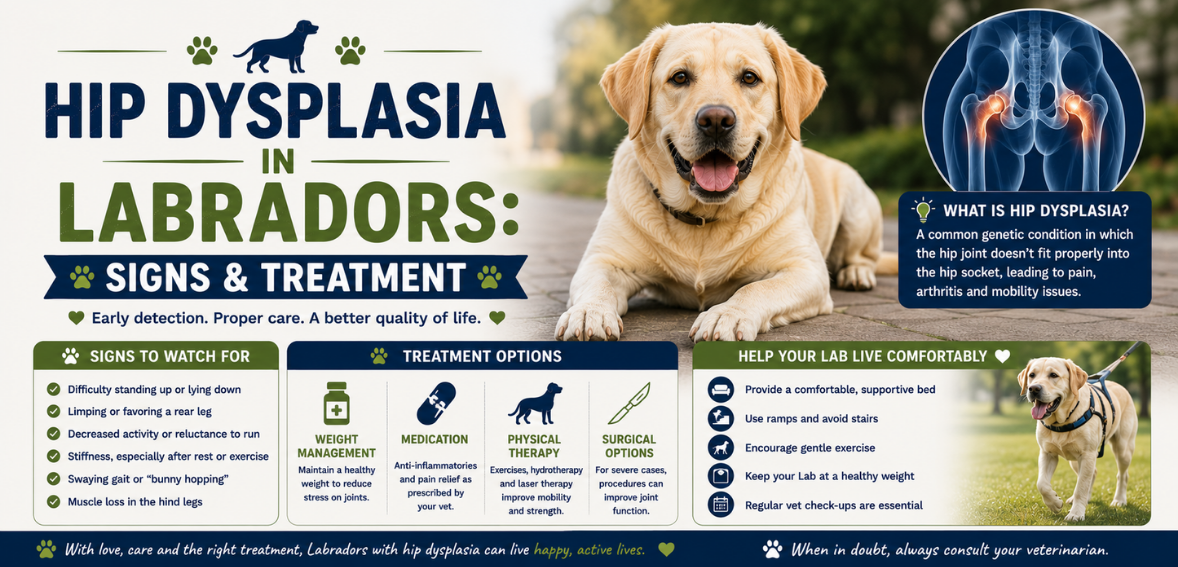
Hip dysplasia is a developmental condition in which the ball-and-socket hip joint doesn’t fit or grow together properly, leading to abnormal joint looseness (laxity), grinding, and progressive osteoarthritis over time. It’s fundamentally a mismatch between the femoral head (the “ball”) and the acetabulum (the “socket”), and it typically develops during a puppy’s growth period rather than being present at birth.
Labradors are among the breeds most predisposed to hip dysplasia due to a combination of genetics and their large, fast-growing body type. OFA data indicates roughly 12–15% of AKC-registered Labradors show some degree of hip dysplasia — a meaningfully higher rate than the general dog population.
Early and Advanced Symptoms (Bunny Hopping, Stiffness, Limping)
Symptoms can appear as early as 5 months old in severe cases, though many dogs don’t show obvious signs until middle age when osteoarthritis has progressed further.
- Early signs: A “bunny hopping” gait (moving both back legs together when running), stiffness after rest, reluctance to jump into the car or onto furniture, and a subtle decrease in exercise tolerance
- Progressing signs: Visible limping, difficulty rising from lying down, a swaying or “loose” hip movement, and audible grinding or clicking from the hip
- Advanced signs: Significant muscle loss in the hind legs, marked reluctance to walk or exercise, and visible pain when the hip is touched or manipulated
Any bunny-hopping gait, persistent stiffness after rest, reluctance to jump or climb stairs, or any limping lasting more than a day or two. Early diagnosis significantly widens the range of effective treatment options, including joint-preserving surgeries only available in young puppies.
Causes and Risk Factors (Genetics, Growth Rate, Weight)
- Genetics: The single biggest risk factor; dogs with a family history of hip dysplasia are significantly more likely to develop it themselves, which is exactly why OFA/PennHIP screening of breeding stock matters.
- Growth rate: Puppies that grow rapidly during the first year — often from overfeeding or excess calories — develop more severe joint conformation abnormalities than genetically similar puppies grown at a moderate pace, since bone growth outpaces cartilage and muscle development.
- Body weight: Excess weight at any age increases mechanical stress on already-vulnerable joints and accelerates the progression of arthritis in dogs who already have hip dysplasia.
- Exercise during growth: High-impact activity (forced long runs, repetitive jumping) during the puppy growth period can stress developing joints, though normal, moderate puppy activity is not itself a cause.
How Vets Diagnose It (X-ray, OFA, PennHIP)
| Method | How It Works | Typical Age |
|---|---|---|
| Physical exam | Vet manipulates the hip joint to check for pain, laxity, and range of motion (e.g., the Ortolani sign for looseness) | Any age |
| Standard X-ray | Visualizes joint conformation and any existing arthritic changes | Any age when symptomatic |
| OFA hip evaluation | A standardized X-ray view scored as Excellent, Good, Fair, Borderline, Mild, Moderate, or Severe | Final certification at 24 months; preliminary reads earlier |
| PennHIP evaluation | Measures a “distraction index” quantifying joint laxity, which can predict dysplasia risk earlier and more precisely than standard OFA films | Can be performed as early as 16 weeks |
PennHIP’s earlier screening window matters clinically: predisposed or symptomatic puppies should ideally be evaluated for hip laxity before 20 weeks of age, since several of the most effective joint-preserving surgeries are only available within a narrow early window.
Non-Surgical Management (Weight, Physio, Joint Supplements, NSAIDs)
Conservative management can meaningfully maintain quality of life for many dogs, particularly those with mild to moderate disease, with published success rates around 50–60% for avoiding surgery altogether. It is not a substitute for veterinary diagnosis and should always be built under your vet’s guidance.
- Weight management: Keeping a dog lean is one of the single most effective interventions, directly reducing joint stress.
- Physical therapy: Controlled exercises like swimming and underwater treadmill work build supporting muscle without high joint impact.
- Joint supplements: Glucosamine, chondroitin, and omega-3 fatty acids are commonly recommended, though evidence of benefit is more modest than for weight management; discuss appropriate products and dosing with your vet.
- NSAIDs and pain management: Veterinary-prescribed anti-inflammatory medications can meaningfully reduce pain and improve mobility, but require veterinary supervision due to potential side effects, particularly with long-term use.
None of these should be started, especially NSAIDs or supplements at meaningful doses, without your vet confirming the diagnosis and appropriate plan first.
Surgical Options (FHO, THR, JPS, TPO)
| Procedure | Best Candidate | Typical Cost (Per Hip) | Reported Outcomes |
|---|---|---|---|
| Juvenile Pubic Symphysiodesis (JPS) | Puppies with mild-moderate laxity, ideally 12–16 weeks old, no later than ~20 weeks | $1,000–$5,000 | Reduces future dysplasia signs; most effective the earlier it’s done |
| Double/Triple Pelvic Osteotomy (DPO/TPO) | Young dogs under about 8–10 months, no arthritis yet | $3,000–$6,000 | 86–92% achieve normal or near-normal limb function |
| Femoral Head Ostectomy (FHO) | Any age; better suited to smaller/lighter dogs, used in larger dogs when THR isn’t accessible | $1,200–$3,000 | ~63% good-to-excellent outcomes; relieves pain but doesn’t restore normal joint function |
| Total Hip Replacement (THR) | Dogs at least 1 year old with arthritis; considered the gold standard for large breeds like Labradors | $3,500–$7,000+ | 80–98% return to normal limb function |
All-in treatment costs — including diagnostics, surgery, and post-operative care — commonly range from roughly $4,000 to $14,500+ depending on the procedure and region. The right option depends heavily on your dog’s age, weight, arthritis severity, and activity goals, which is why a board-certified veterinary surgeon’s input matters more than any general chart. The American College of Veterinary Surgeons (ACVS) is a good resource for finding a qualified specialist.
Prognosis and Long-Term Care
Most Labradors with hip dysplasia, whether managed medically or surgically, can go on to lead good-quality lives. Prognosis depends heavily on severity at diagnosis, how early treatment begins, and consistency with weight management and activity modification over the dog’s lifetime. Regular veterinary follow-up, ongoing weight monitoring, and adapting exercise type (favoring swimming over repetitive high-impact activity) all support long-term comfort regardless of which treatment path is chosen.
See our guide to caring for a senior Labrador for how joint management priorities shift as dogs age, and our Labrador obesity guide for weight management strategies directly relevant to joint health.
Prevention and Screening Before Breeding
- OFA or PennHIP evaluation of both parents before breeding is the single most impactful prevention step, since genetics is the leading risk factor
- Ask breeders for actual hip scores and registration numbers, verifiable on the OFA public database, not just verbal assurance of “good hips”
- Feed a large-breed puppy formula with controlled calcium and phosphorus to support moderate, steady growth rather than rapid growth spurts
- Avoid high-impact exercise during the puppy growth period, favoring controlled, moderate activity instead
- Maintain lean body condition throughout your dog’s life, since this is one of the few risk factors fully within an owner’s control after adoption
See our full guide to common Labrador health problems for how hip dysplasia fits into the broader picture of breed-specific health, and our guide to elbow dysplasia in Labradors, a related orthopedic condition with similar genetic and growth-related risk factors.
Frequently Asked Questions
What are the early signs of hip dysplasia in Labradors?
Early signs include a “bunny hopping” gait when running, stiffness after rest, reluctance to jump or climb stairs, and a subtle decrease in exercise tolerance. These can appear as early as 5 months in severe cases.
How is hip dysplasia in dogs treated?
Treatment ranges from conservative management (weight control, physical therapy, joint supplements, and vet-prescribed NSAIDs) to surgical options including JPS, TPO, FHO, and total hip replacement, chosen based on the dog’s age, severity, and activity goals.
At what age does hip dysplasia show up in Labs?
Symptoms can appear as early as 5 months old in severe cases, though many dogs don’t show obvious signs until middle age as osteoarthritis progresses. Predisposed puppies can be screened for hip laxity via PennHIP as early as 16 weeks.
Can a Labrador live a normal life with hip dysplasia?
Yes, in most cases. With appropriate management — whether conservative or surgical — the large majority of Labradors with hip dysplasia maintain a good quality of life, especially when the condition is caught and treated early.
How much does hip dysplasia surgery cost for a dog?
Costs vary by procedure: roughly $1,000–$5,000 for JPS, $3,000–$6,000 for TPO, $1,200–$3,000 for FHO, and $3,500–$7,000+ for total hip replacement, per hip. All-in treatment costs including diagnostics and post-operative care commonly range from about $4,000 to $14,500 or more.
Sources
- American College of Veterinary Surgeons (ACVS) — Canine Hip Dysplasia
- Cornell University College of Veterinary Medicine — Canine Hip Dysplasia (CHD)
- Orthopedic Foundation for Animals (OFA) — Hip Dysplasia Statistics by Breed
- VCA Animal Hospitals — Hip Dysplasia in Dogs
- PennHIP — Distraction Index Evaluation Methodology