
If you’ve ever wondered why the Labrador Retriever spent three decades as America’s favorite dog, you don’t need to look far. Labs are the breed equivalent of a reliable friend: steady, easygoing, and genuinely happy to see everyone — the mail carrier included. But “popular” doesn’t automatically mean “right for your household,” and a lot of new owners are surprised by just how much dog a Labrador actually is, especially in the first two or three years.
This guide covers everything a prospective or new Lab owner needs to know — history, physical traits, temperament, exercise and training demands, health and lifespan, grooming, and an honest look at whether the breed fits your lifestyle. Where a topic deserves a deeper dive, we’ve linked out to our full guides.
Labrador Retriever at a Glance
Before we get into detail, here’s the breed at a glance — the numbers and traits most people search for first.
| Trait | Details |
|---|---|
| Breed Group | AKC Sporting Group (recognized 1917) |
| Origin | Newfoundland, Canada |
| Height | 22.5–24.5 in (male), 21.5–23.5 in (female) |
| Weight | 65–80 lb (male), 55–70 lb (female) |
| Lifespan | 11–13 years |
| Coat | Short, dense, water-resistant double coat |
| Colors | Black, yellow, chocolate |
| Temperament | Friendly, outgoing, eager to please |
| Exercise Needs | High — 60–90 minutes daily |
| Trainability | Very high; food and retrieve-motivated |
| Good With Kids | Excellent, with supervision as a boisterous puppy |
| Shedding | Heavy, year-round, with biannual coat “blows” |
| AKC Popularity (2025) | No. 2 of 202 registered breeds |
History and Original Purpose
Despite the name, the Labrador Retriever didn’t originate in Canada’s Labrador region — it developed in Newfoundland in the 1700s and 1800s, descended from the now-extinct St. John’s water dog. These small, hardy dogs worked alongside fishermen, hauling in nets, retrieving fish that slipped the line, and swimming through frigid Atlantic water for hours at a stretch. That working history is exactly why modern Labs have webbed feet, an otter-like tail that acts as a rudder, and a coat built to shed water rather than absorb it.
English nobility — most notably the Earl of Malmesbury and the Duke of Buccleuch — imported the dogs to Britain in the early 1800s and refined the breed for upland and waterfowl hunting. The UK Kennel Club recognized the Labrador Retriever in 1903, and the American Kennel Club followed in 1917. From there, the breed’s working versatility carried it into new roles throughout the 20th century: messenger dogs in WWII, and later guide dogs, search-and-rescue dogs, explosive and narcotics detection dogs, and therapy and service dogs.
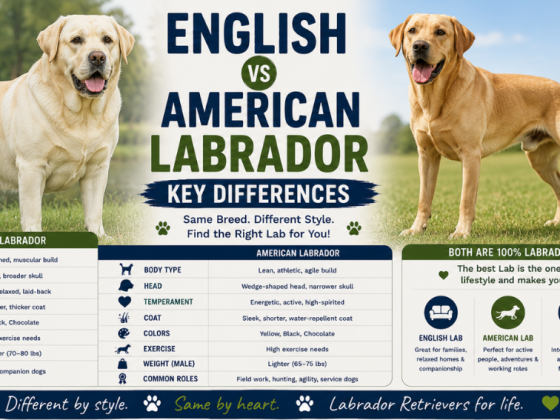
Today’s Labradors are generally split into two loose types. American (field) lines tend to be leaner, longer-legged, and higher-energy, bred for hunting and field trial work. English (show/bench) lines are stockier, with a blockier head and calmer disposition, bred more toward the conformation ring and companion life. Most family pets fall somewhere between the two, but it’s worth asking a breeder which lines a puppy comes from if you have a strong preference for energy level.
If you’re choosing between a field-line and show-line Lab as a first-time owner, show-line dogs are usually the gentler introduction — field lines are wonderful but often need a genuinely active household to stay balanced.
Physical Characteristics and Colors
The Labrador Retriever is a medium-to-large, athletically built dog designed for endurance rather than speed. Males typically stand 22.5–24.5 inches at the shoulder and weigh 65–80 pounds; females run slightly smaller, at 21.5–23.5 inches and 55–70 pounds. The breed’s defining physical features include a broad skull, kind, expressive eyes, a thick “otter tail” that never stops wagging, and a short, straight, dense double coat with a soft, weather-resistant undercoat.
The AKC recognizes exactly three Labrador colors:
- Black — the original and most common color, solid and glossy
- Yellow — ranges from pale cream to a deep fox-red
- Chocolate — ranges from light milk-chocolate to dark brown
A small white spot on the chest is permitted but not preferred, and any other color or color combination disqualifies a dog from AKC conformation showing (it doesn’t affect the dog’s health or suitability as a pet). Color is purely cosmetic — there’s no meaningful difference in temperament between a black, yellow, or chocolate Lab, despite persistent myths to the contrary.
Temperament and Personality
Labradors are, almost without exception, outgoing, sociable, and eager to please — traits the AKC breed standard specifically calls for and actively penalizes shyness or aggression against in the show ring. This isn’t an accident of popularity; it’s a temperament that was deliberately bred in, since a hunting retriever that startled at gunfire or bit the birds it retrieved would be useless in the field.
That friendliness comes with a strong food drive. Labradors as a breed carry a higher rate of a POMC gene mutation linked to increased appetite and slower satiety signaling, which is part of why the breed struggles with obesity more than most. Many longtime Lab owners will tell you the same thing: a Labrador’s nose runs their day, and a countertop within reach is a countertop that will eventually be raided.
Labs are also famously mouthy, especially as puppies and adolescents — a legacy of the “soft mouth” retrieving instinct bred for carrying game undamaged. This usually shows up as chewing, carrying objects around the house, and gentle mouthing during play, rather than aggression. It responds well to redirection and training, but owners who aren’t prepared for it are often caught off guard.
One thing that surprises a lot of new owners: physical maturity and mental maturity don’t arrive together. A Lab can look like a full-grown adult dog well before the boisterous, easily distracted puppy brain settles down — most Labs don’t fully mature in temperament until somewhere between two and three years old.
Exercise and Training Needs
As a working retriever breed, the Labrador needs real daily exercise — not just a walk around the block. Most adult Labs do best with 60 to 90 minutes of activity a day, split between physical exercise (walks, runs, swimming, fetch) and mental stimulation (training games, puzzle feeders, scent work). Under-exercised Labs are far more likely to develop destructive habits like chewing furniture, digging, or excessive barking.
| Life Stage | Typical Daily Exercise | Notes |
|---|---|---|
| Puppy (2–6 months) | Short, frequent sessions | Avoid forced running or jumping while joints develop |
| Adolescent (6–24 months) | 60–90+ minutes | Peak energy; structured training pays off here |
| Adult (2–8 years) | 45–90 minutes | Swimming and fetch are ideal low-impact options |
| Senior (8+ years) | 20–45 minutes | Shorter, gentler sessions; watch for joint stiffness |
On the training side, few breeds are more rewarding. Labradors are consistently ranked among the most trainable breeds thanks to their intelligence and food motivation, which makes positive reinforcement methods especially effective — a Lab will happily repeat a behavior for a piece of kibble. This is also why the breed dominates guide dog, detection dog, and service dog programs worldwide.
Start basic obedience and recall training the day your Lab puppy comes home. Their food drive is a training asset, but it fades in usefulness if you wait until bad habits — like jumping or counter-surfing — are already established.
Health and Lifespan
Labrador Retrievers typically live 11 to 13 years and are a generally healthy, robust breed, but they’re predisposed to several conditions that responsible owners should watch for and that responsible breeders should screen against.
- Hip and elbow dysplasia — malformation of the joints that can lead to arthritis; screened via OFA or PennHIP evaluations in breeding stock
- Obesity — the breed’s biggest everyday health risk, linked partly to the POMC gene mutation and worsened by their food motivation
- Exercise-induced collapse (EIC) — a genetic condition causing weakness or collapse after intense exercise; a DNA test is available
- Progressive retinal atrophy (PRA) — an inherited eye condition leading to gradual vision loss
- Ear infections — the breed’s floppy ears and love of swimming create a warm, moist environment bacteria and yeast thrive in
- Gastric dilatation-volvulus (bloat) — a life-threatening emergency more common in deep-chested breeds; feeding smaller meals and avoiding vigorous exercise right after eating reduces risk
When choosing a puppy, ask the breeder for OFA (Orthopedic Foundation for Animals) hip and elbow certifications, plus eye and EIC clearances on both parents. These don’t guarantee a healthy dog, but they meaningfully reduce the odds of inherited conditions.
Grooming and Shedding
Labradors are low-maintenance in terms of styling — no haircuts, no trims — but they shed a genuinely surprising amount for a short-coated breed. That dense double coat sheds lightly year-round and then “blows” heavily twice a year, typically in spring and fall, when the undercoat releases in large clumps.
- Brushing: Once or twice weekly normally; daily during seasonal coat blows
- Bathing: Every 6–8 weeks, or as needed — overbathing strips the natural water-resistant oils
- Ears: Check and dry weekly, especially after swimming, to prevent infection
- Nails: Trim every 3–4 weeks, or as soon as you hear them click on hard floors
- Teeth: Brush several times a week to prevent dental disease
Is a Labrador Right for You?
Labradors are wonderful family dogs, but “popular” and “easy” aren’t the same thing. Here’s a balanced look at what you’re signing up for.
Reasons Labs Work Well For Families
- Gentle, patient temperament around children
- Highly trainable and food-motivated
- Sociable with other dogs and strangers
- Versatile — hiking companion or couch companion
- Well-documented breed with predictable traits
Things to Plan For
- High daily exercise requirement, especially years 1–3
- Heavy, year-round shedding
- Strong food drive can lead to obesity if unmanaged
- Mouthy, boisterous adolescent phase
- Not naturally suited to small apartments without a real exercise plan
Are Labradors good for first-time owners? Generally, yes — their eagerness to please and responsiveness to training make them one of the more forgiving breeds to learn on, provided you’re realistic about the exercise commitment. They tend to be a poor match for households that are away 10+ hours a day with no exercise plan, or for owners who want a low-energy, low-shedding dog.
If the breed sounds right for you, our deeper guides can help with the next step: finding a reputable breeder or rescue, preparing for a new Labrador puppy, and managing feeding and weight from day one.
Frequently Asked Questions
What do I need to know before getting a Labrador Retriever?
Plan for 60–90 minutes of daily exercise, heavy year-round shedding, a strong food drive that needs weight management, and a boisterous, mouthy adolescent phase lasting into their second or third year. Budget for regular vet care and joint- and eye-health screening if buying from a breeder.
Are Labradors good for first-time dog owners?
Yes, in most cases. Their eagerness to please and strong food motivation make them responsive to positive-reinforcement training, which is forgiving for new owners. The main requirement is a genuine, ongoing commitment to daily exercise and mental stimulation.
What are the pros and cons of owning a Labrador?
Pros include a gentle temperament, high trainability, and sociability with people and other dogs. Cons include heavy shedding, a high exercise requirement, a tendency toward obesity, and a lengthy, energetic puppy-to-adult transition.
Is a Labrador Retriever a good family dog?
Yes — Labradors are consistently rated among the best family breeds for their patience with children, stable temperament, and sociability, provided the family can meet their exercise and training needs.
What is a Labrador Retriever like as a pet?
Friendly, energetic, and deeply food-motivated, with a strong desire to be near their people. Labs thrive as active family companions, service dogs, and hunting partners, and generally struggle with being left alone for long stretches without exercise.
Sources
- American Kennel Club — Official Standard for the Labrador Retriever
- American Kennel Club — Most Popular Dog Breeds (2025 registration statistics)
- American Kennel Club — “Is the Labrador Retriever the Right Dog Breed for You?”
- VCA Animal Hospitals — Hip Dysplasia in Dogs
- Orthopedic Foundation for Animals (OFA) — Labrador Retriever Health Testing Requirements
- Raffan, E., et al. “A Deletion in the Canine POMC Gene Is Associated with Weight and Appetite in Obesity-Prone Labrador Retriever Dogs.” Cell Metabolism, 2016.