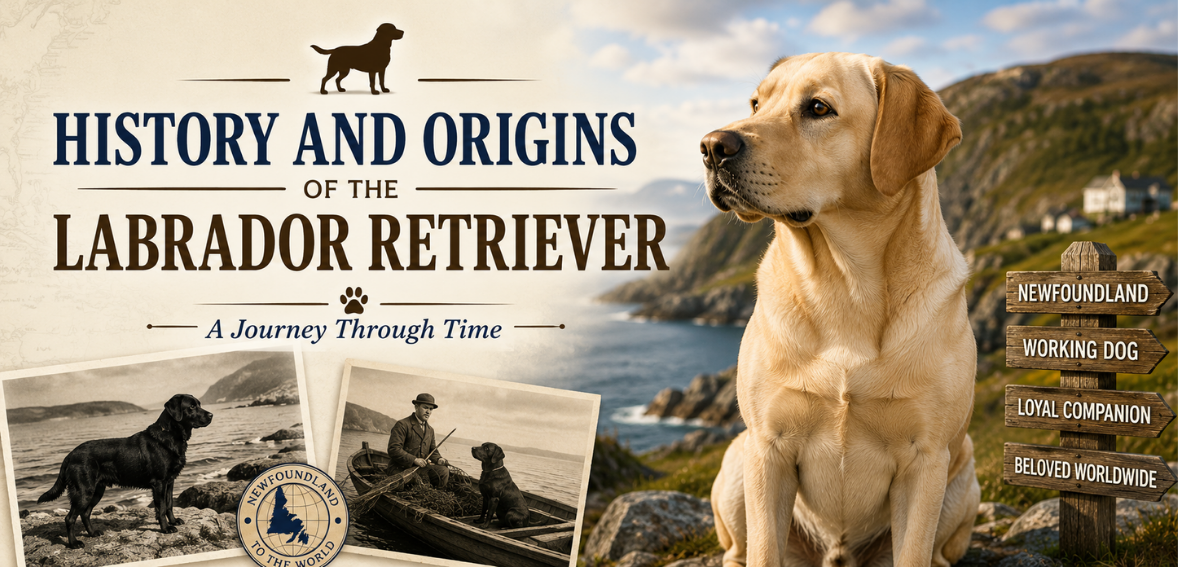
It’s one of the most common points of confusion in the dog world: the Labrador Retriever isn’t from Labrador at all. The breed’s real birthplace is Newfoundland — a different Canadian region entirely — and its journey from working fisherman’s dog to the world’s most beloved family companion runs through English country estates, a near-extinction of its ancestor breed, and a naming decision nobody can fully explain to this day.
This article traces that documented history in order, from the extinct dog that started it all to the kennel club recognitions that made “Labrador Retriever” official. For the breed as it exists today, see our full Labrador Retriever breed guide and the official Labrador breed standard.
- The St. John’s Water Dog Ancestor
- Newfoundland Fishing Origins
- How the Breed Came to England
- The Malmesbury and Buccleuch Kennels
- Why the Name Says Labrador, Not Newfoundland
- Kennel Club Recognition (UK 1903, AKC 1917)
- Evolution into a Modern Companion and Working Dog
- Key Milestones Timeline
- Frequently Asked Questions
The St. John’s Water Dog Ancestor
Every Labrador alive today traces back to a breed that no longer exists: the St. John’s water dog. Developed by European settlers and fishermen in Newfoundland’s coastal outports, likely from a mix of English, Irish, and Portuguese working dog stock, the St. John’s water dog was built for cold-water retrieving work — a dense, water-resistant coat, webbed feet, and a thick, rudder-like tail.
Historical accounts describe two coat lengths within the breed: a shorter-coated variety that became the direct ancestor of the modern Labrador, and a longer-coated variety believed to be behind other retriever breeds, including the Flat-Coated and Golden Retriever. Some period texts also referred to the smaller St. John’s dog as the “lesser Newfoundland,” to distinguish it from the much larger Newfoundland dog that was already gaining fame in Britain as a working and companion breed.
Newfoundland Fishing Origins
The St. John’s water dog wasn’t bred for looks or companionship — it was a working partner for Newfoundland’s fishing families. Dogs hauled in fishing lines and nets, retrieved fish that slipped free, and ferried gear between boats and shore, often swimming for hours in the frigid waters of the Grand Banks.
Breed histories record one especially vivid account: a St. John’s dog named “Brandy,” imported by the 5th Duke of Buccleuch, reportedly leapt from the ship’s deck mid-Atlantic to retrieve a crew member’s cap and swam for roughly two hours before he could be pulled back aboard — and was later revived with a dose of the drink he was named after. Whether or not every detail survives intact after a century of retelling, the story captures exactly the kind of stamina and retrieving drive the breed was prized for.
The Labrador’s love of water, retrieving instinct, and “soft mouth” (carrying items without damaging them) aren’t quirks — they’re direct inheritances from a working dog bred to retrieve fish undamaged in dangerous conditions.
How the Breed Came to England
St. John’s water dogs began arriving in England in the early 1800s aboard trading ships running between Newfoundland and the port of Poole, in Dorset. The 2nd Earl of Malmesbury, whose estate sat just outside Poole, was hunting with imported St. John’s dogs by 1809, recognizing them as ideal companions for waterfowl shooting.
Once in England, the imported dogs were crossed with existing British hunting breeds, and breeding programs remained largely the domain of the landed aristocracy — importing dogs from Newfoundland and maintaining kennels required resources few others had. This is why so much of the breed’s early history is tied to a small handful of noble families rather than widespread ownership.
The Malmesbury and Buccleuch Kennels
Two family lines did more than any others to secure the Labrador Retriever’s future. In England, the 2nd Earl of Malmesbury’s kennel passed to his son, the 3rd Earl, who continued breeding and documenting the dogs. In Scotland, the 10th Earl of Home, the 5th Duke of Buccleuch, and Lord John Scott independently imported St. John’s dogs during the 1830s for their own waterfowl shoots.
For decades, the two kennels developed in parallel, unaware their dogs shared the same ancestry. That changed in 1885, when the 5th Duke of Buccleuch attended a shoot at the Malmesbury estate and noticed the resemblance between his own dogs and the 3rd Earl’s. The Earl gave the Duke two young males — later named Buccleuch Ned and Buccleuch Avon — bred from two of his dogs, Malmesbury Tramp and Malmesbury June, both born in 1878. Those two dogs, crossed into the Buccleuch line, are considered the direct foundation of the modern Labrador Retriever. Every chocolate Labrador alive today can trace its lineage back to this same trio: Buccleuch Avon, Malmesbury Tramp, and Malmesbury June.
Why the Name Says Labrador, Not Newfoundland
The obvious name for the breed — “Newfoundland” — was already taken by the much larger Newfoundland dog, a distinct working breed used mainly for hauling. The smaller fisherman’s dog needed its own name to avoid confusion, and “Labrador” is the one that stuck, even though the region of Labrador sits north of Newfoundland and has no clear direct connection to the breed’s development.
The earliest known print use of “Labrador” to describe the breed appears in 1814, in Peter Hawker’s book Instructions to Young Sportsmen, and the name resurfaces in the title of an 1823 painting by artist Edwin Landseer. The 2nd Earl of Malmesbury is widely credited with popularizing the name among sporting circles, and in an 1887 letter to the Duke of Buccleuch, the 3rd Earl of Malmesbury confirmed the family’s preference, writing that they had “always call[ed] mine Labrador dogs” and describing the breed’s distinctive water-resistant coat and otter-like tail.
Exactly why “Labrador” won out is still debated among breed historians. Leading theories include the dogs’ geographic association with the wider Labrador coast and fishing trade of the era, and a possible link to the Portuguese word lavradore, meaning “worker” or “farmer.” No single explanation is definitively proven — which means the breed has carried a slightly mismatched name for over two centuries.
Kennel Club Recognition (UK 1903, AKC 1917)
Formal recognition came decades after the breed had already taken shape. The Kennel Club in the United Kingdom officially recognized the Labrador Retriever as a distinct breed in 1903, giving breeders a formal standard to work toward for the first time. The American Kennel Club followed in 1917, placing the Labrador in its Sporting Group — the category reserved for dogs bred to work alongside hunters in the field.
These recognitions mattered beyond paperwork: they gave the Labrador a documented, protected identity separate from the general pool of “retriever” and “water dog” types that had been loosely interbred throughout the 1800s.
Evolution into a Modern Companion and Working Dog
Once formally recognized, the Labrador’s versatility carried it far beyond the hunting field. The breed served as a messenger dog during the Second World War, and in the decades that followed became the backbone of guide dog, search-and-rescue, and detection dog programs around the world — a direct result of the trainability and stable temperament English breeders had spent a century reinforcing.
That same versatility fueled the Labrador’s rise as a family pet through the second half of the 20th century, eventually making it the AKC’s most-registered breed for 31 consecutive years, from the early 1990s until 2021. The breed’s original ancestor was not so fortunate: heavy dog taxation in Newfoundland aimed at protecting the sheep farming industry, combined with the decline of traditional outport fishing communities through the 20th century, drove the St. John’s water dog to extinction. The last known individuals of the breed died out by the early 1980s — meaning the dog that gave the world the Labrador Retriever didn’t survive to see just how far its descendants would go.
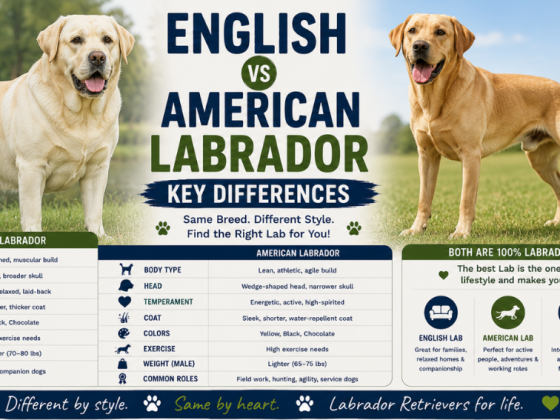
Today’s Labradors are generally grouped into English (show) and American (field) types, reflecting the split between the conformation-focused and working-dog breeding traditions established in the 1800s. See our guide to English vs. American Labrador differences for how that history still shapes the breed’s build and energy level today, and our guide to Labrador temperament and personality traits for how these working origins show up in the modern family dog.
Key Milestones Timeline
| Date | Milestone |
|---|---|
| 1700s–1800s | St. John’s water dog develops in Newfoundland’s fishing outports |
| 1809 | 2nd Earl of Malmesbury hunts with imported St. John’s dogs near Poole, Dorset |
| 1814 | Earliest known print use of “Labrador” for the breed, in Peter Hawker’s Instructions to Young Sportsmen |
| 1823 | Edwin Landseer painting references the “Labrador” dog |
| 1830s | Earl of Home, Duke of Buccleuch, and Lord John Scott import St. John’s dogs to Scotland |
| 1878 | Malmesbury Tramp and Malmesbury June born — future foundation dogs |
| 1885 | Malmesbury and Buccleuch kennels discover shared bloodlines; Buccleuch Ned and Buccleuch Avon sent to Scotland |
| 1887 | 3rd Earl of Malmesbury’s letter documents the “Labrador dogs” name and breed traits |
| 1903 | The Kennel Club (UK) officially recognizes the Labrador Retriever |
| 1917 | American Kennel Club recognizes the Labrador Retriever |
| Early 1980s | The St. John’s water dog becomes extinct in Newfoundland |
| 1991–2021 | Labrador holds AKC’s No. 1 most-registered breed spot for 31 consecutive years |
| 2022–present | French Bulldog takes over the No. 1 spot; Labrador ranks No. 2 |
Frequently Asked Questions
Where do Labrador Retrievers come from?
Labrador Retrievers descend from the St. John’s water dog, a fisherman’s working dog developed in Newfoundland, Canada. English aristocrats imported and refined the breed from the early 1800s onward.
Why are Labradors called Labradors if they came from Newfoundland?
The name “Newfoundland” was already used for a separate, larger breed, so the smaller fisherman’s dog needed its own name. “Labrador” first appeared in print in 1814 and was popularized by the Earl of Malmesbury, though historians still debate exactly why that specific name was chosen.
What breed did the Labrador descend from?
The Labrador descends from the St. John’s water dog, sometimes called the “lesser Newfoundland,” a now-extinct working breed from Newfoundland’s fishing communities.
When were Labrador Retrievers first recognized as a breed?
The Kennel Club in the United Kingdom recognized the Labrador Retriever in 1903. The American Kennel Club followed in 1917.
What were Labradors originally bred to do?
They were originally bred to help Newfoundland fishermen haul nets and lines and retrieve fish that slipped free in icy coastal waters, later being refined in England as waterfowl-retrieving gun dogs.
Sources
- American Kennel Club — “Labrador Retriever History”
- The Kennel Club (UK) — Breed recognition records
- CBC News — “This extinct N.L. dog is the ancestor of all modern retrievers”
- Wolters, Richard A. The Labrador Retriever: The History… The People. 1981.
- Hawker, Peter. Instructions to Young Sportsmen. 1814.