When I house trained my own Lab, the biggest lesson wasn’t some clever trick — it was that a schedule beats intuition every time. Labradors are smart and genuinely eager to get it right, and their strong food motivation makes positive reinforcement work fast once you’re consistent. The puppies who struggle longest are usually the ones whose owners are waiting for signals rather than working a set schedule.
This guide covers exactly when to start, how much bladder control to realistically expect at each age, and how to build a schedule that gets most Labs reliably house trained well before the six-month mark.
- When to Start House Training
- Puppy Bladder Control by Age
- Setting Up a Consistent Potty Schedule
- Choosing and Using a Designated Potty Spot
- Reward Timing and Positive Reinforcement
- Supervision, Confinement, and the Crate
- Cleaning Accidents to Remove Scent Markers
- Troubleshooting Regression and Common Mistakes
- Frequently Asked Questions
When to Start House Training a Lab Puppy
Start the moment your puppy comes home, typically around 8 weeks old. There’s no benefit to waiting — young puppies are already forming habits and associations from day one, and the earlier a consistent routine begins, the faster it sticks. At 8 weeks, expect this to be mostly about managing the puppy’s environment and schedule rather than the puppy fully “understanding” the concept; real, deliberate control comes a bit later as their bladder and muscles mature.
Understanding Puppy Bladder Control by Age
A widely used veterinary and trainer rule of thumb: a puppy can hold its bladder for roughly one hour per month of age, plus one — up to an adult maximum of around 8 hours. Use this as a planning guide, not a strict limit to push toward.
| Age | Approximate Bladder-Hold Time | Notes |
|---|---|---|
| 8–10 weeks | 1–2 hours | Frequent breaks needed; expect several accidents as normal |
| 3 months | 3–4 hours | Middle-of-the-night break usually still needed |
| 4 months | 4–5 hours | Daytime schedule becomes more predictable |
| 5 months | 5–6 hours | Many puppies begin sleeping through the night |
| 6 months | 6–7 hours | Most Labs are reliably house trained by this age |
| 7–8+ months | Up to 8 hours (adult range) | Full bladder maturity for most dogs |
Treat these numbers as what your puppy can manage under stress, not a target to routinely stretch toward. A puppy that’s forced to hold it right up to their limit regularly is far more likely to have accidents and to develop anxiety around holding it.
Setting Up a Consistent Potty Schedule
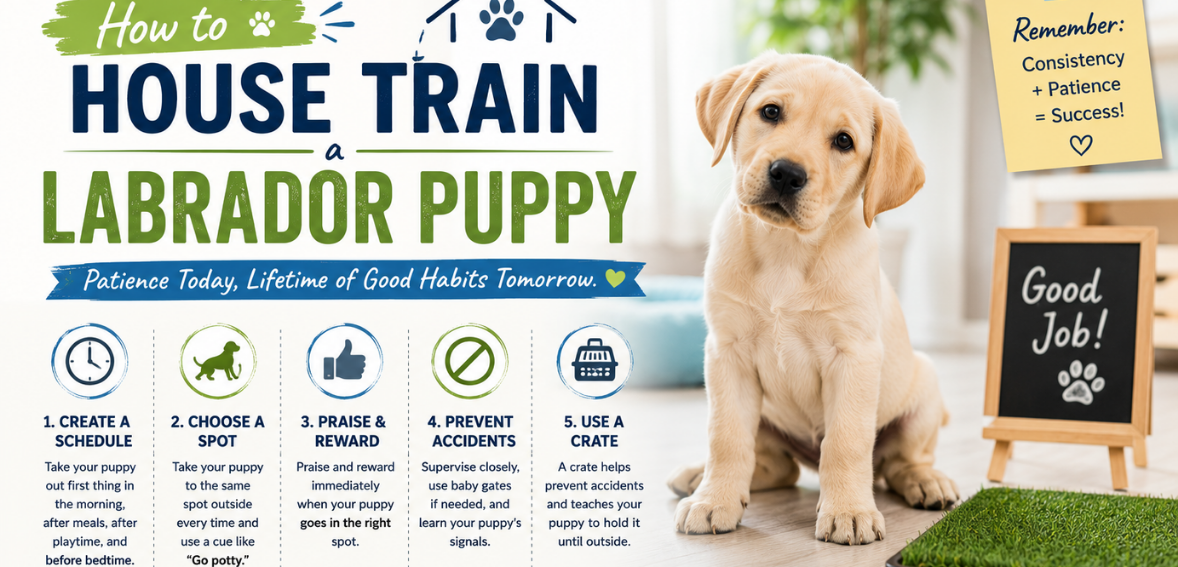
Rather than waiting for your puppy to signal they need to go, take them out proactively at these predictable triggers:
- First thing every morning, before anything else, including breakfast.
- Within 15–20 minutes of every meal. Eating and drinking stimulate the digestive system almost immediately in young puppies.
- Immediately after waking from any nap, not just overnight sleep.
- Right after play or training sessions, since activity gets things moving too.
- Every 1–2 hours in between, scaled to your puppy’s age using the bladder chart above.
- Last thing before bed, ideally with a few quiet minutes outside to make sure they’ve fully emptied their bladder.
Choosing and Using a Designated Potty Spot
Pick one consistent outdoor spot and take your puppy there every single time, on leash even in your own yard, for the first several weeks. The lingering scent from previous successful potties actually helps prompt the behavior again. Use a simple, consistent cue word (“go potty”) right as they start to go, so the word becomes associated with the action itself rather than the command coming beforehand.
Going outside directly, rather than using pee pads first, is generally the more efficient route for a large breed like a Labrador who will need to be reliably trained to go outdoors anyway — pads can create a habit of eliminating indoors that has to be untrained later. Pads may make sense temporarily for owners in high-rise apartments without easy outdoor access, but expect an extra transition step down the line.
Reward Timing and Positive Reinforcement for Successful Potties
Timing is everything. Praise and offer a small treat within about 3–5 seconds of your puppy finishing, while they’re still outside — waiting until you’re back inside disconnects the reward from the behavior in your puppy’s mind. A calm “yes!” or “good potty!” followed immediately by a treat works well.
Never scold or punish an accident, especially one you didn’t personally witness. Puppies don’t associate punishment after the fact with something they did minutes ago, and it can create anxiety or a fear of eliminating in front of you at all — which actually makes house training harder, not easier.
Supervision, Confinement, and Using the Crate
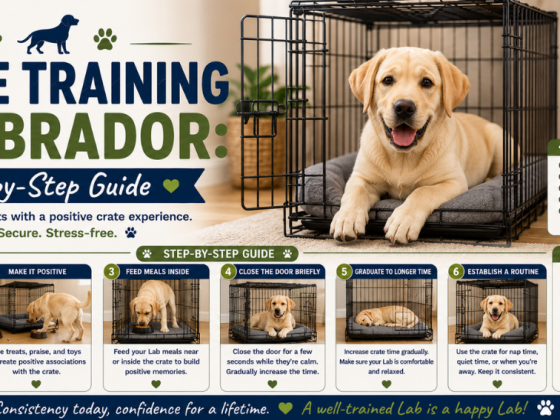
Between scheduled outdoor breaks, your puppy should either be under direct supervision or safely confined — never given free run of the house unsupervised during the early weeks. A crate works well because dogs instinctively avoid soiling the space they sleep in, provided it’s sized correctly.
- Size the crate for the puppy, not the adult dog, or use a divider — too much space lets a puppy soil one end and sleep in the other.
- Use a leash indoors during supervised time if your puppy tends to wander off to sneak an accident in another room.
- Baby gates and playpens work well for supervised confinement in a single puppy-proofed room.
See our full guide to crate training a Labrador for building positive crate associations from the very start.
Cleaning Accidents to Remove Scent Markers
Standard household cleaners, including ones with ammonia, don’t fully break down the compounds in urine and can actually leave a scent that reads as “bathroom” to a dog’s far more sensitive nose. Use an enzymatic cleaner specifically formulated for pet accidents, which breaks down the odor-causing proteins rather than just masking them.
- Blot up as much liquid as possible with paper towels before applying any cleaner.
- Saturate the area with an enzymatic cleaner, following the product’s instructions.
- Let it sit for the recommended time rather than wiping it away immediately — the enzymes need contact time to work.
- Blot dry and keep the puppy away from the spot until it’s fully dry to avoid re-marking the same area.
Troubleshooting Regression and Common Mistakes
Likely Causes of Regression
- Schedule change — new work hours, travel, or routine disruption
- A recent growth spurt outpacing bladder capacity briefly
- Stress from a new pet, baby, or move
- Too much unsupervised freedom too soon
Common Owner Mistakes
- Punishing accidents after the fact
- Giving free roam of the house before the puppy is ready
- Cleaning with ammonia-based products
- Inconsistent schedule between household members
If accidents suddenly increase after a period of reliability, rule out a medical cause first — a urinary tract infection can cause genuine loss of control that no amount of training will fix. If your puppy checks out healthy, simply tighten the schedule and supervision back up to where it was a few weeks earlier, rather than assuming the training has failed.
For the bigger picture of what to expect at each stage, see our Labrador puppy development stages guide, and once house training is underway, our guides to Labrador puppy feeding schedules and basic obedience commands every Labrador should know build naturally on the same routine.
Frequently Asked Questions
How long does it take to house train a Labrador puppy?
Most Labrador puppies are reliably house trained between 4 and 6 months old, with full bladder maturity by around 6–8 months. Consistency in schedule and supervision matters more than the puppy’s individual “smartness.”
What’s the best potty training schedule for a Lab puppy?
Take your puppy out first thing in the morning, within 15–20 minutes of every meal, immediately after waking from any nap, right after play, and every 1–2 hours in between based on their age, plus last thing before bed.
Why is my Labrador puppy still peeing in the house?
This is usually a supervision or schedule gap rather than defiance — puppies given too much unsupervised freedom, an inconsistent schedule, or residual scent from incompletely cleaned accidents will keep having accidents. Sudden regression after a period of success is worth ruling out medically, such as a urinary tract infection.
How often should I take my Lab puppy outside to pee?
Roughly every 1–2 hours for very young puppies, extending as they age, using the one-hour-per-month-of-age-plus-one rule as a guide, plus immediately after waking, eating, and playing.
Should I use pee pads or go straight outside with a Labrador?
Going straight outside is generally more efficient for a large breed like a Labrador, since they’ll need to be outdoor-trained eventually regardless. Pee pads can create an indoor-elimination habit that has to be retrained later, though they may be a temporary bridge for owners without easy outdoor access.
Sources
- PetMD — “How to Stop a Puppy From Peeing in the House”
- American Veterinary Medical Association (AVMA) — General puppy care and behavior guidance
- Certified Professional Dog Trainer (CPDT-KA) positive-reinforcement training standards