Every Lab I’ve crate trained has ended up napping in their crate with the door wide open, completely by choice, long after training was “done” — which is really the clearest evidence that a properly introduced crate isn’t something a dog tolerates, it’s somewhere they want to be. This guide walks through exactly how to get there: sizing, introduction, a day-by-day duration protocol, and how to handle whining without accidentally teaching your Lab that crying gets them out.
- Why Crate Training Works for Labradors
- Choosing the Right Crate Size
- Introducing the Crate Positively
- Building Duration Gradually: Step-by-Step
- Crate Training at Night vs. Daytime
- Managing Whining and Crate Anxiety
- Maximum Safe Crate Times by Age
- Weaning Off the Crate as Your Lab Matures
- Frequently Asked Questions
Why Crate Training Works for Labradors (Den Instinct)
Dogs descend from den-dwelling ancestors and retain a natural preference for small, enclosed, secure spaces, especially for rest. A crate introduced positively taps into that instinct rather than working against it — the difference between a den and a cage is entirely in how it’s introduced and used, not the object itself. A crate used as a genuine safe space, never as punishment, is widely supported by trainers and behaviorists as a humane, useful management tool.
For Labradors specifically, this translates practically into faster house training, a safe space during chewing-prone adolescence, and a portable “home base” that travels well for vet visits, car rides, and boarding.
Choosing the Right Crate Size for a Growing Lab (With Dimensions)
| Dog | Recommended Crate Size | Notes |
|---|---|---|
| 8–16 week old puppy | 42″ crate with divider panel | Divider keeps space appropriately small for house training |
| Standard adult Lab (55–80 lb) | 42″ (42″L x 28″W x 30.5″H typical) | Fits the vast majority of adult Labs comfortably |
| Oversized male or 90+ lb Lab | 48″ | Extra room for larger frames only; don’t size up unnecessarily |
To size correctly: measure nose to base of tail and add 4 inches for length; measure floor to top of head while standing and add 4 inches for height. A crate that’s too large lets a puppy eliminate at one end and sleep at the other, which works against house training — this is exactly why the divider panel matters for growing puppies. See our full house training guide for how crate size ties directly into potty schedule success.
Introducing the Crate Positively with Food and Toys
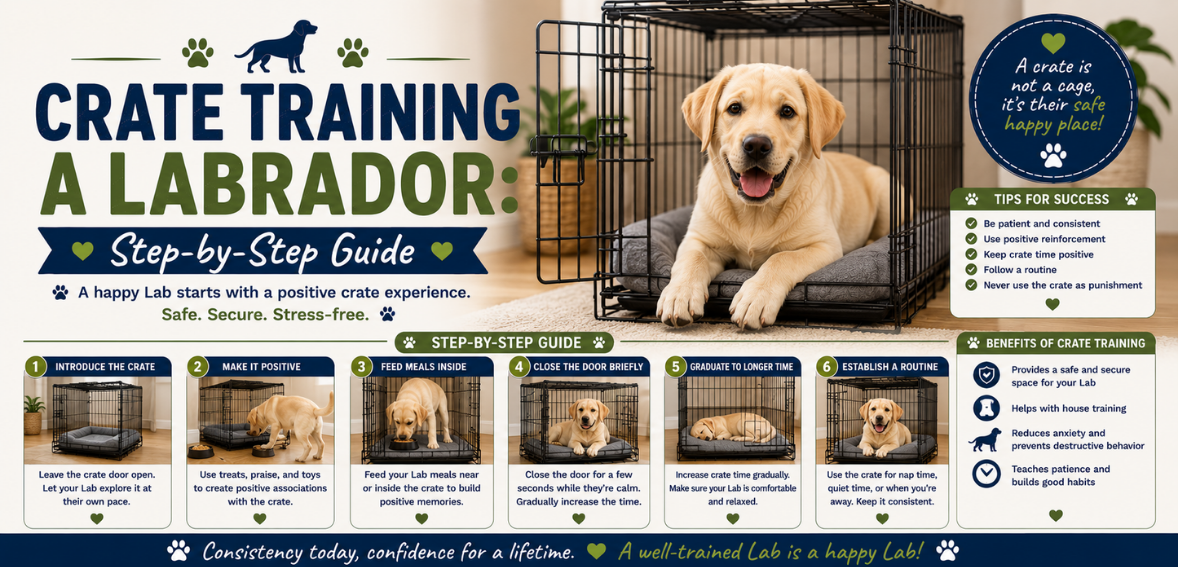
- Leave the door open and let your Lab explore the crate freely at their own pace, with no pressure to enter.
- Toss treats inside throughout the day, letting your dog walk in and out on their own to retrieve them.
- Feed meals in or right next to the crate, gradually moving the bowl further inside over several days.
- Offer a stuffed, frozen food toy only inside the crate, so the crate becomes associated with the single best thing in the house.
- Close the door briefly for the first time only while your dog is calmly engaged with a toy, opening it again before any sign of distress.
Building Duration Gradually: Step-by-Step Protocol
- Day 1–2: Close the door for 1–2 minutes at a time while you remain in the room, rewarding calm behavior before opening the door.
- Day 3–4: Extend to 5–10 minutes, still in the room, gradually moving further away as your dog stays settled.
- Day 5–7: Step out of the room briefly (30 seconds to a few minutes), returning calmly regardless of whether your dog was quiet or not.
- Week 2: Extend departures to 15–30 minutes, then up to an hour, always returning calmly rather than with an excited greeting that overhypes the release.
- Week 3+: Continue extending gradually toward your target duration, adding real departures (leaving the house) once your dog tolerates an hour or more calmly indoors.
The key principle throughout: only increase duration once your dog is calm and settled at the current length, and never open the door in response to whining or barking — release only during a quiet moment, even if that means waiting a bit longer than planned.
Crate Training at Night vs. Daytime
| Night | Daytime | |
|---|---|---|
| Placement | Bedroom, next to your bed for the first weeks | Common living area, near household activity |
| Duration | Full night, with a puppy potty break as needed | Building gradually per the duration protocol above |
| Common challenge | Nighttime whining tied to a genuine potty need | Boredom or separation-related whining |
| Key tip | Take puppies out immediately before bed; set an alarm for a middle-of-night break if needed | Provide a stuffed toy to occupy the early minutes alone |
Managing Whining and Crate Anxiety Without Reinforcing It
- Don’t let the dog out while whining — wait for even a few seconds of quiet before opening the door, so quiet, not crying, is what earns release.
- Rule out a genuine need first — a young puppy’s whine may mean a real potty need, which is different from protest whining at bedtime.
- Back up a step if whining escalates — if your dog is distressed rather than simply protesting, you’ve likely increased duration too fast; return to an easier step and rebuild more slowly.
- Distinguish boredom from true anxiety — mild protest whining that settles within a few minutes is normal; frantic escape attempts, self-injury, or non-stop distress point toward genuine separation anxiety needing a dedicated behavior plan.
See our guide to managing Labrador separation anxiety if whining escalates into genuine panic rather than settling with time and consistency, and our best chew toys for Labradors guide for safe, engaging options to use during crate time.
Maximum Safe Crate Times by Age
| Age | Maximum Crate Time |
|---|---|
| 8–10 weeks | ~1 hour |
| 3 months | ~3–4 hours |
| 4 months | ~4–5 hours |
| 6 months | ~6 hours |
| Adult (12+ months) | Up to ~8 hours |
These are maximums, not targets — shorter stretches with regular breaks for exercise, food, and enrichment are always preferable, even for adult dogs. A crate should never be a substitute for adequate daily exercise and attention.
Weaning Off the Crate as Your Lab Matures
Once your adult Lab has a long track record of calm house behavior — no accidents, no destructive chewing — you can begin giving supervised free time outside the crate, starting with short absences and a puppy-proofed area, and extending gradually. Many owners keep the crate available with the door open indefinitely, since most well-conditioned Labs continue using it voluntarily as a resting spot long after formal crate training is complete.
Frequently Asked Questions
What size crate does a full-grown Labrador need?
Most adult Labradors (55–80 lb) need a 42-inch crate. Oversized males or dogs over roughly 90 lb typically need a 48-inch crate. Measure nose-to-tail-base and floor-to-head, adding 4 inches to each measurement.
How do I crate train my Labrador without them crying?
Build duration very gradually, starting with just 1–2 minutes with you in the room, only increasing time once your dog is calm at the current step, and never releasing them during whining — release during a quiet moment instead.
How long can I leave a Labrador in a crate?
Healthy adult Labradors can generally be crated up to about 8 hours, though shorter stretches are always better when possible. Puppies need much shorter maximums — roughly 1 hour per month of age as a starting guideline.
Is crate training cruel for Labradors?
No, when introduced positively and never used as punishment. Dogs retain a natural preference for den-like enclosed spaces, and most well-conditioned Labradors come to use their crate voluntarily as a preferred resting spot.
How do I stop my Lab from whining in the crate at night?
First rule out a genuine potty need, especially in young puppies. For protest whining, avoid releasing your dog while they’re crying, keep the crate in your bedroom for reassurance, and build overnight duration gradually rather than expecting a full night immediately.
Sources
- American Kennel Club — Crate Training Guidance
- ASPCA — Crate Training Your Dog
- Certified Professional Dog Trainer (CPDT-KA) force-free training standards