Labradors carry a documented genetic mutation (in the POMC gene) that drives a stronger appetite and slower satiety signaling than most breeds, found in roughly 1 in 4 pet Labradors. Combined with a body type that can hide early weight gain under a thick coat, this makes portion precision more important for this breed than almost any other. This guide gives you concrete numbers to start from, plus how to adjust them using your dog’s actual body condition rather than the bag alone.
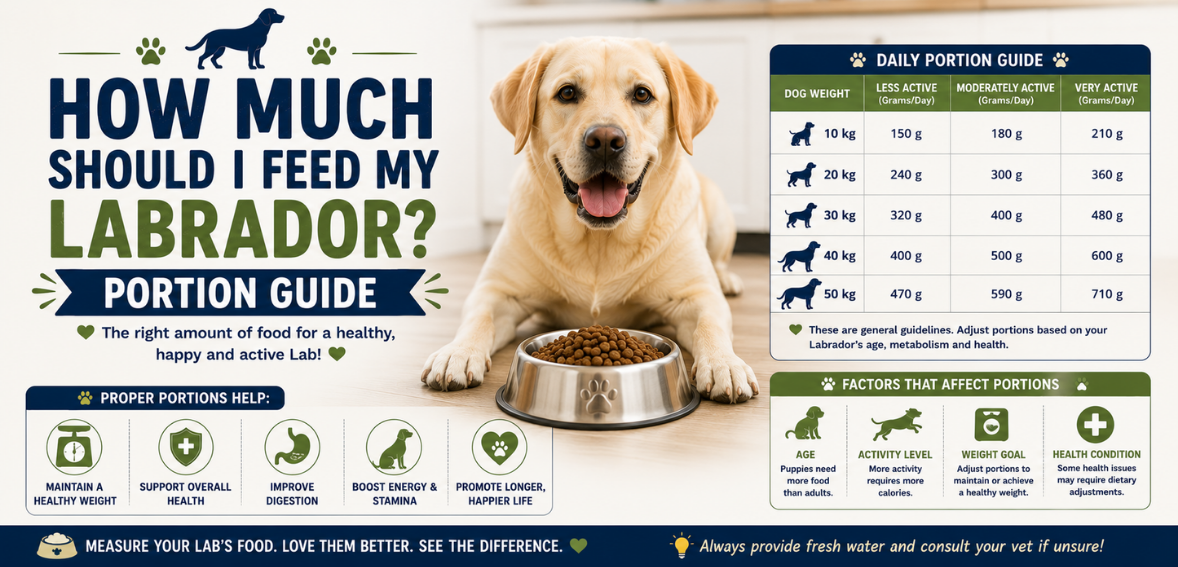
How Much to Feed a Labrador by Weight and Age (Chart)
| Life Stage / Weight | Approx. Daily Calories | Approx. Cups/Day* | Meals/Day |
|---|---|---|---|
| Puppy, 8 weeks (~10 lb) | 400–600 kcal | 1.1–1.7 | 3–4 |
| Puppy, 4 months (~30 lb) | 800–1,100 kcal | 2.3–3.1 | 3 |
| Puppy, 6 months (~50 lb) | 1,200–1,600 kcal | 3.4–4.6 | 2–3 |
| Adult, 55 lb | ~1,100 kcal | ~3.1 | 2 |
| Adult, 65 lb | ~1,300 kcal | ~3.7 | 2 |
| Adult, 80 lb | ~1,700 kcal | ~4.9 | 2 |
| Senior, less active (55–80 lb) | ~900–1,400 kcal | ~2.6–4.0 | 2 |
*Cup estimates assume a typical dry kibble at roughly 350 kcal/cup. Always check your specific food’s calorie density, since premium and high-fat foods run denser and require less volume.
Use the full calorie calculator guide for a more precise starting number tailored to your individual dog’s activity level.
Puppy Feeding Amounts and Schedule
Puppies need considerably more calories per pound of body weight than adults, since growth itself demands significant energy on top of daily activity. Feed 3–4 measured meals a day from 8–12 weeks, dropping to 3 meals through about 6 months, then transitioning to 2 meals between roughly 6 and 7 months as growth slows. Use a large-breed puppy formula with controlled calcium and phosphorus throughout, and weigh your puppy weekly during peak growth (2–6 months) to catch excessive weight gain early — more than 10 lb of gain in a single month is worth mentioning to your vet.
Adult Labrador Portions
Adult Labradors (roughly 12 months and older, once growth has finished) typically need 1,100–1,700 kcal per day depending on weight and activity level, split into two meals roughly 10–12 hours apart. This translates to approximately 2.5–4.5 cups of a typical dry kibble, though your specific food’s calorie density should always take precedence over any generic cup estimate.
Weigh food with a kitchen scale rather than a scoop — cup measurements can vary by 20–30% depending on how kibble settles, which adds up to a meaningful calorie difference over a month.
Senior Labrador Adjustments
Most Labradors are considered seniors starting around 7–8 years old, and metabolism combined with reduced activity typically means senior dogs need roughly 20% fewer calories than an active adult at the same weight to maintain a healthy body condition. A dedicated senior formula, often with reduced calorie density and added joint support, can make portion control easier without needing to feed an uncomfortably small volume of adult food. Adjust gradually and recheck body condition every few weeks rather than making a single large cut all at once.
How Activity Level Changes Portions
| Activity Level | Adjustment from Baseline |
|---|---|
| Sedentary / minimal exercise | Reduce 10–20% below standard adult maintenance |
| Moderate (60–90 min/day, typical pet) | Standard adult maintenance range |
| High (working, field trial, very active) | Increase 20–40% above standard maintenance |
These are starting adjustments, not fixed rules — the real test is body condition over several weeks, not the number on paper.
How to Read Feeding Guidelines on the Bag
Bag feeding charts are calculated to cover a wide range of individual dogs and tend to run generous, in part because manufacturers would rather a dog be slightly overfed than underfed on their product. For a breed already prone to obesity, this makes the printed chart a reasonable starting point but not a target to hit exactly.
- Find your dog’s current weight on the chart, not their goal or expected weight
- Start at the lower end of the range shown for that weight, especially for a less active dog
- Reassess after 2–3 weeks using body condition, adjusting the amount up or down by roughly 10% at a time
- Recheck the chart whenever you switch foods, since calorie density varies significantly between brands and formulas
Signs You’re Over- or Underfeeding (Body Condition Score)
Body condition scoring is a more reliable feeding guide than any chart, weight number, or your dog’s appetite, especially for a breed this food-motivated.
Underweight
Ribs, spine, and hip bones easily visible; minimal muscle covering; obvious waist and abdominal tuck from above and the side
Ideal
Ribs easily felt with light pressure but not visible; visible waist from above; abdominal tuck visible from the side
Overweight
Ribs difficult to feel under fat; little to no visible waist; no abdominal tuck, sometimes a sagging belly
If your dog consistently falls toward the overweight end, don’t wait for a vet visit to act — start reducing portions by roughly 10% and reassess in two to three weeks. See our full guide on how to help an overweight Labrador lose weight for a complete plan if body condition doesn’t improve with modest adjustments.
Meals Per Day and Timing
- Puppies (8–24 weeks): 3–4 meals a day, spaced evenly through waking hours.
- Puppies (6–12 months): Transitioning to 2 meals as growth slows, typically by 7 months.
- Adults and seniors: 2 meals a day, roughly 10–12 hours apart (for example, 7 AM and 6 PM), rather than one large meal — this supports more stable digestion and reduces begging between widely spaced meals.
Avoid free-feeding (leaving food out all day) at any life stage for this breed — it removes your ability to notice appetite changes early and makes portion control nearly impossible given how food-motivated Labradors are.
Frequently Asked Questions
How many cups of food should I feed my Labrador per day?
Most adult Labradors need roughly 2.5–4.5 cups of a typical dry kibble per day, split into two meals, depending on their weight, activity level, and the food’s specific calorie density.
How much should I feed my Lab based on weight?
As a starting point: roughly 1,100 kcal/day for a 55 lb adult, 1,300 kcal/day for 65 lb, and 1,700 kcal/day for 80 lb, adjusted up or down based on activity level and body condition.
How often should I feed an adult Labrador?
Twice a day, roughly 10–12 hours apart, is standard for adult Labradors. Free-feeding is not recommended for this breed given its strong food motivation.
Am I overfeeding my Labrador?
If you can’t easily feel your dog’s ribs with light pressure, there’s no visible waist from above, or there’s no abdominal tuck from the side, you’re likely overfeeding. Reduce portions by about 10% and reassess body condition in 2–3 weeks.
How much food does a Labrador puppy need?
Roughly 400–600 kcal/day at 8 weeks, increasing to 800–1,100 kcal/day by 4 months and 1,200–1,600 kcal/day by 6 months, fed across 3–4 meals depending on age, and adjusted against your specific food’s feeding chart.
Sources
- WSAVA (World Small Animal Veterinary Association) — Global Nutrition Guidelines and Body Condition Scoring Chart
- Association of American Feed Control Officials (AAFCO) — Dog Food Nutrient Profiles
- Raffan, E., et al. “A Deletion in the Canine POMC Gene Is Associated with Weight and Appetite in Obesity-Prone Labrador Retriever Dogs.” Cell Metabolism, 2016.
- VCA Animal Hospitals — Body Condition Scoring in Dogs