One of the real advantages of training a Labrador is that food motivation does most of the heavy lifting for you. A treat held at the right height will get a Lab puppy into a sit faster than almost any other breed I’ve worked with — the challenge isn’t getting the behavior once, it’s building it into something reliable around distractions. This guide covers the six commands every Lab needs, in the order that actually builds on each other, plus the “3 Ds” framework that turns a one-off trick into a dependable command.
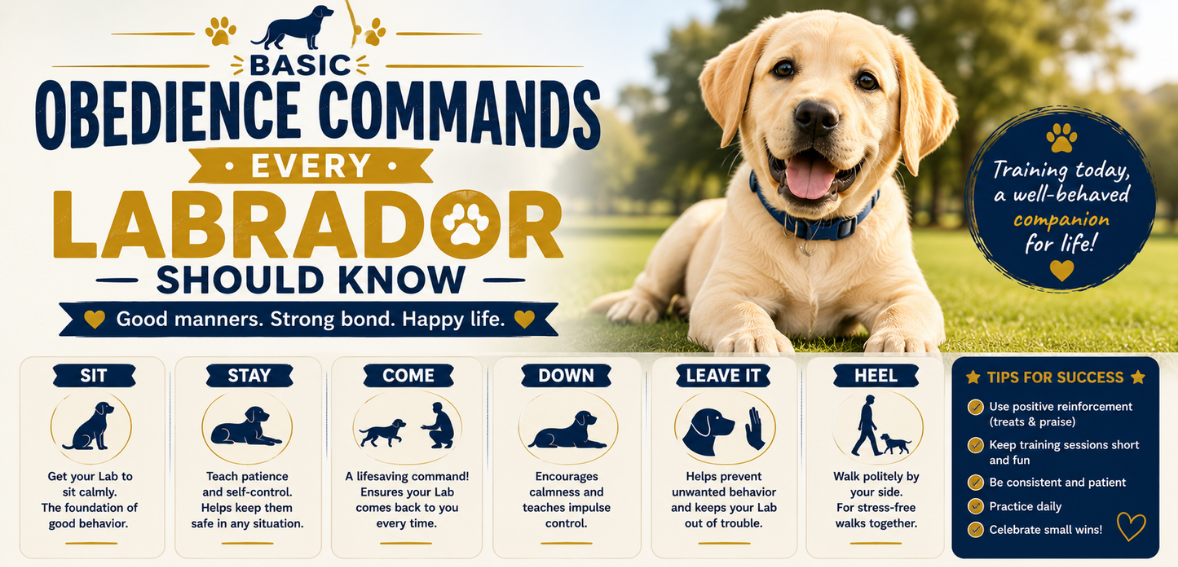
The Core Command List Every Lab Needs
| Order | Command | Why It Matters for a Lab |
|---|---|---|
| 1 | Sit | Foundation command; an easy default “polite” behavior |
| 2 | Down | Builds on sit; useful for calming an excitable Lab |
| 3 | Stay | Adds impulse control on top of sit/down |
| 4 | Come (recall) | Safety-critical, especially given the breed’s scent-driven distractibility |
| 5 | Leave It | Directly addresses the breed’s tendency to eat anything in reach |
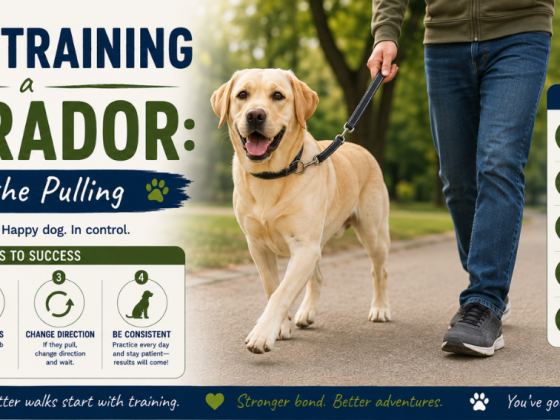
| 6 | Heel | Manages a strong-pulling breed on leash walks |
This guide covers step-by-step methods for sit, down, stay, leave it, and drop it below. For a full deep dive on the other two safety-critical commands, see our guides to teaching your Labrador a reliable recall and leash training a Labrador.
When to Start Obedience Training with a Labrador
Start the day your puppy comes home, typically around 8 weeks old. There’s no benefit to waiting for a certain age — young puppies are already forming habits and associations, and early training sessions take advantage of that. Keep expectations age-appropriate: an 8-week-old puppy has a short attention span, so early sessions are about building simple associations in short, upbeat bursts rather than expecting polished, reliable responses right away.
How to Teach Sit (Lure-Reward Method)
- Hold a treat right at your dog’s nose and slowly move it up and back over their head.
- As their head follows the treat up, their bottom will naturally lower into a sit.
- The instant their bottom touches the ground, say “sit” and reward immediately.
- Repeat 5–10 times per short session, saying the word right as the behavior happens, not before.
- Once your dog sits reliably with the lure motion, start saying “sit” first, then use the hand motion only if needed, fading it out over subsequent sessions.
How to Teach Down and Stay
- Start with your dog in a sit, holding a treat at their nose.
- Slowly lower the treat straight down to the floor, then slightly forward, encouraging their body to follow into a lying position.
- The moment their elbows touch the floor, say “down” and reward.
- If your dog’s back end pops up instead of lying down, you likely moved the treat too far forward too fast — reset and move more slowly and directly downward.
- Ask for a sit or down, then say “stay” while holding a flat palm toward your dog.
- Wait just one to two seconds, then reward while your dog is still in position — don’t wait for them to break the stay first.
- Gradually increase the wait time by a second or two at a time, always rewarding while they’re still holding position.
- Release with a clear word like “okay” or “free,” teaching your dog that the stay ends on your cue, not theirs.
How to Teach Leave It and Drop It
- Show a treat in your closed fist and let your dog sniff and paw at it without opening your hand.
- The instant your dog stops trying and pulls back, say “leave it” and reward from your other hand — never the one they were told to leave.
- Progress to placing a treat on the floor, covered by your hand, then eventually uncovered, rewarding any moment your dog resists on cue.
- Practice with increasingly tempting items once the basic behavior is solid.
- Let your dog pick up a toy, then offer a high-value treat near their nose.
- As they open their mouth to take the treat, say “drop it” right as the toy falls.
- Reward, then immediately give the toy back in the early stages — this teaches your dog that dropping something doesn’t always mean losing it forever, which builds a much more willing response over time.
Building Duration, Distance, and Distraction (The 3 Ds)
A command your dog only performs in a quiet kitchen with a treat in your hand isn’t reliable yet — the “3 Ds” framework is how trainers systematically build a command into something that holds up in real life.
- Duration: How long your dog holds the behavior (a 2-second stay building to a 30-second stay)
- Distance: How far you can move away while your dog holds the behavior (starting at arm’s length, building to across the room)
- Distraction: How much activity or temptation your dog can hold the behavior through (starting in a quiet room, building to a busy park)
Only increase one “D” at a time. If you’re adding distance, keep duration and distraction the same as your dog’s last successful rep — stacking multiple increases at once is the most common reason a command that worked at home falls apart outside.
Reward Schedules and Fading Treats
Reward every single correct response when first teaching a command — this is called continuous reinforcement, and it builds the behavior fastest. Once your dog performs the command reliably and quickly on cue, shift to rewarding intermittently (every 2nd or 3rd correct response, varying unpredictably) rather than stopping treats abruptly. This variable schedule actually strengthens the behavior’s reliability over time and gradually reduces your dependence on carrying treats everywhere, while occasional real-life rewards (praise, a favorite toy, going outside) keep the behavior solid long after food rewards fade to occasional.
Practice Frequency and Session Length
Short, frequent sessions consistently outperform long, infrequent ones, especially for a young puppy’s attention span.
- Puppies: 3–5 minute sessions, 3–4 times a day
- Adolescents and adults: 5–10 minute sessions, 1–2 times a day, plus reinforcing commands naturally throughout daily routines (asking for a sit before meals or before going outside)
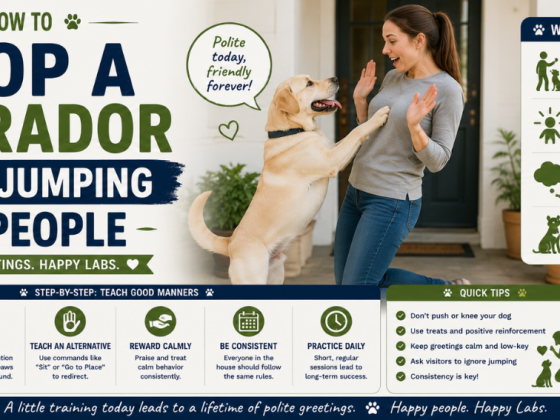
Most Labradors learn the core commands within a few weeks of consistent short sessions, though building full reliability across the 3 Ds — especially around real-world distractions — typically takes a few months of ongoing practice. For an alternative, precision-timed approach to teaching any of these commands, see our guide to clicker training basics for Labradors, and our guide to stopping a Labrador from jumping on people for a common behavior these commands directly help resolve.
- Sit — reliable with lure
- Sit — reliable on verbal cue alone
- Down — reliable with lure
- Down — reliable on verbal cue alone
- Stay — holds 5+ seconds
- Stay — holds with mild distraction
- Come — reliable indoors
- Come — reliable outdoors on leash
- Leave It — reliable with low-value items
- Leave It — reliable with high-value items
- Drop It — reliable with toys
- Heel — reliable on quiet walks
Frequently Asked Questions
What commands should I teach my Labrador first?
Start with sit and down, since they’re the easiest to teach with lure-reward training and build the foundation for stay, come, leave it, and heel.
How do I teach my Lab to sit and stay?
For sit, lure with a treat moved up and back over the head until the bottom lowers, marking and rewarding the instant it touches the ground. For stay, ask for a sit, say “stay,” reward after just 1–2 seconds while still in position, and gradually build duration from there.
What are the most important obedience commands for a Labrador?
Sit, down, stay, come, leave it, and heel form the essential set — with come and leave it carrying particular safety importance given the breed’s scent-driven distractibility and tendency to pick up and eat things it shouldn’t.
At what age can a Labrador learn commands?
Training can start the day a puppy comes home, typically around 8 weeks old, using short, simple sessions appropriate to a young puppy’s attention span.
How long does it take to train a Lab to obey basic commands?
Most Labradors learn the core commands within a few weeks of consistent short daily sessions, though building full reliability around real-world distractions typically takes a few months of ongoing practice.
Ready to build a fully reliable recall next?
Read our full guide to teaching a reliable recall →Sources
- Certified Professional Dog Trainer (CPDT-KA) positive-reinforcement training standards
- American Kennel Club — AKC Canine Good Citizen program command requirements