
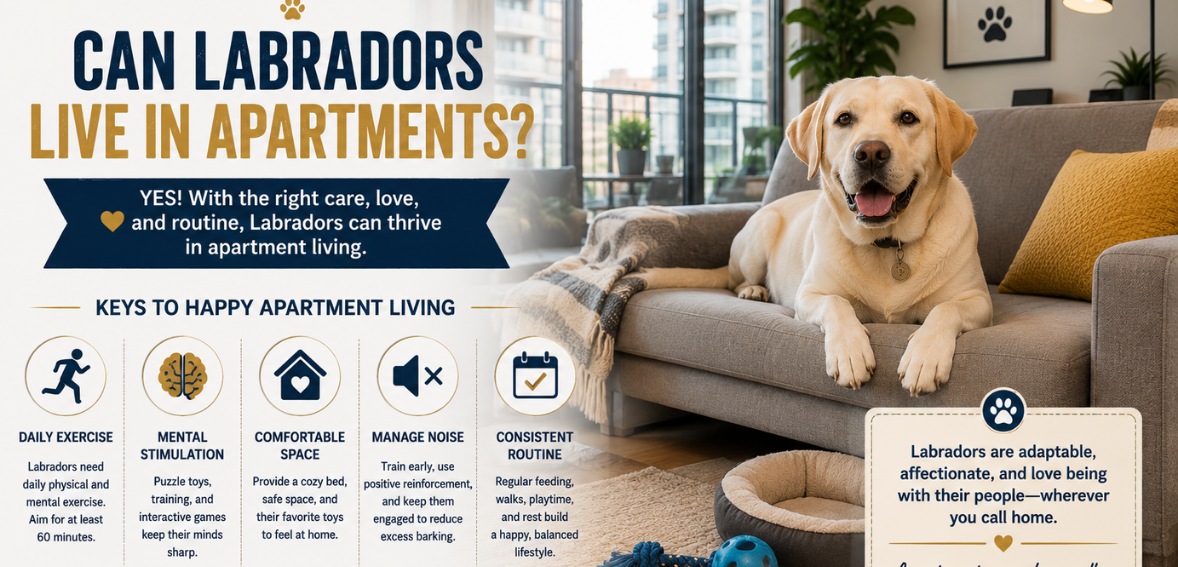
The “big dog needs a big yard” rule gets repeated so often that people assume it’s simply true, but it skips the actual mechanism. A yard doesn’t exercise a dog — a bored Labrador left alone in a fenced yard all day will often just stand at the fence barking, not run laps. What actually tires a Lab out is structured activity: walks, play, training, and mental engagement, all of which are entirely deliverable from an apartment.
- The Honest Answer: Yes, With Conditions
- Daily Exercise and Mental Stimulation Needs
- Managing Energy Without a Yard
- Barking, Noise, and Neighbor Considerations
- Potty and Bathroom Logistics Without a Garden
- Apartment Setup: Crate, Space, and Flooring
- Breed-Restriction and Lease/Insurance Realities
- Signs Your Lab Is Under-Exercised
- Frequently Asked Questions
The Honest Answer: Yes, With Conditions
A Labrador can absolutely thrive in an apartment, but it comes with a real condition attached: you need to be genuinely committed to daily structured exercise and mental engagement, not casually hoping the dog “figures it out.” This isn’t a breed that adapts to a sedentary lifestyle just because the space is smaller — an under-stimulated Lab in a small apartment tends to become destructive, vocal, or restless faster than in a larger home, precisely because there’s less room to absorb that unspent energy passively.
Labrador Daily Exercise and Mental Stimulation Needs
Adult Labradors need roughly 60 to 90 minutes of physical activity daily, combined with mental stimulation like training or puzzle toys. This figure doesn’t change based on where you live — an apartment dog and a house-with-a-yard dog have the same underlying exercise requirement; only the delivery method differs. See our full guide to how much exercise a Labrador needs daily for the complete breakdown by life stage.
Managing Energy Without a Yard
- Structured walks replace unsupervised yard time — two or three real walks a day cover most of the physical exercise requirement
- Nearby parks or dog runs provide off-leash space for fetch or free play a yard would otherwise offer
- Mental stimulation indoors — puzzle feeders, scent games, and short training sessions — tires a Lab out in a genuinely different way than physical exercise, and works well in limited square footage
- Stairs, elevators, and hallway routines can double as bonus low-key exercise and training opportunities in an apartment building
Barking, Noise, and Neighbor Considerations
Labradors aren’t an inherently high-barking breed compared to many others, but any dog — regardless of breed — will bark more when bored, under-exercised, or anxious about being left alone. In an apartment, that barking is simply more noticeable to neighbors through shared walls than it would be in a detached house. The fix isn’t different from the general exercise and enrichment advice above: a well-exercised, mentally satisfied Lab is a quieter one. If barking specifically happens during alone time, it’s worth ruling out separation anxiety rather than just noise sensitivity — see our guide to leaving your Labrador home alone for building comfortable independence.
Potty and Bathroom Logistics Without a Garden
- Establish a consistent outdoor potty schedule tied to elevator/stair travel time, building in a few extra minutes versus a house with direct yard access
- Identify a reliable potty spot near your building and use it consistently, especially during house training
- Plan for weather — a covered spot or a plan for rain and snow prevents skipped bathroom breaks from becoming a habit
- Consider a puppy’s more frequent bathroom needs when planning apartment logistics, since young puppies can’t hold it as long and elevator/stair delays add real time pressure during house training
Apartment Setup: Crate, Space, and Flooring
- A properly sized crate works exactly the same in an apartment as anywhere else, and is especially useful as a defined “den” space in a smaller home — see our full guide to crate training a Labrador
- Non-slip flooring or rugs over hardwood or tile help prevent slipping, especially relevant for a breed with elevated joint-health risk
- A defined “dog zone” with bed, water, and toys helps a Lab settle into a routine even in a compact layout
See our Labrador-friendly home setup ideas for more space-efficient layout suggestions.
Breed-Restriction and Lease/Insurance Realities
Good news here: Labradors are rarely included on the breed-restriction lists used by landlords or home/renters insurance policies, which typically target breeds perceived as higher liability risk (commonly Pit Bulls, Rottweilers, and Doberman Pinschers, among others). That said, many apartment buildings apply a straightforward weight limit (often 25–50 lb) that has nothing to do with breed and would still exclude a full-grown Labrador at 55–80 lb — so check your specific lease’s weight restrictions, not just its breed list, before assuming a Lab is automatically welcome.
Signs Your Lab Is Under-Exercised in an Apartment
- Destructive chewing of furniture, baseboards, or belongings
- Excessive barking or whining, especially when left alone
- Restlessness or difficulty settling, pacing in circles
- Attention-seeking behavior that escalates over time (jumping, nudging, mouthing)
- Weight gain from a mismatch between calorie intake and actual activity level
Any of these signs point to an exercise or enrichment gap, not a sign the apartment itself is the wrong environment — the fix is almost always more structured activity, not more space.
| Time | Activity |
|---|---|
| Morning | 20–30 minute walk, ideally including some off-leash park time |
| Midday | Short training session or puzzle feeder (10–15 minutes) |
| Evening | Second walk or park visit (20–30 minutes), plus a game of fetch or tug if space allows |
| Before bed | Calm wind-down activity, like a slow sniff walk |
- Committed to 60–90 min of daily exercise
- Nearby park or dog run identified
- Consistent potty spot and schedule planned
- Building’s weight/breed policy confirmed
- Crate and defined dog zone set up
- Non-slip flooring in key areas
- Plan for managing alone-time barking
- Puzzle toys and mental enrichment on hand
Frequently Asked Questions
Can a Labrador live happily in an apartment?
Yes, provided the dog gets 60 to 90 minutes of real daily exercise and regular mental stimulation. Square footage isn’t the limiting factor — exercise and enrichment are.
How much exercise does a Labrador need in an apartment?
The same as any Labrador: roughly 60 to 90 minutes of physical activity daily, combined with mental stimulation like training or puzzle toys, delivered through walks and park visits rather than unsupervised yard time.
Do Labradors bark a lot in apartments?
Labradors aren’t an inherently high-barking breed, but any under-exercised or anxious dog will bark more, and that barking is more noticeable through shared apartment walls. A well-exercised, mentally engaged Lab is typically a quiet apartment dog.
Is an apartment too small for a Labrador?
No — apartment size itself isn’t the deciding factor for this breed. What matters is whether the owner can consistently deliver the dog’s daily exercise and mental stimulation needs, which is entirely achievable from an apartment.
What do I need to keep a Lab in a flat with no yard?
A committed daily exercise routine (60–90 minutes), a nearby park or off-leash space, a consistent potty schedule and spot, a properly sized crate, and a plan for mental enrichment like puzzle toys and short training sessions.
Ready to build out the rest of your apartment setup?
See our Labrador-friendly home setup ideas →Sources
- American Kennel Club — Labrador Retriever Exercise and Living Space Guidance
- Certified Professional Dog Trainer (CPDT-KA) standards on boredom-driven behavior