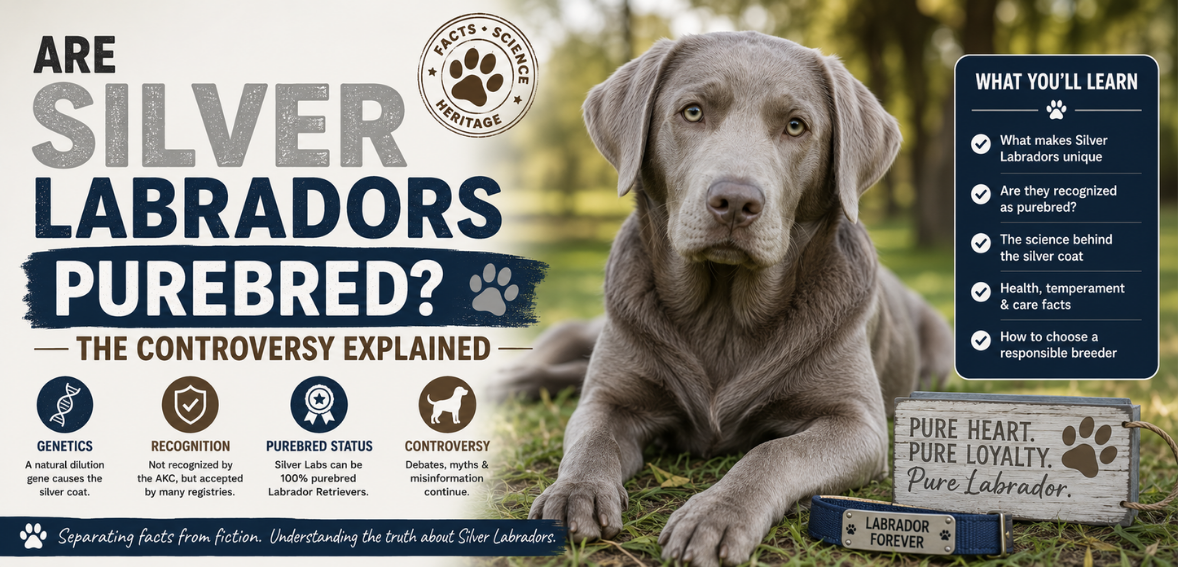
Few coat-color questions in the dog world generate as much genuine disagreement as this one. Unlike the settled, evidence-backed answer to “do black, yellow, and chocolate Labs have different temperaments” (they don’t), the silver Labrador question doesn’t have a single, universally agreed-upon answer — even among credible experts. This guide lays out the genetics, the official positions on both sides, and what’s actually known versus argued.
What Is a Silver Labrador?
A “silver” Labrador is a chocolate-based dog whose coat appears diluted into a blue-gray shade, rather than the standard rich brown. Silvers first appeared commercially in the 1950s through specific kennels, and while they remain rare relative to the three standard colors, demand and prices have grown substantially in recent years precisely because of the color’s novelty.
The Dilution Gene (dd) Explained
Coat dilution in dogs is controlled by the D locus, separate from the B and E genes that produce standard black, yellow, and chocolate. A dog with two copies of the recessive “d” allele (genotype dd) has its black or brown pigment diluted — black becomes “blue” or charcoal, and chocolate becomes silver. Critically, according to the Labrador Retriever Club’s own published position, scientific literature has never identified the dd genotype occurring naturally within the Labrador Retriever breed. That absence is the crux of the entire controversy: if the gene was never part of the breed’s genetic makeup, its sudden appearance requires an explanation.
The AKC’s Official Position
It’s important to separate two different organizations here, since their positions genuinely differ:
- The AKC (the registry itself) will register a silver-coated dog with documented Labrador parentage, filing it under the “chocolate” color category, since AKC registration is a paperwork and lineage-tracking process rather than a genetic color audit.
- The Labrador Retriever Club, Inc. (LRC), the AKC’s own official parent club for the breed, has taken a public position that silver Labradors are not purebred Labrador Retrievers, citing the genetic evidence above.
In other words: AKC registration paperwork accepting a dog does not equal the breed’s governing club endorsing its purebred status. This distinction is exactly why you’ll see conflicting claims — both “the AKC registers silver Labs” and “silver Labs aren’t purebred” are true simultaneously, depending on which organization’s statement you’re citing.
The Weimaraner Crossbreeding Theory
The leading explanation for how the dd gene entered Labrador lines centers on a specific historical detail: the original breeders who began advertising “silver Labradors” in the 1950s through 1970s were also documented breeders of Weimaraners — a breed in which the dd genotype is universal and breed-defining (every Weimaraner is dilute; it’s part of what makes the breed gray). The Labrador Retriever Club has stated it cannot conclusively prove crossbreeding occurred, but considers the circumstantial case — the historical overlap between silver Lab breeders and Weimaraner breeding, combined with the total absence of dd anywhere else in Labrador genetic history — persuasive.
Arguments From Silver Lab Breeders
Breeders and owners of silver Labradors generally push back on the crossbreeding theory with a few counterarguments:
- The dilute gene could have existed at very low frequency within Labrador lines for a long time without being noticed or documented, only becoming visible and selectively bred once specific breeders started intentionally pairing carriers
- Silver Labs behave, move, and are shaped like Labradors in every respect other than coat color, unlike an actual Weimaraner-Labrador hybrid would likely appear
- The AKC’s willingness to register silver-coated dogs as Labradors (under the chocolate category) reflects, in their view, a reasonable acknowledgment that these are Labradors with an unusual color, not a different breed
- Excluding a color from recognition doesn’t necessarily mean the dog isn’t genetically a Labrador — it may simply mean kennel clubs haven’t chosen to recognize a rare variant
These arguments don’t resolve the genetic evidence problem the parent club raises, but they represent the sincere case breeders make, and they’re part of why this remains a live debate rather than a settled fact.
Health Concerns: Color Dilution Alopecia
Separate from the purebred debate, there’s a genuine, documented health consideration tied to the dilute coat itself: color dilution alopecia (CDA), also called “blue balding syndrome.” CDA is a hereditary condition seen across multiple diluted breeds (blue Great Danes, blue Doberman Pinschers, blue Yorkshire Terriers, and Weimaraners), and now documented in silver Labradors as well. It causes progressive, patchy hair loss, typically starting in young adulthood, and can lead to recurrent skin and hair follicle infections in affected dogs. It isn’t life-threatening and isn’t universal — not every dd dog develops CDA, and estimates suggest a meaningful minority (roughly 10–30% in some assessments) of dilute-coated dogs are affected, while the majority remain unaffected.
If you’re considering a silver Labrador, ask the breeder directly whether they screen for or have experience with CDA in their lines, and watch for progressive thinning or patchy hair loss as your dog matures. This is a real, if not universal, risk specifically tied to the dilute gene — not internet exaggeration.
Charcoal and Champagne Dilutes Too
Silver isn’t the only dilute Labrador color being marketed. “Charcoal” refers to a dilute black Labrador (a blue-gray shade distinct from standard black), and “champagne” is sometimes used for a dilute yellow. All three — silver, charcoal, and champagne — stem from the same dd genotype and carry the identical controversy and CDA risk profile discussed above; none are recognized as standard colors by the AKC breed standard, and all three receive the same skepticism from the parent club.
Should You Buy a Silver Labrador?
| Consider This | The Case For | The Case Against |
|---|---|---|
| Purebred status | AKC will register the dog under “chocolate” | Parent club disputes purebred status on genetic grounds |
| Conformation showing | N/A | Not eligible to compete or win in AKC conformation |
| Temperament | Behaves like a typical Labrador in most cases | No difference from standard colors either way |
| Health | Most dd dogs never develop CDA | Real, documented CDA risk tied specifically to the dilute gene |
| Price | N/A | Typically commands a premium tied to novelty rather than quality |
Whatever you decide, this is a case where being informed matters more than landing on a particular verdict — the genetics, the parent club’s stated position, and the real (if not universal) CDA risk are all worth weighing for yourself rather than accepting either “it’s obviously a scam” or “it’s obviously fine” at face value. See our full guide to Labrador colors explained for how silver fits into the broader color picture, our official Labrador breed standard for what is formally recognized, and our guide to fox red Labradors for a very different — and uncontroversial — example of color variation within the standard yellow range.
Frequently Asked Questions
Are silver Labradors purebred Labs?
It’s disputed. The AKC will register them under the chocolate color category, but the Labrador Retriever Club (the AKC’s own parent club for the breed) has stated it does not consider silver Labradors purebred, citing the absence of the dilution gene in documented Labrador genetics.
Can you register a silver Labrador with the AKC?
Yes, the AKC registers silver-coated dogs with documented Labrador parentage under the “chocolate” color category, since silver isn’t a separately recognized color. This registration doesn’t reflect the parent club’s separate, more skeptical position on purebred status.
Where does the silver color in Labradors come from?
The leading theory, per the Labrador Retriever Club, points to a historical cross with the Weimaraner (a breed in which the dilution gene is universal), based on documentation that the earliest silver Lab breeders were also involved in Weimaraner breeding. This can’t be conclusively proven, but no scientific literature has ever documented the dilution gene occurring naturally in Labradors otherwise.
Is a silver Labrador a mix with a Weimaraner?
A modern, AKC-registered silver Lab descends from documented Labrador lines and looks and behaves like a Labrador, not a Weimaraner. The crossbreeding theory refers to a historical cross believed to have introduced the dilution gene generations ago, not a claim that today’s silver Labs are literally half Weimaraner.
Are silver Labs recognized by kennel clubs?
No major kennel club recognizes silver as a standard Labrador color, and silver Labs cannot compete in AKC conformation showing. The AKC will still register them under the chocolate color designation for general registration purposes.
Curious how this fits into the full picture of recognized Labrador colors?
Read our full guide to Labrador colors explained →Sources
- The Labrador Retriever Club, Inc. — “The Issue of the Silver Labrador” (official parent club position statement)
- American Kennel Club — Labrador Retriever registration and color policy
- Veterinary dermatology literature on color dilution alopecia (CDA) in dilute-coated breeds