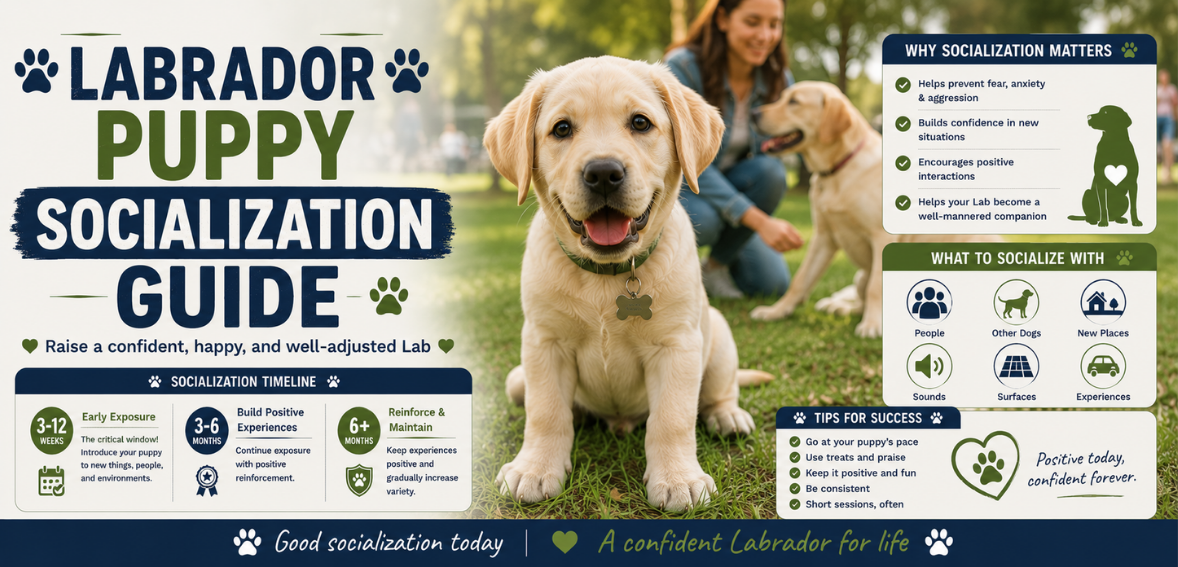
Labrador socialization matters more than owners often realize, precisely because the breed’s famous friendliness isn’t fully automatic — it’s the product of genetics and a proper early foundation. Skip that foundation and even a Lab can grow up fearful, reactive, or poorly equipped to handle normal life. This guide walks through the critical window, how to socialize safely before your puppy is fully vaccinated, a full exposure checklist, and how to handle the fear periods every puppy goes through.
- The Critical Socialization Window
- Balancing Socialization With Incomplete Vaccinations
- The 100-Experiences Exposure Checklist
- Introducing Your Lab to Other Dogs and Animals
- Recognizing and Handling Fear Periods
- Puppy Classes vs. At-Home Socialization
- Building the Friendly, Confident Labrador Temperament
- Common Socialization Mistakes to Avoid
- Frequently Asked Questions
The Critical Socialization Window (3–14 Weeks) and Why It Matters
The AVSAB identifies the first three months of life, roughly 3 to 14 weeks, as the primary window when puppies are neurologically primed to form calm, positive associations with new people, animals, and experiences. Miss this window and those same experiences become much harder to teach later — an adult dog can still learn, but nowhere near as efficiently or completely as a puppy inside this period.
The stakes are genuinely high: according to the AVSAB’s official position statement, behavioral problems are “the number one cause of relinquishment to shelters,” and behavioral issues — not infectious disease — are the leading cause of death for dogs under three years old. Proper socialization during this window is one of the most protective things an owner can do for a puppy’s entire future.
Balancing Socialization With Incomplete Vaccinations Safely
This is the tension every new owner runs into: vaccines aren’t fully complete until around 14–16 weeks, but the socialization window closes around the same time. The AVSAB’s official position directly addresses this conflict, recommending that puppies begin socializing — including structured puppy classes — as early as 7 to 8 weeks old, after just one set of vaccinations given at least 7 days prior, and a first deworming.
- Do: Carry your puppy in unfamiliar places, invite healthy, vaccinated dogs and friendly people over, attend a well-run puppy class with disinfection protocols and same-age puppies
- Avoid: Dog parks, pet store floors, and other high-traffic areas with unknown vaccination status until your puppy’s vaccine series is complete
- Confirm with your vet which specific settings they consider appropriate for your individual puppy’s vaccination progress and regional disease risk
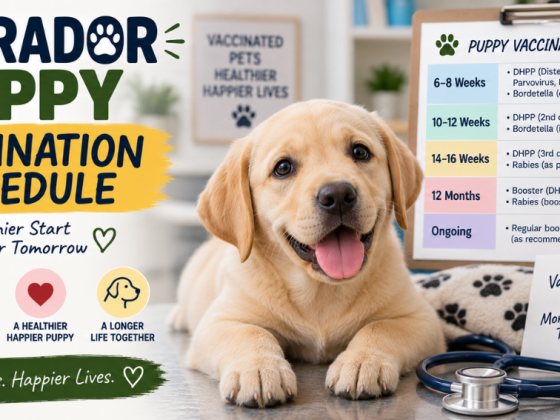
See our full Labrador puppy vaccination schedule for exactly when each shot happens, so you can plan safe socialization activities around it rather than around vague age guesses.
The 100-Experiences Exposure Checklist
A useful mental model: aim for roughly 100 different positive experiences before 14 weeks, spread across people, sounds, surfaces, and handling. You don’t need to hit exactly 100 — the number is a mindset that pushes you toward genuine variety rather than a handful of repeated, similar experiences.
People
- Men, women, children of various ages
- People wearing hats, sunglasses, uniforms
- People using canes, wheelchairs, or walkers
- People with beards or unusual facial hair
- Delivery workers at the door
Sounds
- Vacuum cleaner, blender, washing machine
- Doorbell and knocking
- Thunder or fireworks recordings at low volume
- Traffic and sirens from a safe distance
- Other dogs barking
Surfaces
- Grass, gravel, sand, and mud
- Tile, hardwood, and carpet
- A wobbly or unstable surface (like a thick cushion)
- Metal grates or textured mats
- Wet surfaces
Handling
- Paws, ears, mouth, and tail touched gently
- Nail trims and brushing practiced calmly
- Being lifted and held briefly
- Vet-style handling (table, stethoscope sounds)
- Collar and harness worn comfortably
Introducing Your Lab to Other Dogs and Animals
- Start with known, healthy, vaccinated adult dogs who are reliably friendly and tolerant of puppy behavior, in a controlled setting like a home or yard.
- Keep first meetings brief and calm, watching both dogs’ body language and separating before either shows signs of overstimulation.
- Introduce a range of dog sizes, breeds, and energy levels over time, not just one or two familiar dogs repeatedly.
- Include calm exposure to other species your household or extended family has — cats, for instance — using the same gradual, positive approach.
- Wait for full vaccination before dog parks or other high-density, unknown-status dog environments.
Recognizing and Handling Fear Periods
Puppies go through at least one predictable “fear period” — commonly around 8 to 11 weeks — where normal experiences can suddenly trigger an outsized fearful reaction. A second fear period often appears during adolescence, roughly 6 to 14 months. These are a normal part of neurological development, not a sign socialization has failed.
- Avoid introducing new, intense, or overwhelming experiences until it passes
- Never force or flood your puppy through a fear reaction — let them retreat and recover at their own pace
- Keep already-familiar routines calm and predictable rather than introducing anything new
- A single negative experience during a fear period can create a lasting association, so extra caution here pays off
Puppy Classes vs. At-Home Socialization
| Puppy Classes | At-Home Socialization | |
|---|---|---|
| Structure | Guided curriculum, professional oversight | Self-directed, flexible timing |
| Dog exposure | Controlled group of same-age, vetted puppies | Depends on your own network of known dogs |
| Safety protocols | Disinfection and vaccination checks typically enforced | Entirely up to the owner to manage |
| Best for | Structured exposure plus foundational training | Supplementing classes with everyday-life variety |
These aren’t mutually exclusive — a well-run puppy class handles the controlled dog-to-dog exposure piece safely, while at-home socialization covers the broader variety of people, surfaces, and sounds a class alone won’t fully provide.
Building the Friendly, Confident Labrador Temperament
The Labrador’s reputation as a friendly, stable family and service-dog breed didn’t happen by accident — it’s the product of generations of breeding for temperament, reinforced (or undermined) by each individual dog’s early experiences. Proper socialization during the critical window is what actually delivers on that genetic potential; a genetically well-tempered puppy raised without adequate exposure can still grow up fearful or reactive, while consistent, positive socialization gives every puppy the best chance of reaching the calm, confident adult temperament the breed is known for.
Common Socialization Mistakes to Avoid
- Waiting until vaccines are fully complete to begin any socialization, missing much of the critical window entirely
- Flooding a puppy with too much, too fast — overwhelming exposure can create fear rather than confidence
- Forcing interaction with a fearful or reluctant puppy instead of letting them approach at their own pace
- Repeating the same few experiences (like only meeting familiar family members) rather than seeking genuine variety
- Ignoring handling practice, which matters just as much as meeting new people and often gets skipped
See our guide to dealing with Labrador puppy biting and nipping, since mouthy behavior often surfaces during exactly this socialization window, and our Labrador puppy growth stages guide for how socialization fits alongside other developmental milestones. Once the social foundation is underway, see our guide to basic obedience commands every Labrador should know to build training in parallel.
Frequently Asked Questions
How do I socialize my Labrador puppy?
Start as early as 7–8 weeks old, exposing your puppy to a wide variety of people, animals, sounds, surfaces, and handling experiences in a calm, positive way, before the critical socialization window closes around 14 weeks.
What is the critical socialization window for puppies?
Roughly 3 to 14 weeks of age, according to the AVSAB — the period when puppies are most neurologically primed to form calm, lasting positive associations with new experiences.
When can my Lab puppy meet other dogs?
Known, healthy, fully vaccinated adult dogs in a controlled setting can be introduced early, even before your puppy’s vaccine series is complete. Save dog parks and high-density, unknown-status environments for after full vaccination.
Is it safe to socialize a puppy before vaccinations are complete?
Yes, according to the AVSAB’s official position, which recommends starting socialization after just one set of vaccines (given at least 7 days prior) and a first deworming, while avoiding high-risk areas like dog parks until fully vaccinated.
What should I expose my Labrador puppy to for good temperament?
A wide range of people, sounds, surfaces, and handling experiences, aiming for genuine variety rather than repeating a few familiar experiences. A rough goal of 100 different positive exposures before 14 weeks is a useful mindset, though the exact number matters less than the variety.
Ready to build training alongside your socialization plan?
See our guide to basic obedience commands every Labrador should know →Sources
- American Veterinary Society of Animal Behavior (AVSAB) — Position Statement on Puppy Socialization
- Certified Professional Dog Trainer (CPDT-KA) standards on fear periods and force-free socialization