The first thing to understand about a pulling Labrador is that it isn’t stubbornness or dominance — it’s a straightforward physical reflex working against you, plus a genuinely exciting world at the end of that leash. My own strong, young Lab used to drag me down the block toward every squirrel, jogger, and interesting smell; what actually fixed it wasn’t more strength on my end, it was understanding why pulling harder back never worked in the first place.
- Why Labradors Pull
- Choosing the Right Equipment
- The Stop-and-Go / Be-a-Tree Method
- Rewarding Position and Loose-Leash Checkpoints
- Adding Turns and Direction Changes
- Managing Distractions and High-Arousal Environments
- Common Leash-Training Mistakes
- Progressing to a Reliable Heel
- Frequently Asked Questions
Why Labradors Pull So Hard on Walks (Opposition Reflex and Excitement)
Dogs have a built-in physical reflex called the opposition reflex: when something applies pressure against their body, their instinctive response is to push or pull against that pressure, not to yield to it. A taut leash pressing against a harness or collar triggers exactly this reflex — meaning the harder you pull back, the harder your dog’s body instinctively pulls forward, regardless of any actual desire to “get away.” Layer a Labrador’s high excitement level and strong interest in scents, people, and other dogs on top of that reflex, and you get a breed that’s especially prone to pulling hard, fast, and often.
Choosing the Right Equipment (Front-Clip Harness vs. Flat Collar, Avoid Retractable)
| Equipment | Effect on Pulling | Recommendation |
|---|---|---|
| Front-clip harness | Redirects forward pulling energy sideways, reducing leverage | Best general-purpose choice for training |
| Back-clip harness | Doesn’t discourage forward pulling; can even encourage it (similar to sled-dog harnesses) | Fine for a dog that doesn’t pull; not ideal during training |
| Flat collar | No leverage advantage; pressure lands directly on the neck | Fine for a well-trained dog; not ideal for active pulling correction |
| Head halter (e.g., Gentle Leader style) | Redirects the head, which the body follows; very effective | Effective but needs gradual, positive desensitization before regular use |
| Retractable leash | Inconsistent tension and length rewards forward pulling; safety hazard | Avoid during training and in general for a strong breed |
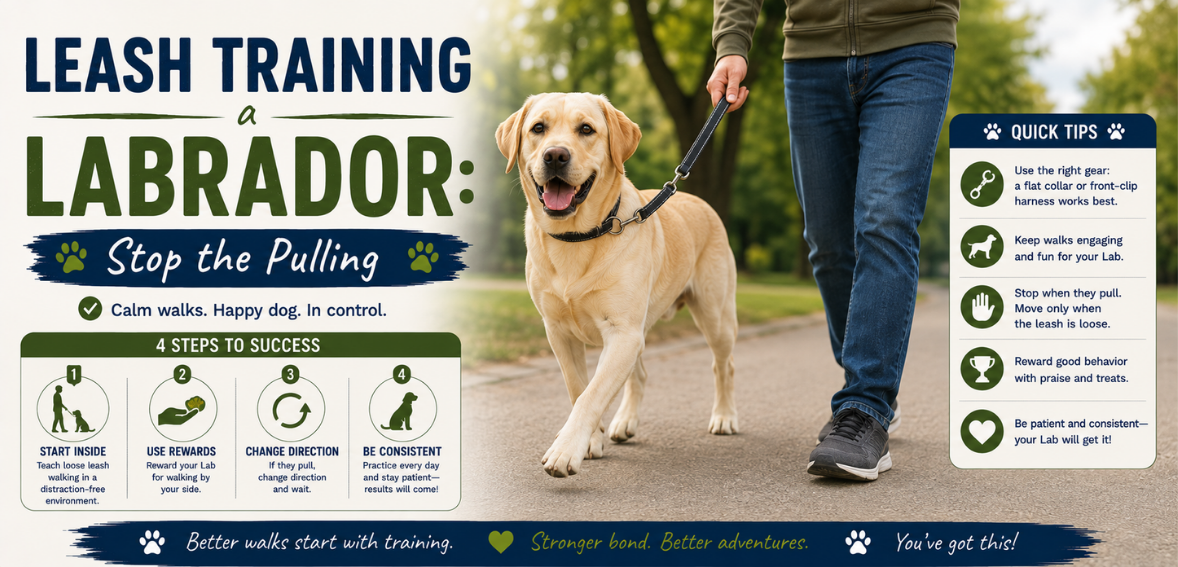
No equipment “fixes” pulling on its own — it simply makes training easier or harder. A front-clip harness is the most balanced general recommendation: no aversive pressure on the neck, genuine reduction in pulling leverage, and no desensitization period required the way a head halter needs.
The Stop-and-Go / Be-a-Tree Method
- Start walking normally. The moment the leash goes fully taut, stop moving completely — plant your feet like a tree.
- Wait without talking or pulling back. Simply stand still until your dog turns back toward you or the leash slackens on its own.
- The instant the leash goes loose, mark it with “yes” and continue walking.
- Repeat every single time the leash tightens, even if that means very short stretches of walking at first.
- Stay consistent across every walk, since inconsistency (sometimes allowing pulling, sometimes not) confuses the pattern and slows progress significantly.
Rewarding Position and Loose-Leash Checkpoints
Stopping pulling is only half the equation — actively rewarding the position you want builds the habit faster than correction alone.
- Reward frequently while your dog is walking in a loose-leash position near your side, not just after a correction
- Use a consistent verbal marker (“yes” or a clicker) the instant the leash is loose, followed by a treat
- Gradually stretch the interval between rewards as loose-leash walking becomes more consistent
Adding Turns and Direction Changes
Once basic stop-and-go is working, add unpredictability to sharpen attention to your movement rather than the environment:
- Make a sudden 180-degree turn whenever your dog gets slightly ahead, walking the opposite direction without warning.
- Reward heavily when your dog catches up and re-engages with your new direction.
- Add random left and right turns during otherwise normal walks, rewarding quick, attentive follow-through.
This teaches your dog that paying attention to you, not just the leash tension, is what keeps the walk moving forward.
Managing Distractions and High-Arousal Environments
Training in a quiet backyard or hallway first, then gradually working up to a quiet street, a busier sidewalk, and finally a park with other dogs, prevents the common trap of expecting full success in a high-distraction environment too soon. If your dog is too aroused to respond to stopping or turning at all, that’s a sign you’ve jumped a level too fast — step back to an easier environment and rebuild from there rather than pushing through.
Common Leash-Training Mistakes
- Pulling back against the pull — this directly triggers the opposition reflex and makes pulling worse, not better
- Inconsistent enforcement — allowing pulling on “quick” walks but not training walks confuses the pattern
- Only correcting, never rewarding — position needs to be actively reinforced, not just the absence of pulling
- Skipping the “boring” phase — many owners give up on stop-and-go before it has time to work, especially in the early sessions where progress feels slow
- Training exclusively in high-distraction settings before the skill is solid anywhere quieter
Progressing to a Reliable Heel
Loose-leash walking (a relaxed walk without pulling, not in a fixed position) and a formal “heel” (a precise position at your side) are related but different skills. Once loose-leash walking is consistent, add a heel cue by rewarding your dog specifically for walking with their shoulder near your leg, gradually extending how long they hold that tighter position before release. See our full guide to basic obedience commands every Labrador should know for how heel fits alongside the rest of your dog’s training foundation, and our guide to why your Labrador might be so hyper if high arousal is making walks especially difficult right now.
Frequently Asked Questions
How do I stop my Labrador from pulling on the leash?
Stop moving the instant the leash goes tight, wait for slack before continuing, and reward generously for walking in a loose-leash position. Pair this with a front-clip harness rather than a flat collar or retractable leash while training.
What’s the best harness for a Lab that pulls?
A front-clip harness is generally the best balance — it redirects pulling energy sideways without applying pressure to the neck, and requires no desensitization period, unlike a head halter.
Why does my Labrador pull so hard on walks?
Dogs have a natural opposition reflex that makes them instinctively pull against pressure on their body, and Labradors’ high excitement and scent-driven curiosity compound that reflex, making pulling especially common in this breed.
How do I teach loose leash walking?
Use the stop-and-go method: stop the moment the leash tightens, wait for it to loosen, then continue and reward walking near you. Gradually add turns and distractions once the basic pattern is consistent in a quiet setting.
Are no-pull harnesses good for Labradors?
Front-clip “no-pull” harnesses are a good, balanced choice for Labradors, since they reduce pulling leverage without aversive pressure on the neck. They work best combined with actual training, not as a standalone fix.
Ready to build a full training foundation alongside leash work?
See our guide to basic obedience commands every Labrador should know →Sources
- Certified Professional Dog Trainer (CPDT-KA) force-free training standards
- American Kennel Club — How to Leash Train a Dog